Zombie Genes: Why Does DNA Activate Days After Death?
Scientists have realized that death is not a definitive moment but a quiet process that continues at the cellular level for days.
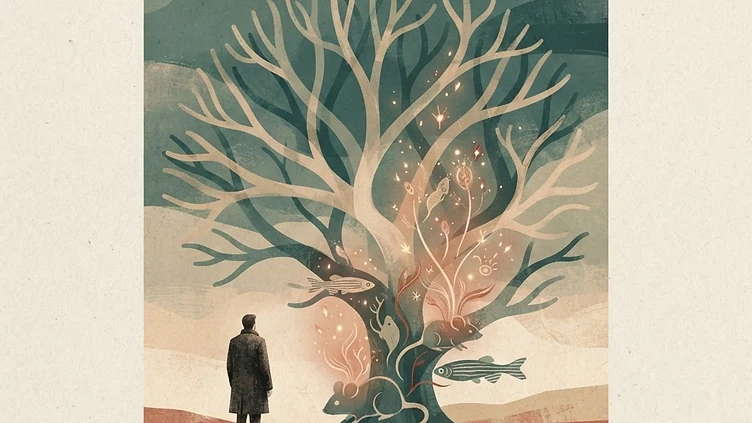
Is what we call death a sharp line or a light that slowly dims? For most, the answer is clear: the pulse stops, breathing ceases, the heart falls silent, and at that moment, everything ends. However, recent findings from molecular biology laboratories are shaking this certainty. Studies conducted on mice and zebrafish show that death is not a single instant but a quiet, strangely disciplined process occurring at the cellular level over several days. While the body's grand structure shuts down, things are still turning on in the tiny world of cells; some genes begin to function even when their host is no longer there. This image is both chilling and forces us to reconsider our conventional understanding of death. ## Silent Activity Beginning Immediately After Death Researchers noticed something unexpected in mice and zebrafish that were clinically dead: some genes activated hours after death, while others did so days later. This is completely counterintuitive, as the common belief is that cellular activity ends rapidly upon death. Yet, the observed tableau resembles an orchestra where, after most have left the stage, a few instruments continue to play in the corner. Even though the body has lost its overall function, some cells continue to act according to their own internal clocks. At first glance, this might seem like an error or a measurement bias, perhaps even false positives. But repeated experiments show that this activation is not random noise; rather, it follows a specific pattern. The timing and tissue specificity of these genes are almost predictable. This begs the question: if cells behave in such an orderly fashion after death, perhaps death is a biologically longer and more layered transition than we thought. Maybe there is an uncharted zone between the point where life ends and the point where cells go completely silent. ## Why Do Cells Continue to Function? So, why and for whom are these genes working? This is where it gets interesting. It appears the activated genes are not chosen from a random pool; they are largely related to stress response, immunity, and embryonic development. It is as if the cell, realizing its owner is gone, does not surrender but instead enters a final mode of struggle. The activation of stress genes indicates that the cell is still operating an alarm system against extreme conditions like oxygen or nutrient deprivation. The involvement of immunity-related genes implies that even when the body is no longer a whole capable of self-defense, cells continue to perceive threats on their own. The presence of genes linked to embryonic development is perhaps the most thought-provoking part. These genes are usually active at the very beginning of life, while an organism is taking shape, and then they fall silent. Their reappearance days after death suggests that the cell is reverting to some primitive, deep-seated program. It is as if, while the body collapses, cells are resorting to the oldest codes in their history, attempting to speak in the only language they know: the language of survival. A counterargument might arise: is this activation not a meaningful response, but rather a side effect of the disintegration of cellular order, a form of molecular chaos? However, the fact that these genes belong to such specific categories weakens the possibility of randomness; chaos is rarely so selective. ## Rewriting the Definition of Death These findings move beyond abstract curiosity and touch one of the most sensitive thresholds of medicine: organ transplantation. For an organ to be considered suitable for transplant, the donor's death must be confirmed, yet the organ is expected to still be alive and functional. If cells maintain a form of biological activity for days after death, the line between these two conditions is no longer as clear. Perhaps when determining an organ's suitability for transplant, it will be necessary to look not just at whether the heart has stopped, but at the genetic phase of the organ's cells. This may not be an idea that radically alters medical protocols, but it is a door to rethinking them. A similar window opens for forensic medicine. Estimating the time of death has historically relied on external signs like body temperature and rigor mortis. But if the activation time of specific genes marks the hours and days after death with surprising consistency, these genes could be used as a kind of biological clock. Imagine, at a crime scene, being able to consult the cells' internal calendar rather than just relying on forensic observations. This may sound like science fiction, but laboratory findings are moving in this direction. Nevertheless, a caveat is needed: it would be premature to claim with certainty that a pattern observed in mice and zebrafish will reflect in the human body at the same speed or in the same way. Considering death as an incline rather than a line changes one's relationship with their own end. Perhaps there is never truly a final moment, only a series of moments that follow one another and slowly fade. This thought may be unsettling because the human mind loves certainty; it wants a threshold, a before and an after. But perhaps biology is showing us that neither life nor death operates with such clear boundaries, and that the two are intertwined for much longer than we imagined. This strange activation, which we call zombie genes, may not be telling us about death, but rather about how stubborn life truly is.
İlgili Denemeler
Can the Human Brain Detect Magnetic Fields?
Geophysicist Joseph Kirschvink's experiment at Caltech indicates that the human brain responds to magnetic fields, raising questions about a potential sixth sense.
Jan Hendrik Schön: The Physicist Who Fooled Science
The scandal of Jan Hendrik Schön's fabricated data at Bell Labs highlights the critical vulnerabilities in the scientific peer-review system.
Barry Marshall Drank Bacteria to Prove Stomach Ulcer Theory
Barry Marshall made medical history by consuming harmful bacteria to prove that stomach ulcers are caused by an infection rather than stress alone.
Tartışma (0)
Henüz yorum yok. İlk yorumu siz yapın.
Join the Newsletter
New essays, once a week, delivered to your inbox.