Can the Human Brain Detect Magnetic Fields?
A controversial experiment suggesting that the secret compass found in birds and fish might also be hidden within the human brain
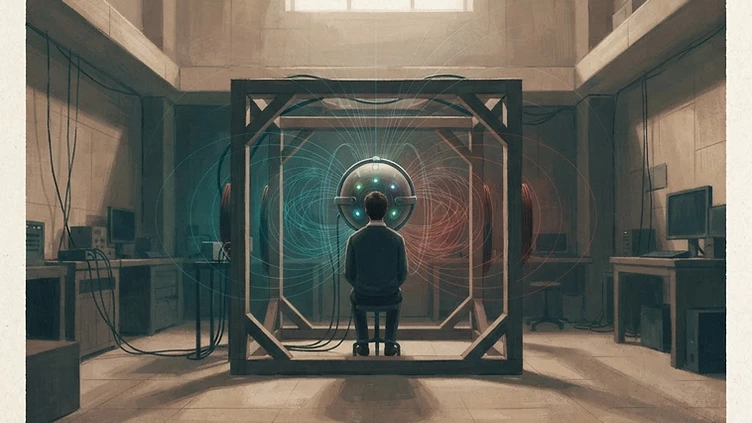
Could there be an internal compass within us that we never notice? The idea that the mysterious magnetic field perception which guides bird migrations and the ocean-crossing journeys of fish might also be quietly dormant in humans felt overly ambitious when I first heard it. However, an experiment conducted in the laboratory of Caltech geophysicist Joseph Kirschvink has moved this notion to the heart of scientific debate. The issue is no longer merely speculation; it has become a matter of measurable, debatable data. And this data suggests that the human brain reacts to magnetic fields quietly, somewhere beyond our conscious awareness. ## A Strange Drop in Brain Waves Kirschvink and his team placed subjects in a room shielded from external electromagnetic interference, attached EEG electrodes to their heads, and established a controlled magnetic field around them. What was remarkable was not the intensity of the field, but its direction. When the field was rotated at a specific angle, a sudden and consistent drop was observed in the alpha waves of some subjects; this drop was the type of reaction that occurs when the brain directs its attention toward something. Moreover, the subjects were unaware of this change. No one said, I felt something, and no one raised their hand to announce that the field had rotated. The brain was providing its own minor reaction, independent of its owner's consciousness. What is truly striking here is that this response appeared specific to a certain direction—a field turning toward the north—rather than being random noise. This raises a question: if our consciousness does not perceive something, can it really be considered sensed? Perhaps there is a situation here similar to peripheral vision; much like the many things we see out of the corner of our eye but do not think about, our brains may be processing magnetic fields without bringing them to a conscious level. This is exactly what Kirschvink proposes: there may be a remnant of an old sensory system in the human brain that is unused or has lost its function. This remnant may be a trace of our evolutionary past. ## From Birds to Humans: A Brief History of Magnetoreception Magnetoreception, the ability of living creatures to sense magnetic fields, is no longer a surprising idea in biology; it is a well-established concept. Pigeons find their way thanks to iron oxide crystals in their beaks; sea turtles appear to use the Earth's magnetic field map to return to the beaches where they hatched after traveling thousands of kilometers. Fish, bees, and even some bacteria can read this invisible map in some way. Seeing the same type of ability in such diverse and distant groups of living things suggests that this is not a coincidence, but rather that evolution has reached the same solution repeatedly. So, should humans be entirely excluded from this list? Kirschvink's earlier work revealed that magnetite crystals are also present in human brain tissue, which indicates that at least the biological infrastructure could exist. Of course, the presence of a material does not mean it is functional; having a radio antenna in my home does not automatically transform me into a being that senses radio waves. But the existence of these crystals makes the question far from meaningless. Perhaps humans have simply forgotten this ancient sensory system, which their ancestors shared with other creatures, in the shadow of language, technology, and our complex audiovisual world. Evolution does not always erase an ability; sometimes it just pushes it into the background. ## The Problem of Replication and the Limits of Science The most brutal question that must be asked before believing in the validity of a scientific finding is this: can another laboratory achieve the same result? So far, Kirschvink's experiment has not entirely passed this test. Some teams have reported observing similar reactions, while others have found no meaningful difference. This inconsistency may stem from the precision of the experimental design, individual differences among subjects, or even minor calibration differences in measurement devices. When working with a highly sensitive method like EEG, separating noise from signal is not easy; capturing a tiny fluctuation specific to a magnetic field within the electrical hum produced by millions of cells in an organ is like trying to hear a whisper in a dark room. Nevertheless, reading the lack of replication as an immediate refutation seems like a hasty attitude to me. In the history of science, many ideas were left in limbo for years because the measuring tools were insufficient when they first emerged; only later, as technology developed, did it become clear whether those ideas were justified or not. A similar waiting period may be at play here. Perhaps one day, more precise EEG techniques and larger sample groups will definitively reveal whether this reaction is real or a statistical illusion. For now, we do not have a definitive answer, but an open question; and open questions are where science is most productive, because they force humanity to keep searching. Perhaps the most interesting aspect of this story is that it does not give us a definitive answer. The question of whether the human brain reacts to magnetic fields is actually a small version of a larger question: whether our consciousness really captures everything our bodies perceive. Perhaps many signals we are unaware of pass through us every day; beyond our familiar senses of light, sound, and smell, a subtle sensitivity we cannot even name may still be there, working silently. Kirschvink's experiment does not offer us a definitive sixth sense, but it reminds us of this: the human body may know more about itself than we are aware of, and it may simply have not yet found the right language to tell us that information.
İlgili Denemeler
Jan Hendrik Schön: The Physicist Who Fooled Science
The scandal of Jan Hendrik Schön's fabricated data at Bell Labs highlights the critical vulnerabilities in the scientific peer-review system.
Barry Marshall Drank Bacteria to Prove Stomach Ulcer Theory
Barry Marshall made medical history by consuming harmful bacteria to prove that stomach ulcers are caused by an infection rather than stress alone.
Carrington Event: Can Modern Tech Survive a Solar Storm?
If the Carrington Event were to strike again, global electrical grids, satellite systems, and internet infrastructure could face collapse within mere days.
Tartışma (0)
Henüz yorum yok. İlk yorumu siz yapın.
Join the Newsletter
New essays, once a week, delivered to your inbox.