Jan Hendrik Schön: The Physicist Who Fooled Science
How did a star physicist at Bell Labs convince the scientific community for years with results that no one could replicate?
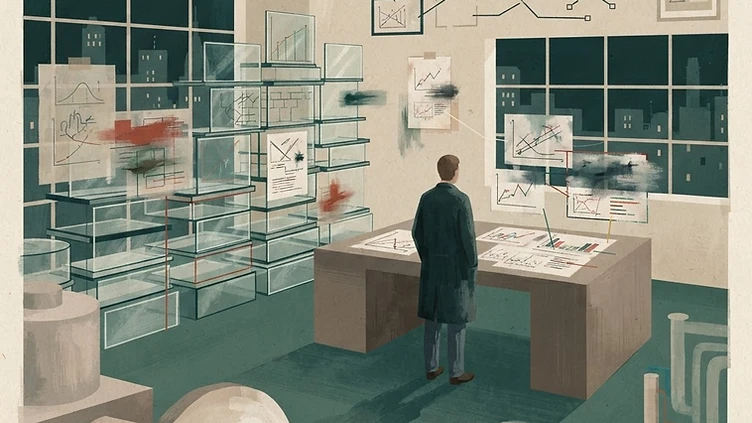
The history of science is often told as a narrative of crumbling theories, but sometimes the most sobering lesson is how a non-existent truth can survive for so long. Today, most physicists remember the name Jan Hendrik Schön as a cautionary tale. While working at Bell Labs in the early 2000s, he produced such striking results in organic semiconductors and molecular electronics that, for a short time, it was believed he was rewriting the future of physics. How could someone pass through the world's most prestigious journals and past the sharpest peer reviewers for years with data from experiments that no one could ever replicate? The answer lies not just in a fraudster's intellect, but in a silent vulnerability within the mechanics of science itself. ## The Rise of a Star Schön's ascent occurred with a speed the scientific community was not accustomed to. A physicist's career is usually built on years of patient, incremental work; however, Schön's name began to be associated with articles published in rapid succession, each with more ambitious results than the last. Transistors made of organic molecules, compounds exhibiting superconductivity at room temperature, and material behaviors previously considered impossible—all were presented as discoveries pushing the boundaries of physics. That a single scientist could solve such diverse problems in so short a time should have raised suspicions, but the opposite happened: the community interpreted this as a sign of genius. What is interesting here is why admiration took root so easily. Perhaps it was the physics world's hunger for its own age of acceleration; fields like nanotechnology and molecular electronics were expecting major breakthroughs, and Schön provided results that matched those expectations perfectly. When someone dared to ask if such perfect results might be suspicious, the response was usually: perhaps this man is truly exceptionally talented. Yet in the history of science, real discoveries are often rough, they do not quite fit together, and they are rarely perfect on the first try. Schön's data, however, were strangely clean—too clean—and this cleanliness could have been read as a warning sign, but it was not. ## The Blind Spot of the Peer-Review System Contrary to what most people believe, the scientific peer-review system is not an investigative institution. A manuscript submitted to a journal does not arrive in the hands of reviewers as raw, unprocessed laboratory data; what is presented are the author's carefully selected graphs, summarized tables, and compiled results. Reviewers evaluate the logical consistency, methodology, and alignment of the findings with existing knowledge in the field, but no one sits down to re-check the raw data, electrode by electrode, measurement by measurement. This is not malicious negligence but an inherent limit of the system, as science is fundamentally built on a network of trust. The assumption that a researcher will not fabricate their data is essential for the system to function. The revelation of Schön's fraud began precisely when this blind spot was exposed. When it was noticed that the same noise patterns and identical small fluctuations were repeating in graphs purportedly from different experiments, the matter shifted from interpretation to concrete evidence. In nature, two different experiments and two independent measurements cannot produce the exact same noise; it is statistically almost impossible. But this realization came years later, because no one had thought to examine the graphs with such a skeptical eye. The peer-review system looks at whether a paper looks good; it is not designed to determine whether it is true. This distinction is one of the most painful lessons the Schön case has taught us. ## The Legacy of the Scandal for Science When the scandal broke, an investigation initiated by Bell Labs revealed that most of Schön's data was either entirely fabricated or seriously manipulated. Articles were retracted one by one, titles were revoked, and one of the brightest names of the era turned into one of the greatest disgraces in the scientific world overnight. But the truly valuable part of the story began after the punishment. The physics community was forced to ask itself: if such a high-profile, long-term fraud was possible in such a prestigious journal, what must change in the system itself? This questioning significantly accelerated debates on scientific reproducibility. Researchers were expected to archive raw data, share it when requested, and provide enough detail for independent teams to replicate experiments. Some journals introduced additional verification steps for particularly striking results, and some institutions attempted to make data transparency part of career evaluations. Of course, these reforms do not function perfectly, and the reproducibility crisis is still discussed in many fields. But the Schön case placed a concrete, undeniable example before these discussions: this is how the system can be deceived, and this is why we need more transparency. Another dimension of this legacy was the redefinition of trust between scientists. If trust were to disappear entirely, science would become impossible, as it is impossible to verify every result from scratch. However, granting trust unconditionally—especially when results appear too perfect—is dangerous. In the post-Schön era, encountering such clean data began to be read as a warning sign. This was perhaps the quietest yet most profound change the scandal left for science. The story of Jan Hendrik Schön is not just a portrait of a fraudster, but also a mirror held up to the vulnerability of science itself. The illusion he created should not be read as a technical trick, but as a moment where human nature infiltrated scientific institutions; it showed how easily admiration can silence critical thinking in the face of rapidly achieved success. Today, even though the scientific community places greater importance on data transparency, reproducibility, and the accessibility of raw results, the core question remains: the next time we encounter a result that looks too perfect, will admiration or skepticism speak first?
İlgili Denemeler
Can the Human Brain Detect Magnetic Fields?
Geophysicist Joseph Kirschvink's experiment at Caltech indicates that the human brain responds to magnetic fields, raising questions about a potential sixth sense.
Barry Marshall Drank Bacteria to Prove Stomach Ulcer Theory
Barry Marshall made medical history by consuming harmful bacteria to prove that stomach ulcers are caused by an infection rather than stress alone.
Carrington Event: Can Modern Tech Survive a Solar Storm?
If the Carrington Event were to strike again, global electrical grids, satellite systems, and internet infrastructure could face collapse within mere days.
Tartışma (0)
Henüz yorum yok. İlk yorumu siz yapın.
Join the Newsletter
New essays, once a week, delivered to your inbox.