Barry Marshall Drank Bacteria to Prove Stomach Ulcer Theory
While the scientific community dismissed him as a dreamer mocking established theories, he turned his own stomach into a test tube.
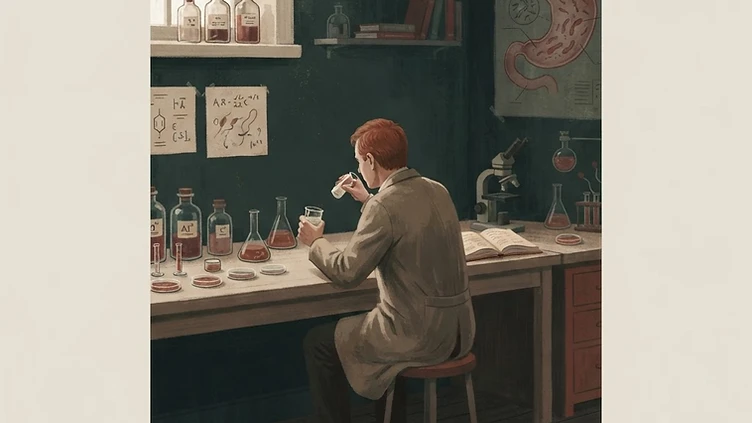
One morning in Perth, a man in a white lab coat drinks a cloudy liquid in a single gulp. It is not ordinary medicine, but millions of living bacteria. Soon, he will experience abdominal pain and burning, and he will celebrate this suffering not as a catastrophe, but as proof. This scene, which seems strange or even insane today, was the beginning of a quiet revolution that toppled one of the most stubborn dogmas in medical history. Why would a doctor turn his own body into such a dangerous experiment? The answer lies in how deeply rooted a long-standing misconception had become.
The Common Misconception: The Stress Theory
For most of the twentieth century, stomach ulcers were framed as a medical reflection of personal weakness. Patients were told they were too stressed, to avoid spicy foods, or to calm their nerves, as if the illness stemmed from character rather than biology. Doctors prescribed antacids, extended diets, and sometimes surgically removed parts of the stomach. This approach was so pervasive that it was taught as an absolute fact in medical schools rather than a subject of inquiry. Yet patients were not recovering, recurrences were frequent, and the number of people returning to the operating table did not diminish.
The reason this theory persisted for so long likely had to do with how the human mind seeks causality. Stress is visible, tangible, and a shared experience, making it intuitively easy to pair with stomach pain. But science must advance through evidence, not intuition. For years, no one asked if there was another cause, because questioning the dogma was considered disrespectful. Thus, patients were forced to fight not against a microbial enemy, but against their own psychology, suffering not because a cure could not be found, but because no one was looking.
Turning His Body Into a Lab Bench
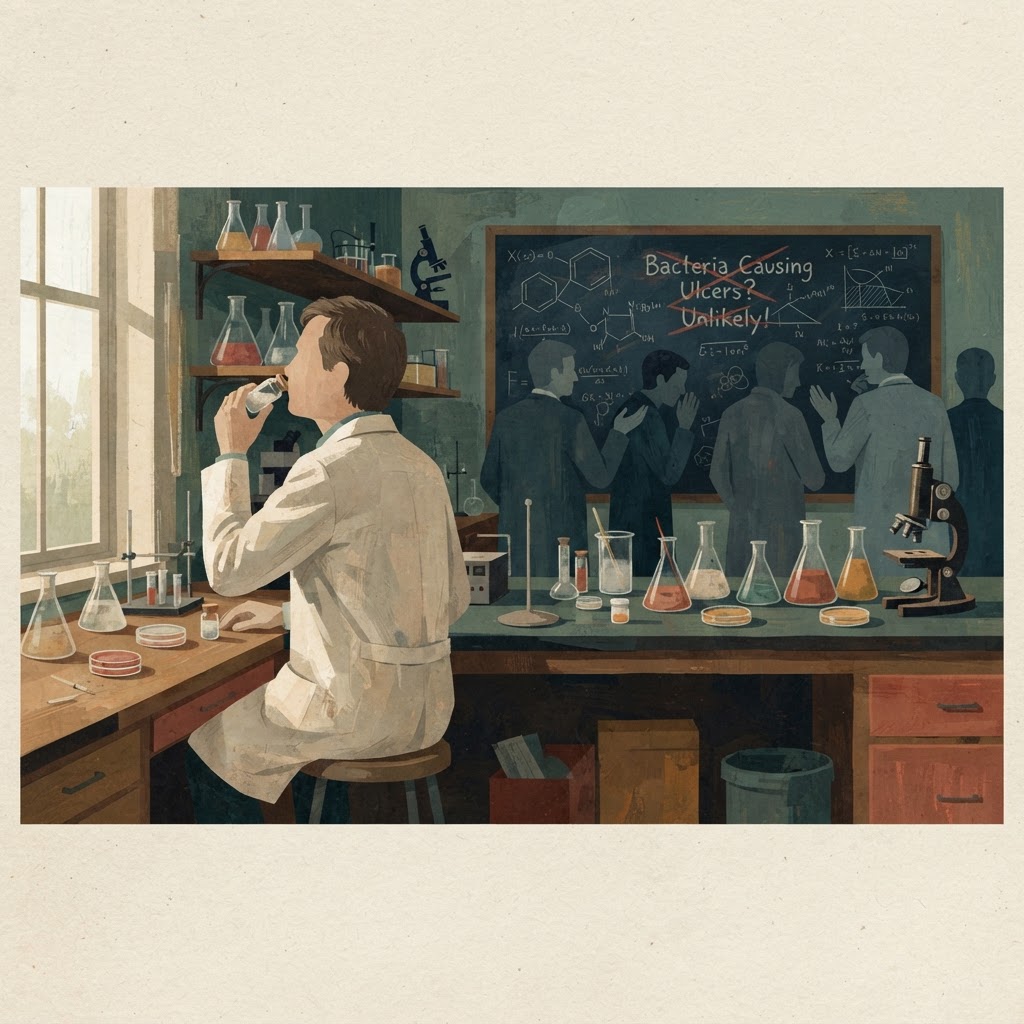
In the early 1980s, Barry Marshall and his colleague Robin Warren noticed strange, curved bacteria in stomach biopsies. They suggested this microorganism could cause the sores everyone else attributed to acid and stress. The idea was met with ridicule in scientific circles; it was believed that stomach acid killed bacteria, and the notion that a living organism could survive in such an acidic environment was dismissed. Journals rejected their papers, conferences mocked them, and animal studies failed because laboratory animals did not become infected as humans did.
Unable to persuade the scientific community, Marshall chose a different path: producing evidence not in another body, but in his own. He drank a culture of Helicobacter pylori and, within days, showed signs of gastritis, which was confirmed by endoscopy. This was not merely an act of courage; it was a decision to make himself both the subject and the object at a point where the scientific method had reached a dead end. It was like an architect entering a building to prove it would collapse; when he could not defend the theory on paper, he tested it with his own life.
The most striking aspect of this action was how it pushed the boundaries of science. While ethics committees prohibited subjecting patients to such risks, a scientist was free to impose that same risk on himself. The reader might ask: would I risk my body to prove an idea I believe in? Marshall’s answer was clear, for he believed the truth was worth seeking, however uncomfortable it might be. This scene serves as a reminder that science progresses not just through data, but sometimes through sheer persistence.
A Nobel Tale: Science's Struggle with Resistance
Despite presenting his own body as proof, Marshall’s theory was not accepted overnight. The antacid industry had become a giant market, and this new explanation threatened established economic and scientific structures. Colleagues remained skeptical for years, some dismissing the data and others labeling it an isolated case. Eventually, however, other laboratories reported similar findings, the number of patients recovering via antibiotic treatment grew, and the evidence accumulated to an undeniable point.
In 2005, Marshall and Warren were awarded the Nobel Prize in Medicine. This award highlighted not only a scientific achievement but also how slow and resistant science can be to new ideas. Institutions are often reluctant to abandon deep-seated beliefs because shifting a paradigm disrupts not just a theory, but the careers, textbooks, and treatment protocols built upon it. Marshall’s story demonstrates that for a correct idea to be accepted, it sometimes requires more than evidence: it requires unwavering persistence.
This entire process also challenges the illusion that science is a cold and objective mechanism. In reality, science is a living system that operates alongside human biases, interests, and habits. Marshall’s nausea proved not only the effect of a bacterium but also how slowly this system turns. Perhaps the true point was not that science must be flawless, but that it must remain flexible enough to recognize and correct its errors.
Today, we no longer advise someone with a stomach ulcer to simply avoid stress; we recommend antibiotic treatment. This simple change was made possible by one man risking his own body. Marshall’s story reminds us that science sometimes advances not in a microscope, but in the stomach of a stubborn individual. Perhaps the real question is not why he went so far, but why we question so little. Behind every established truth, there may be a liquid that no one else has yet dared to drink.
İlgili Denemeler
Can the Human Brain Detect Magnetic Fields?
Geophysicist Joseph Kirschvink's experiment at Caltech indicates that the human brain responds to magnetic fields, raising questions about a potential sixth sense.
Jan Hendrik Schön: The Physicist Who Fooled Science
The scandal of Jan Hendrik Schön's fabricated data at Bell Labs highlights the critical vulnerabilities in the scientific peer-review system.
Carrington Event: Can Modern Tech Survive a Solar Storm?
If the Carrington Event were to strike again, global electrical grids, satellite systems, and internet infrastructure could face collapse within mere days.
Tartışma (0)
Henüz yorum yok. İlk yorumu siz yapın.
Join the Newsletter
New essays, once a week, delivered to your inbox.