Carrington Event: Can Modern Tech Survive a Solar Storm?
How could a solar storm capable of spontaneously igniting telegraph lines bring down the electronic backbone of the modern world?
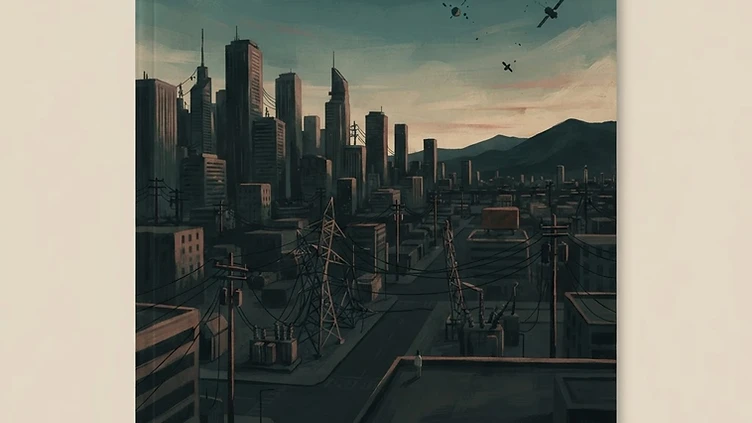
There is a strange irony in human history: we experience our greatest sense of power at the exact moment we are at our most vulnerable. We have instant access to every corner of the globe at our fingertips, an entire library in our pockets, and satellites guiding us from above. Yet beneath all this grandeur runs a thin, fragile thread; an vulnerability that is invisible, intangible, and only noticed by its consequences. In 1859, long before we had invented anything more electronic than the telegraph wire, the Sun provided us with a preliminary rehearsal of this fragility. That night, known as the Carrington Event, was the first major geomagnetic storm to prove how defenseless humanity is against nature. The question is simple yet chilling: if the same storm were to erupt today, would our advanced technology protect us, or would it, conversely, amplify the catastrophe?
The Night of 1859: How Telegraph Lines Began to Ignite Spontaneously
On the morning of September 1, 1859, when British astronomer Richard Carrington turned his telescope toward the Sun, he saw an unexpected flash of white light amidst the sunspots. He did not fully grasp what was happening at that moment, but hours later, skies around the world began to blaze with auroras that should have been confined to the poles. In Cuba, Hawaii, and even regions near the equator, people watched the midnight sky glow as if it were daytime. This was no ordinary celestial event; a massive plasma cloud, a coronal mass ejection thrown from the Sun, had sent ripples through Earth's magnetic field.
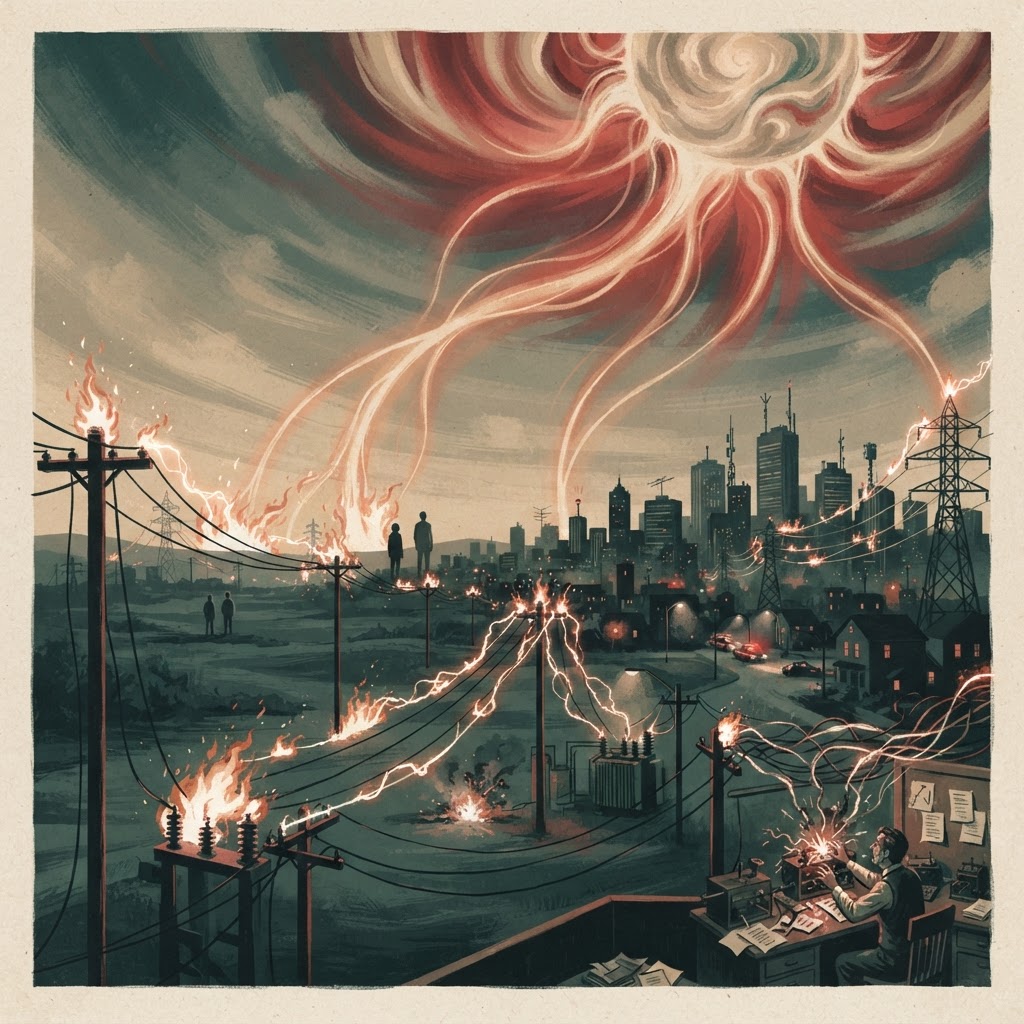
What is truly striking is that this cosmic event reached even the simplest technology on the ground. Telegraph lines, the most advanced communication tools of the era, suddenly began to generate their own current. Operators reported that the lines functioned even when their batteries were disconnected, with sparks leaping in some places and paper catching fire. This scene is one of the most clearly documented natural events in the history of science because the Sun's power collided directly and visibly with a man-made system. That night, we saw for the first time just how innocent and vulnerable our technology is in the face of nature.
The Fragility of the Modern World: Why a Solar Storm Could Collapse the Entire Grid
Comparing today's world to 1859 is like comparing a candle flame to an entire city's power grid. Back then, there were only a few thousand kilometers of telegraph wire; now, we have power lines spanning continents, fiber-optic cables running beneath oceans, thousands of satellites orbiting the Earth, and a massive internet backbone connecting it all. Is such an expansive network more resilient to electromagnetic effects, or more fragile? At first glance, one might think it is more resilient because of the increased redundancy and alternative paths. But reality points in the opposite direction.
The true danger of solar storms lies in the currents induced in long conductive lines. The massive transformers of modern power grids were not designed to withstand these sudden, unexpected surges; they can overheat instantly and be permanently destroyed. In 1989, a relatively minor geomagnetic storm caused a collapse of the Quebec power grid within hours; this impact was not even one percent of the Carrington Event. If a storm of that same magnitude were to occur today, it would not just be a power outage; GPS systems would fail, satellite communications would break down, and a chain reaction of collapse would begin as banking and transportation networks, all interdependent, grind to a halt. The power of the modern world is actually its greatest flaw; when everything is so interconnected, the snapping of one link drags the entire chain down.
At this point, an objection might arise: as technology progresses, shouldn't protection systems advance as well? Certainly they do, but the scale issue remains unresolved. Replacing a house fuse is easy, but retrofitting every transformer in a continent-spanning power grid built on century-old infrastructure is a monumental engineering and economic task. Consequently, our defensive capacity still lags far behind the magnitude of the threat.
Why Are Scientists Not Prepared for This Risk?
NASA's space weather forecasting systems, with satellites constantly monitoring the Sun, can now detect coronal mass ejections hours in advance. This is a massive improvement over 1859, when people were caught in the storm before even knowing what it was; now, at least, there is a warning window. Yet, does this warning truly protect us? The answer depends less on technical capacity and more on institutional and political preparedness. Knowing that a storm is coming is one thing, but taking global-scale precautions against it is entirely another.
The real challenge lies in the fact that the risk has a low probability but a massive impact. Governments and companies are not particularly eager to invest billions of dollars into an event that might happen once a century; the returns are uncertain, while the costs are very concrete. This is a classic trap of human psychology: preparing for rare but catastrophic events is always harder than preparing for frequent but minor ones. Moreover, global infrastructure is not in the hands of a single authority; every country and every corporation is responsible for its own grid, making a coordinated global defense plan almost impossible. Scientists can accurately predict the risk, but the will to translate this knowledge into action remains scattered and insufficient.
A counter-argument may come to mind: perhaps the probability of such a massive storm recurring is truly very low, so it is not worth worrying about. But statistics show the exact opposite; the probability of a similarly sized storm occurring in the coming decades is high enough to be ignored. Furthermore, the fact that it has not happened in the last century does not mean it will not happen in the next; the Sun does not move according to the human calendar.
Perhaps the most chilling aspect of contemplating the Carrington Event is not the catastrophe itself, but what it reminds us of. This entire digital age, this entire sense of connectivity, is built upon a delicate magnetic balance. The Sun is a force so vast and indifferent that it could ignore everything we have built in an instant. Perhaps the point is not to panic over this risk, but to realize how conditional our trust in technology truly is. Because progress does not always take us further from nature; sometimes, it only makes the relationship between us and nature more invisible, more sudden, and more fragile.
İlgili Denemeler
Can the Human Brain Detect Magnetic Fields?
Geophysicist Joseph Kirschvink's experiment at Caltech indicates that the human brain responds to magnetic fields, raising questions about a potential sixth sense.
Jan Hendrik Schön: The Physicist Who Fooled Science
The scandal of Jan Hendrik Schön's fabricated data at Bell Labs highlights the critical vulnerabilities in the scientific peer-review system.
Barry Marshall Drank Bacteria to Prove Stomach Ulcer Theory
Barry Marshall made medical history by consuming harmful bacteria to prove that stomach ulcers are caused by an infection rather than stress alone.
Tartışma (0)
Henüz yorum yok. İlk yorumu siz yapın.
Join the Newsletter
New essays, once a week, delivered to your inbox.