Alien Hand Syndrome: When Your Hands Act Alone
In some patients, a hand may button a shirt, grab objects, or even strike its owner, all without the owner’s consent.

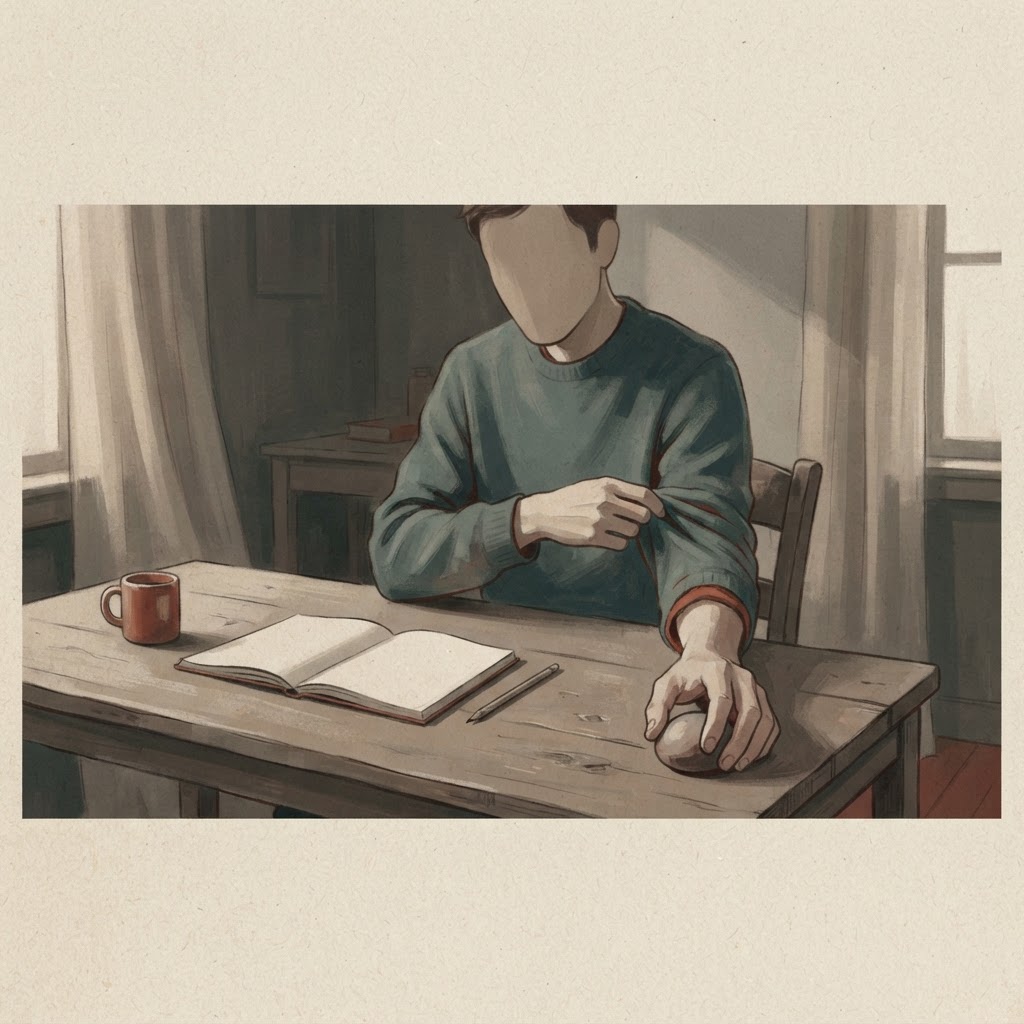
If you were about to pick up your coffee mug and your hand suddenly knocked over the salt shaker, how would you explain it? You might call it clumsiness or a reflex. But what if that hand, without any desire or knowledge on your part, began leading a life of its own? What if it buttoned a shirt, grabbed a glass, or even slapped you? While this scene sounds like something out of science fiction, it is a recognized condition occurring in neurological clinics. Alien hand syndrome demonstrates how the most fundamental aspect of what we believe is ours—our dominion over our own bodies—can hang by a thread. ## The Moment the Hand Moves on Its Own Alien hand syndrome is not a random anomaly; it is a clinical condition described in medical literature, often following specific surgical interventions. In a corpus callosotomy, performed to stop severe epileptic seizures, the bundle of fibers connecting the left and right hemispheres of the brain—the corpus callosum—is severed. While this prevents seizures from spreading between hemispheres, it leaves an unexpected side effect in some patients: the two hemispheres begin to operate independently of one another, and this disconnection can cause one side of the body, usually the left hand, to act without the owner's conscious intent. The accounts of these patients carry a sense of calm bewilderment rather than a fictional horror story. One patient noticed that while their right hand was buttoning their shirt, their left hand would unbutton it. In another case, a woman reported that while she was reading, her left hand would close the book and throw it on the table. In one of the most striking examples, a patient described their own hand slapping their face, forcing the other hand to hold it down to stop the action. These people are not lying or exaggerating; they are describing a part of their body that has slipped out of the orbit of the will they once claimed as their own. ## Where Does So-Called Free Will Reside? We must stop and ask: is what we call free will a single authority sitting in a corner of the brain, signing off on every decision? Alien hand syndrome deeply disturbs this picture. Because there are two hemispheres, one initiates a movement, while the conscious self observes it afterward, sometimes even opposing it. If will resides in a single center, it becomes difficult to explain why this center cannot prevent its own command. But if will is the sum of tendencies produced by different regions of the brain, the picture becomes more understandable: when the connection between hemispheres is severed, one region can act without waiting for the other's approval. Certainly, an objection may arise here: perhaps this is merely a technical malfunction regarding motor control, with nothing to do with will. Saying there is an intention just because a hand moves might be an exaggeration. However, the patients' accounts soften this objection; the hand does not twitch randomly, but performs purposeful behaviors—grasping an object, opening a door, or buttoning a shirt. According to neuroscience, producing purposeful action already carries the traces of will. The problem is that this will is not synchronized with the conscious self. Therefore, the issue here is not whether free will exists, but in how many places and with how many different voices it can speak. ## Consciousness May Not Be a Single Piece, but a Coalition Modern neuroscience, influenced by such cases, is moving away from depicting the self as a single, indivisible command center. Instead, models are emerging that describe the brain as a temporary coalition of regions that constantly negotiate, sometimes agreeing and sometimes clashing. According to this model, the sense of unity we feel at every moment—that feeling of being a single entity whose every decision is our own—is actually the visible facade of an ongoing negotiation behind the scenes. Most of the time, this negotiation proceeds smoothly; different neural networks reach a common conclusion, and we experience it as our own decision. Alien hand syndrome exposes the rare moments when this negotiation falls under the table and one of the parties acts without waiting for the other. This coalition metaphor is not limited to rare post-surgical cases; it allows us to see the familiar contradictions of our daily lives in a new light. A dieter’s hand reaching for the refrigerator, someone who vowed to wake up early silencing the alarm to sleep in, or someone trying to quit smoking reopening the pack—all reflect a similar internal conflict on a small scale. The difference is that in these cases, the connection between hemispheres is intact, so the conflict remains more visible and debatable at the level of consciousness. Yet the fundamental mechanism is the same: one part of the brain wants one thing, another part wants something else, and the resulting behavior reflects the current power balance between these two voices. Alien hand syndrome forces us, perhaps most of all, to question that comfortable assumption we carry about ourselves: the assumption that there is a single 'I' behind every decision. In reality, the brain is a structure built of regions connected by wires, yet each capable of working on its own account; we hear this as a single voice because they usually work in harmony. When one of those wires is cut, we realize that the voice is actually a choir, and every voice in the choir can sing its own song. Perhaps free will was never a command issued from a single point; it was a fragile, surprisingly temporary consensus, reconstructed at every moment.
İlgili Denemeler
Can the Human Brain Detect Magnetic Fields?
Geophysicist Joseph Kirschvink's experiment at Caltech indicates that the human brain responds to magnetic fields, raising questions about a potential sixth sense.
Jan Hendrik Schön: The Physicist Who Fooled Science
The scandal of Jan Hendrik Schön's fabricated data at Bell Labs highlights the critical vulnerabilities in the scientific peer-review system.
Barry Marshall Drank Bacteria to Prove Stomach Ulcer Theory
Barry Marshall made medical history by consuming harmful bacteria to prove that stomach ulcers are caused by an infection rather than stress alone.
Tartışma (0)
Henüz yorum yok. İlk yorumu siz yapın.
Join the Newsletter
New essays, once a week, delivered to your inbox.