The Wow! Signal: Has the Alien Mystery Been Solved?
Captured by a radio telescope in Ohio in 1977, a mysterious signal remains one of the most enduring unanswered questions in scientific history.
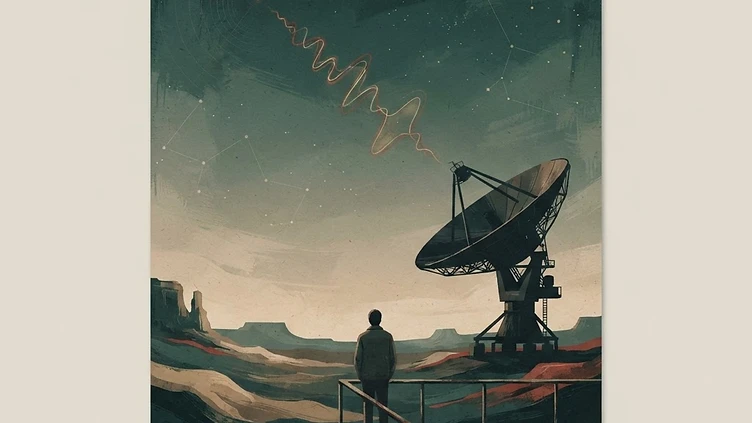
What would you do if a trail appeared on a piece of paper that no human voice or known star could explain? In the summer of 1977, a radio telescope in Ohio experienced exactly that: it recorded a signal lasting seventy-two seconds that resembled neither the known cycles of nature nor any human-made source. The strangeness of that moment evolved into a legend still discussed today, largely because the signal never repeated itself. Perhaps the real question is not whether we received a message from space, but why this brief fragment of data has occupied the scientific community for over fifty years. ## The Anomalous Signal Recorded by Big Ear The Big Ear telescope, built on rural land by Ohio State University, was not a glamorous instrument; it was a patient eye consisting of two large reflective surfaces slowly scanning the sky. Its mission was clear: to capture non-natural, artificial radio waves originating from the depths of the universe. This search was part of the scientists' effort to find a concrete answer to the question of whether we are alone in the universe, and for years, Big Ear quietly posed this question to the sky, mostly without receiving an answer. In mid-August 1977, however, the telescope received an unexpected response. The recorded signal appeared in a band very close to the frequency naturally emitted by the hydrogen atom, but its power was high enough to peak thirty times above the background noise. For astronomers, this was a statistically nearly impossible deviation; natural stars or gas clouds did not produce signals with such sudden intensity in such a narrow band. The shape of the signal was also remarkable: it drew a curve that rose and fell in perfect synchronization with the telescope's rotation speed, behaving as if it were coming from a fixed source in the sky. ## Jerry Ehman's Marginal Note and the Trace That Never Returned No one noticed the signal immediately when it was recorded; the telescope operated automatically, and the data awaited review in paper printouts days later. When volunteer researcher Jerry Ehman spotted this anomaly among stacks of data, he did not write a scientific report but instead scribbled a single word in the margin with his red pen: Wow! This small, instinctive note was a moment of wonder rarely seen in one of science's most level-headed disciplines, and perhaps it remains more memorable than the signal itself. But the real riddle began after that note was written. Big Ear and other telescopes deployed in later years scanned the same coordinates repeatedly, listened to the same frequency band, and attempted to recapture the same moment. None were successful. Some researchers suggested the signal originated from a comet, others thought it might be a reflection bouncing off a secret satellite, but none of these explanations fully aligned with the data, and they were questioned one by one over time. Because an unrepeatable observation does not meet the fundamental requirement of verifiability in science, the Wow! Signal could neither be accepted as a definitive discovery nor dismissed entirely as a misreading; it is precisely this state of limbo that made it one of the most difficult puzzles to solve. ## The Legacy Left to SETI's Methodology The fact that the Wow! Signal could never be verified became a bitter but instructive experience for SETI researchers. Today's signal hunters no longer rely on a single momentary record from one telescope; they have made it standard practice to collect data from multiple observation points simultaneously and to cross-check a suspicious signal with instruments in different geographical locations. These protocols are a direct consequence of the disappointment experienced by Big Ear; they have ingrained in institutional memory the risk of making grand claims based on a trace that was captured once but never seen again. Yet, the legacy left by this event is not merely a list of technical precautions. The Wow! Signal is a living example of how science deals with its own boundaries, as there is neither definitive proof nor a definitive rejection here. Imagine a photograph fading in a developing tray before it becomes clear; you are left with the feeling that the image exists, but you cannot show it to anyone. Scientists have learned to live with this exact feeling because skepticism means not only disbelief but also the capacity to carry uncertainty. The fact that the Wow! Signal remains unsolved is not a testament to the weakness of the scientific method but rather to its honesty; without sufficient data, no telescope's prestigious name or any researcher's enthusiasm is enough to fill that void. Perhaps the true value of the Wow! Signal lies in the fact that it provides no definitive answer. For over half a century, we have been returning to the same seventy-two seconds of data, generating new theories, debunking old explanations, and facing the same question with every attempt: are we alone in the universe? The lack of a definitive answer to this question may be the very thing that keeps human curiosity alive. Every time we continue to lend an ear to the sky, we re-experience that single word written in the margin of that old paper printout—that sense of wonder mixed with confusion.
İlgili Denemeler
Can the Human Brain Detect Magnetic Fields?
Geophysicist Joseph Kirschvink's experiment at Caltech indicates that the human brain responds to magnetic fields, raising questions about a potential sixth sense.
Jan Hendrik Schön: The Physicist Who Fooled Science
The scandal of Jan Hendrik Schön's fabricated data at Bell Labs highlights the critical vulnerabilities in the scientific peer-review system.
Barry Marshall Drank Bacteria to Prove Stomach Ulcer Theory
Barry Marshall made medical history by consuming harmful bacteria to prove that stomach ulcers are caused by an infection rather than stress alone.
Tartışma (0)
Henüz yorum yok. İlk yorumu siz yapın.
Join the Newsletter
New essays, once a week, delivered to your inbox.