Voyager Golden Record: Humanity's Silent Message
Curated by Carl Sagan, the golden record may never find a listener, yet it paints the most honest portrait humanity has ever crafted of itself.
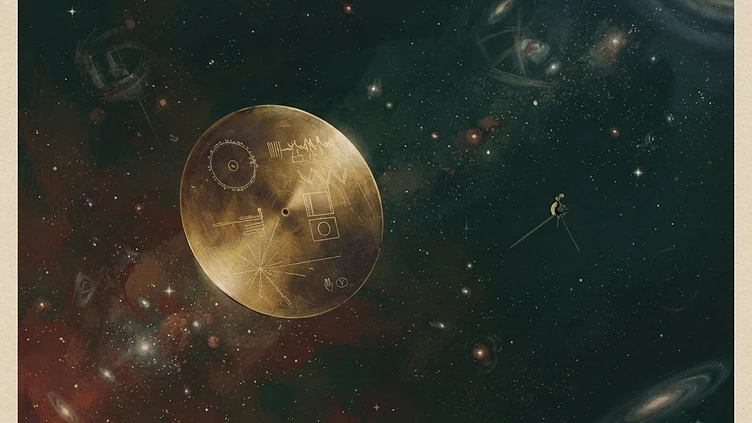
In the summer of 1977, two metal vessels launched from America's space center began their journey toward the edge of our solar system. Attached to these crafts, known as Voyager 1 and Voyager 2, was a small, gold-plated copper disk resembling a phonograph record. A small team led by Carl Sagan attempted to compress the sounds, images, and music of humanity onto this disc, as if the entire planet were attempting to introduce itself through a letter. Yet, there was no address for this letter to be delivered to, and perhaps there never would be. What was the meaning of sending a message while knowing full well that no one might ever read it? This question touches upon a much larger inquiry regarding science itself: is science always conducted to receive a response, or is it sometimes merely an outcry of existence?
An Attempt to Portray a Species
When Sagan's team decided what to place on the record, they were not writing an encyclopedia, but an autobiography. The sounds of nature, the howling wind, a baby's cry, a musical selection ranging from Bach to Chuck Berry, and greetings in various languages were compiled. Photographs of families, images of people playing musical instruments, and schematic representations of scientific achievements were included. But there was no trace of war, poverty, or violence; it was as if we had carefully excised the darkest pages of our history as a species. This omission did not stem from ill intent on the part of Sagan and his team, but rather from the human tendency to select our best qualities when defining ourselves.
What is intriguing here is that this selection occurred within a scientific endeavor. Science is often perceived as an objective, impartial act of recording; yet, deciding what to include on the record was much like a person choosing which memories to keep and which to forget while writing an autobiography. There were no photographs of traffic accidents or battlefields; instead, a mother holding her child, a scientist working in a lab, and an orchestra were chosen. This demonstrates that science constructs a narrative even as it gathers data; it becomes a storyteller when deciding which information is significant and which is unimportant enough to be left out. The Voyager record may not have been a lie humanity told itself, but it was certainly a truth humanity wished to project.
How the Mathematics of Distance Dulls Hope
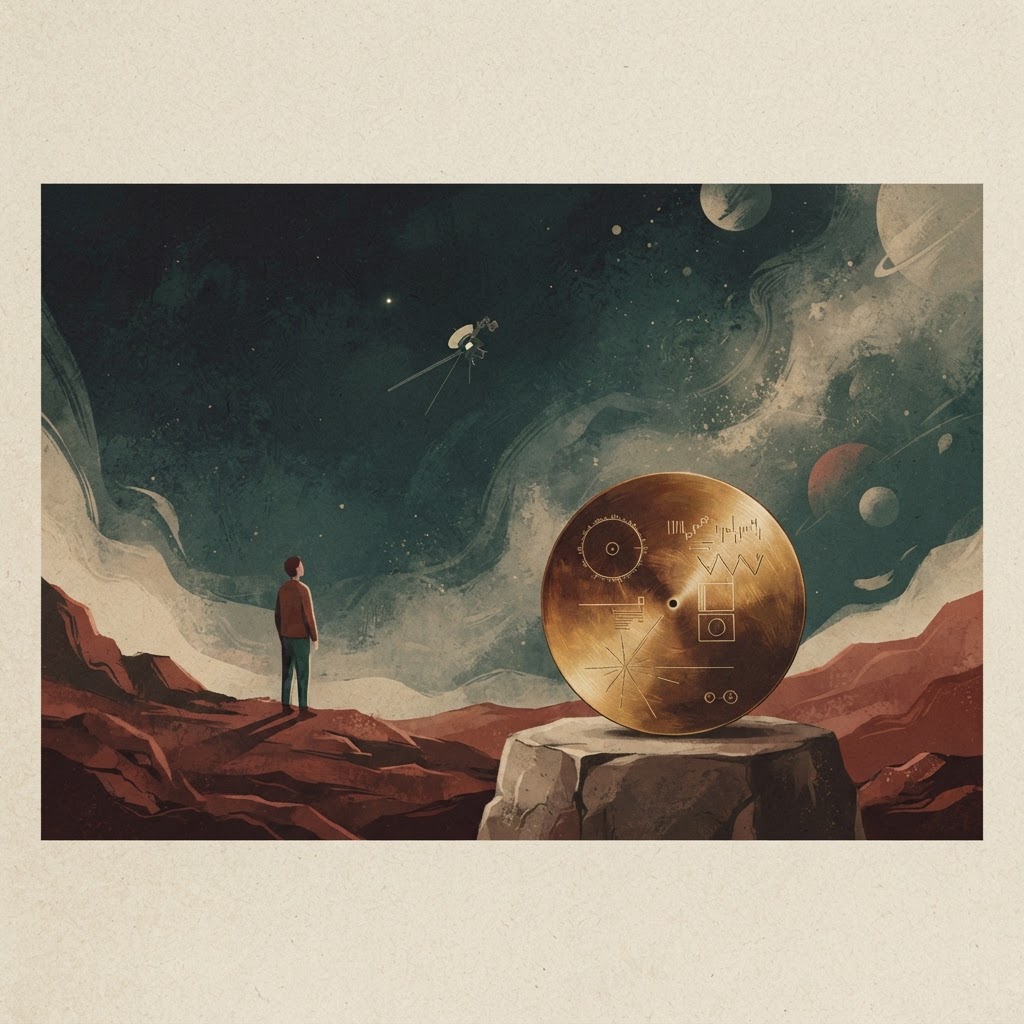
Voyager vehicles are traveling at thousands of kilometers per hour, yet the interstellar void is so vast that even this speed is rendered laughable. Reaching the nearest star system requires a journey that would span tens of thousands of years, meaning the craft will drift silently on its own long before nearing any solar system. Furthermore, the space between stars is measured not just by distance, but by emptiness; the probability of finding something at a specific point is so sparse that it is comparable to dropping a bottle in the middle of the ocean, not toward a shore, but toward the depths of another ocean. Faced with these numbers, hoping that the record will one day be found and played by an extraterrestrial seems less like a scientific prediction and more like a childish wish.
At this point, one must ask: did Sagan and his team not realize this impossibility? Of course they did; they were astronomers who could calculate distances and speeds better than anyone. Yet the goal was never to establish real communication, as communication requires a relationship where both parties exist and can reach one another. The Voyager record was designed more as a symbolic gesture; it was not a message, but a monument. Just as words written on a tombstone are inscribed with the knowledge that they will not bring the deceased back, the record was prepared with the full knowledge that no answer would ever arrive. Here, science ceased to be a tool of discovery and transformed into a scientific version of a prayer.
The Meaning of Science Without Expectation of a Response
Can something done with the knowledge that no reply will ever come truly be considered science? When we ask this, we realize that science is not always performed for utility or discovery. Who were the hunting scenes on cave walls drawn for? Without knowing who would visit that cave or see those pictures, a human thousands of years ago placed their hand on the wall and painted around it. Time capsules are buried with a similar impulse; left beneath the ground to record an existence, without knowing who will open them. The Voyager record is a continuation of this tradition, just a more metallic and distant version.
This impulse may reveal the most vulnerable yet honest side of humanity regarding science. Because an act performed without expectation of benefit is stripped of false glory; it does not have to answer to anyone or convince anyone. The team that prepared the record may have known that the true recipient would not be an alien, but humanity itself, which might one day listen to its own voice. By examining this record, we see the music we chose and the photographs we preserved, learning something about ourselves in the process. Perhaps the true recipient was never an alien; the true recipient was humanity itself, daring to look in the mirror.
Voyager is currently continuing its journey far beyond the boundaries of our solar system, in a cold and silent void. The record on board is still there, carrying a song that no ear has heard and a photograph that no eye has seen. Perhaps one day, in a very distant future, another intelligence will take this metal disk into its hands and attempt to decipher the drawings upon it; perhaps that will never happen. But this impossibility does not diminish the value of the record; on the contrary, it makes it all the more human. Because sometimes the meaning of an act lies not in its outcome, but in the courage to perform it; humanity chose to speak while knowing no one would listen, and this choice itself tells us more than every word recorded upon the disc.
İlgili Denemeler
Can the Human Brain Detect Magnetic Fields?
Geophysicist Joseph Kirschvink's experiment at Caltech indicates that the human brain responds to magnetic fields, raising questions about a potential sixth sense.
Jan Hendrik Schön: The Physicist Who Fooled Science
The scandal of Jan Hendrik Schön's fabricated data at Bell Labs highlights the critical vulnerabilities in the scientific peer-review system.
Barry Marshall Drank Bacteria to Prove Stomach Ulcer Theory
Barry Marshall made medical history by consuming harmful bacteria to prove that stomach ulcers are caused by an infection rather than stress alone.
Tartışma (0)
Henüz yorum yok. İlk yorumu siz yapın.
Join the Newsletter
New essays, once a week, delivered to your inbox.