Lake Vostok: Antarctica's Mysterious Subglacial World
A lake isolated under the Antarctic ice for millions of years both thrills and unsettles the scientific community.
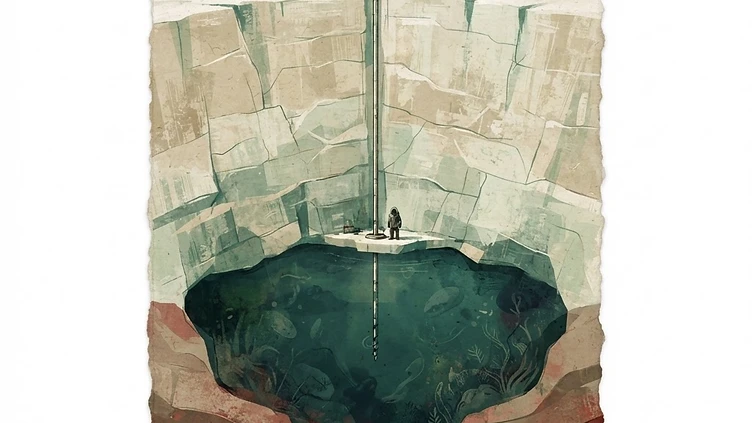
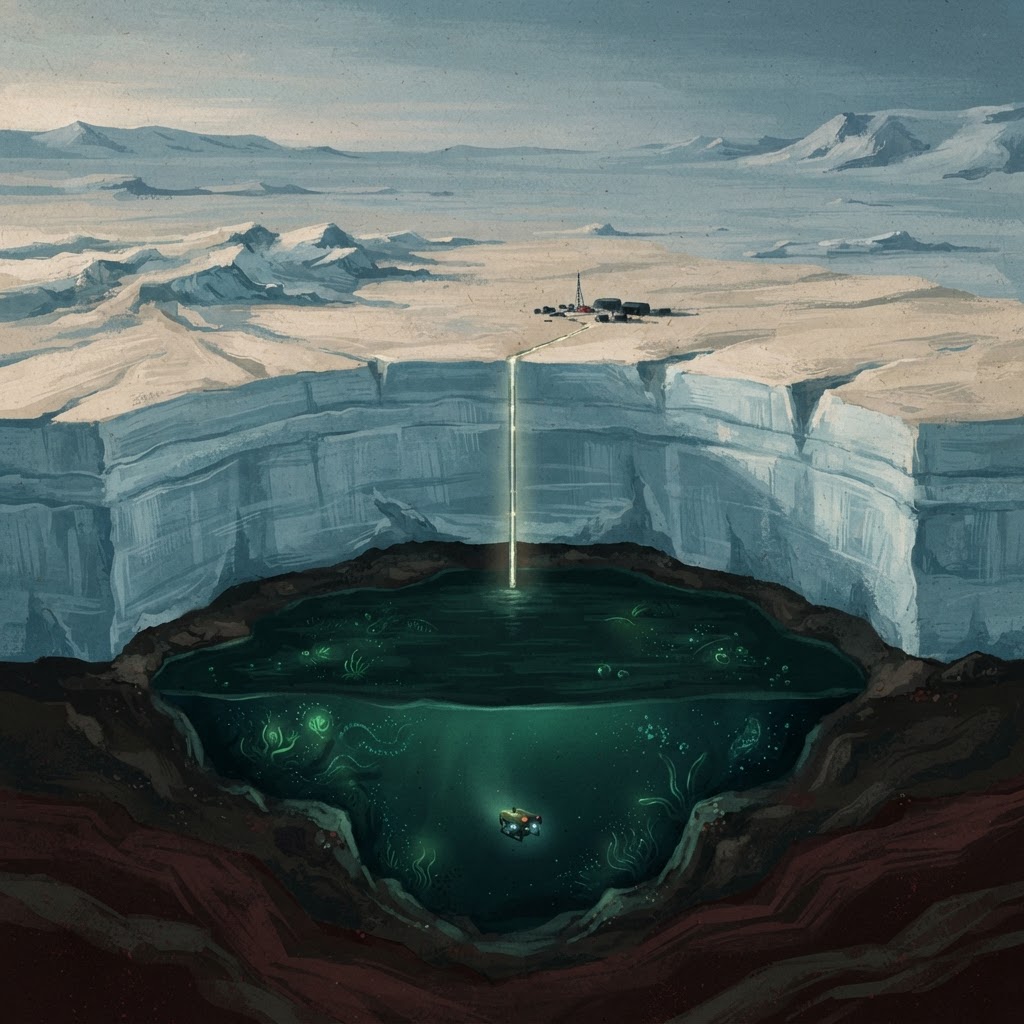
One of the world's coldest, darkest, and most persistent secrets awaits four kilometers beneath the frozen surface of Antarctica, in a darkness untouched by sunlight. When one thinks of Lake Vostok, it feels less like a lake and more like a time capsule; the water there has existed for millions of years without any interaction with the outside world, persisting by its own rules. Such profound isolation evokes both dizzying excitement and a strange sense of unease. No one knows exactly what lies there, and perhaps the real issue is not what will be found, but the inherent risk in the pursuit of discovery itself. ## The Cold War's Secret Drill Just becoming aware of Lake Vostok's existence feels like a strange chain of coincidences. During the Cold War, Soviet scientists establishing a research station deep in Antarctica encountered clues about a massive body of water trapped beneath the ice. Yet, the political climate of the era was too heavy to prioritize scientific curiosity; the discovery was treated more as a strategic secret than a scientific breakthrough. Furthermore, technical capabilities were far from today's standards. Drilling through four kilometers of ice carried uncertainties not only in engineering but also in ethics, as the risk of contaminating the lake with drilling fluids held scientists back for years. This waiting always makes me wonder: how long is a person willing to wait to solve a secret? In the case of Lake Vostok, the answer was decades. Political regimes shifted, technology progressed, but the lake remained there, unchanged and patient. True drilling efforts only became possible toward the end of the twentieth century, once safety protocols had matured. When that moment finally arrived, the scientific world held its breath; the water sample extracted from beneath the ice was not just geological data, but perhaps a doorway to a millions-year-old biological archive. The wait itself reminds us that science is an exercise in patience; every great discovery follows a long silence. ## The Debate Over Unknown Bacteria That silence was broken in 2012. Russian scientists announced they had found a bacterial form in ice samples from Lake Vostok that did not match any known species. The news created an immediate wave of excitement in the scientific community, as this could have been evidence of a life form never before encountered on Earth. But scientific skepticism followed close behind. The risk of surface contamination through the drilling equipment had been debated from the start. Was the bacterium from the depths of the lake, or was it carried down by the drill itself? This question remains unresolved years later. What is interesting here is how the search for scientific certainty and the human drive for curiosity often clash. On one side are cold-headed researchers awaiting rigorous verification; on the other, an excitement wanting to believe it is on the verge of a major breakthrough. These two feelings can conflict even within the same laboratory. This discovery, referred to as Unknown Species Y, is to me not just a microbiological puzzle but a story of the scientific method facing its own limits. As long as the suspicion of contamination remains, it is impossible to say with certainty whether this finding is a true discovery or a methodological error. And perhaps the real lesson lies here: some questions remain valuable to science even without answers. ## Europe's Frozen Mirror What makes Lake Vostok so captivating is not just its internal mystery but the possibilities it points to beyond itself. This lake is considered the closest example on Earth of a frozen, isolated environment. This analogy leads scientists to turn their eyes to Jupiter's moon Europa and Saturn's moon Enceladus, as both are thought to harbor liquid oceans beneath their icy crusts. If an ecosystem can survive in an environment like Lake Vostok, entirely severed from sunlight and the external atmosphere, it offers a tangible hint that similar life could exist beneath the icy shells of Europa. It must be noted that some scientists consider the analogy between Lake Vostok and Europa too optimistic. Lake Vostok is, after all, linked to Earth's atmosphere and geological history, whereas Europa's ocean is fueled by an entirely different planetary context and heat source. Yet, this difference does not diminish the value of the analogy. The point is not to find identical conditions, but to understand how extreme isolation shapes life. In this sense, Lake Vostok acts as a laboratory; observing what survives under the ice gives us an intuition about what might be possible in the icy worlds of space. And perhaps this is exactly how science often progresses: taking the nearest example we have and mirroring it into an unknown distance. The story of Lake Vostok is, to me, not merely a geological or biological matter; it is a mirror reflecting the duality of the human spirit in the face of the unknown. On one side is the patience to wait decades to solve a mystery; on the other, the doubt and caution that emerge as soon as that mystery is touched. Perhaps this lake will never be fully solved; perhaps every answer we find will only give birth to a new question. But for that very reason, Lake Vostok represents one of the most honest states of science: accepting the state of not knowing while refusing to stop asking.
İlgili Denemeler
Can the Human Brain Detect Magnetic Fields?
Geophysicist Joseph Kirschvink's experiment at Caltech indicates that the human brain responds to magnetic fields, raising questions about a potential sixth sense.
Jan Hendrik Schön: The Physicist Who Fooled Science
The scandal of Jan Hendrik Schön's fabricated data at Bell Labs highlights the critical vulnerabilities in the scientific peer-review system.
Barry Marshall Drank Bacteria to Prove Stomach Ulcer Theory
Barry Marshall made medical history by consuming harmful bacteria to prove that stomach ulcers are caused by an infection rather than stress alone.
Tartışma (0)
Henüz yorum yok. İlk yorumu siz yapın.
Join the Newsletter
New essays, once a week, delivered to your inbox.