Credit Notebooks: The Shift From Neighborhood Trust to Digital Scoring
That old notebook on the corner store shelf recorded not money, but trust; who or what is filling its place now?

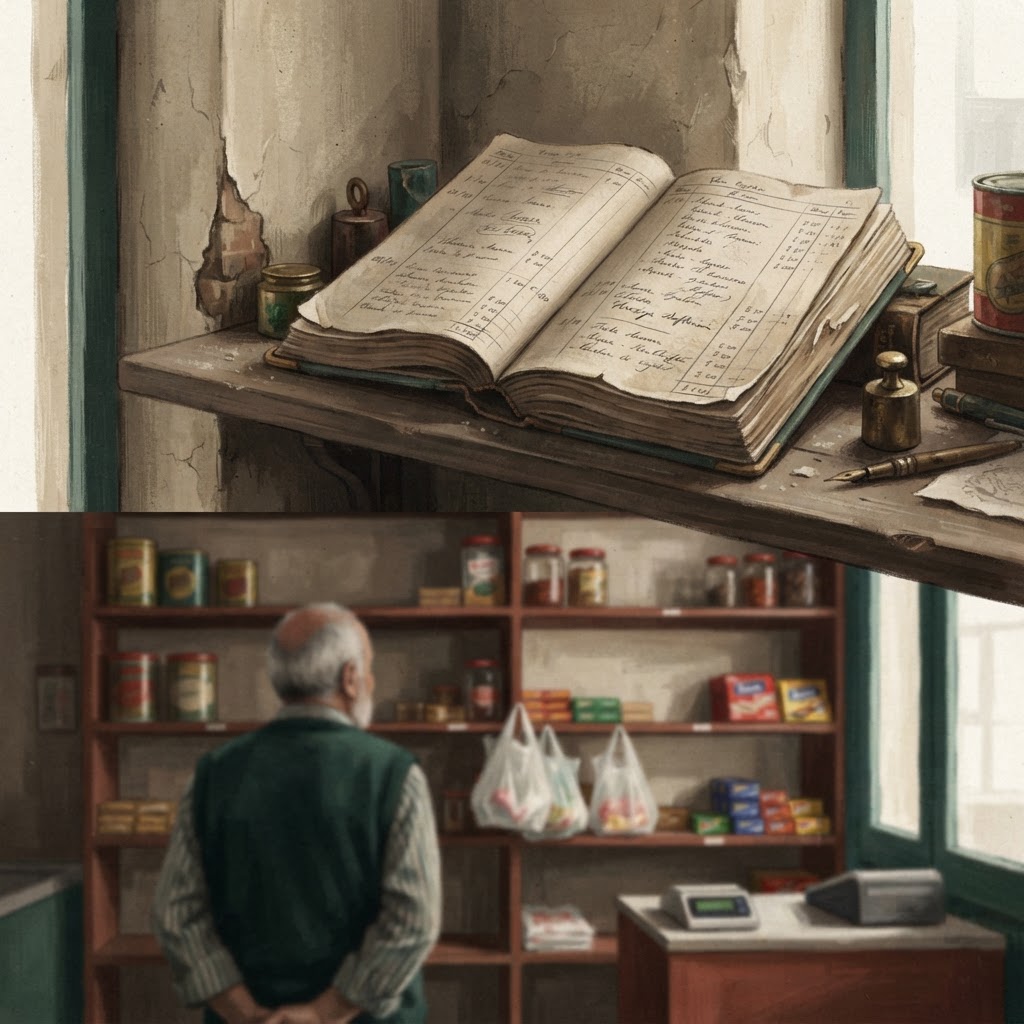
Every time I walked into the neighborhood grocery store, my eyes would drift to that thick, fraying ledger on the counter. It had a cardboard cover, grease-stained pages, and lines filled with names, dates, and numbers. As a child, I thought it was merely a list of debts; as I grew older, I realized those pages were a record of something far more profound. Today, I carry a phone instead of cash, an app calculates my debt, and a score defines my reliability. But who or what has inherited the work of that ledger, the act of one person vouching for another? This question made me wonder if we have lost more than just a piece of paper. ## The Written Form of Trust At first glance, a credit ledger looks like a simple accounting tool: who bought what, how much they owe, and when they will pay. Yet this simple appearance hides its true purpose. The ledger was a written witness to a verbal agreement between two people; the grocer gave credit by looking the customer in the eye, knowing which street they lived on, how many children they had, and where they worked. The number was the result of trust, not its cause. Even if someone delayed payment, the grocer waited because he knew them; they shared a bond rooted in neighborhood ties, not just commerce. The strength of this bond was evident in the physical presence of the ledger. Resting where everyone could see it, it was not a secret, but a document of belonging. Seeing one's name on those pages made one feel like a part of the neighborhood. Thinking of something similar today, perhaps the closest example is lending money to a friend, but even that has become a digital transfer, a screenshot, a cold transaction record. In the credit ledger, there was always a name, a face, and a story alongside the figure. Trust there relied not on a number, but on familiarity. ## The Algorithm Takes Over When digital payment systems and credit scores arrived, they promised to meet an old need more quickly and on a broader scale. It no longer matters if a grocer knows me; my payment history in a bank database, my income, and even my shopping habits define me. The advantage of this system is clear: it can evaluate millions of people simultaneously, granting credit to a stranger without needing any community relationship. Some might argue this is fairer, as it looks at concrete data rather than who is friends with whom. But this fairness comes at a price. That price is the evaporation of the personal nature of the relationship. A credit score does not ask why I was late; it does not know if I was sick, lost my job, or lost a loved one. It simply generates a number and classifies me accordingly. In the grocer's ledger, there was a story behind the delay because the grocer would listen. The algorithm does not listen; it only calculates. This calculation, replaced it.cing trust, does not eliminate it, but rather detaches it from humanity and moves it into a database. During this transition, empathy, the most precious element of trust, is left out of the system. ## Not Just the Ledger is Lost To read this transformation merely as a tale of technology is to stay on the surface. For the loss of the credit ledger was, in essence, the quiet dissolution of the habit of a community vouching for one another. In the past, when someone could not pay their debt, not only the grocer but the entire neighborhood would know, step in when necessary, and find a way to make it right. Trust was not confined to a single notebook, but spread across the web of people surrounding it. Today, when I cannot pay my debt, I am met with nothing but a notification, not a neighbor asking after me. Perhaps someone might argue that this dissolution is inevitable, that urbanization and population growth have made such closeness impossible. There is truth in this; while everyone could know each other in a thirty-household neighborhood, it is impossible in a city of millions. But the problem here is not the loss of intimacy, but that nothing has replaced it. The algorithm did not inherit the lost responsibility; it merely mimicked its function. It produced the number but failed to produce the bond. As a result, we have turned into a society that is financially more secure but humanly more lonely; no one vouches for us, and we vouch for no one. We only look at each other's scores. When the last page of the credit ledger closed, it was not just paper that was lost; it was those brief but deep moments where one human could trust another simply because they were acquaintances. Today, the phone in my pocket can give me credit in seconds, but it will never ask me why I was late. Perhaps the real issue is not that technology measures trust, but that what it measures is no longer trust, but mere risk. When I think of that old ledger, I remember not the numbers, but the familiar voice the grocer used when saying my name; and I realize that today, no app can speak to me with that voice.
İlgili Denemeler
Doorman Culture: The Loss of Community in Cities
This essay explores how the erosion of the apartment caretaker profession has transformed urban neighborliness, trust, and the collective memory of the neighborhood.
Hostile Architecture: Excluding Bodies in Public Spaces
In modern cities, a simple metal fixture added to benches silently exposes who public spaces are intended for and whose presence is systematically excluded.
The Third Place: Where Did Our Sense of Belonging Go?
Drawing on Ray Oldenburg's concept of the third place, this piece explores the societal cost of the vanishing communal spaces that once defined our daily lives.
Tartışma (0)
Henüz yorum yok. İlk yorumu siz yapın.
Join the Newsletter
New essays, once a week, delivered to your inbox.