Hostile Architecture: Excluding Bodies in Public Spaces
A single iron arm added to a bench quietly reveals who public space actually belongs to.
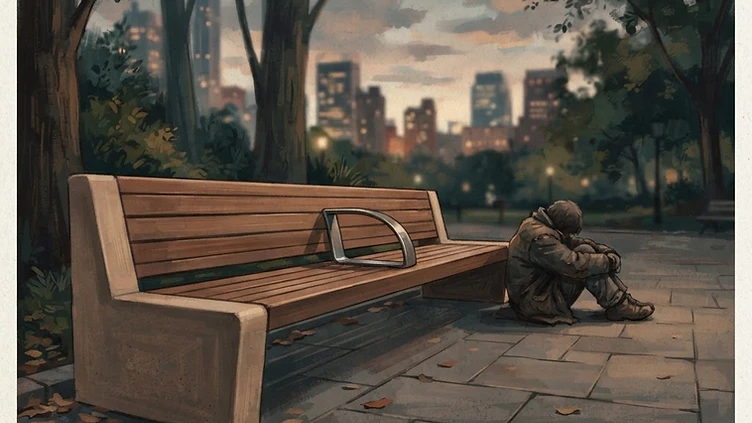
When walking through a city, you may notice that even the most mundane objects carry an intent. You sit on a bench to rest, to breathe, or perhaps just to watch the passing flow of life. Yet, on some benches, a single piece of iron wedged between the armrests catches your eye. At first glance, it seems meaningless, perhaps even decorative. However, that iron is there precisely to prevent you from lying down, stretching out, or letting your body fully relax. No one tells you this; no sign explains its purpose. The city speaks silently, and this silence holds a very clear answer as to whom public space belongs. ## The Language of Iron Design is not as neutral a space as it appears. Although that small piece of iron added to a bench is presented as an aesthetic choice, it is actually designed to shape behavior. Architects and urban planners call this hostile architecture, yet even the coldness of this term fails to capture the weight of the reality. The issue is not merely that a homeless person cannot lie down; it is that public space redraws its own boundaries by placing certain bodies into an unwanted category. A bench is no longer just a place to sit; it becomes a filter that dictates who can be there, for how long, and in what manner. The silence of this filter is the most dangerous part. If a sign were to say that sleeping is forbidden, you could at least argue or object. But the iron piece does its job without producing any discourse, without leaving any door open for debate. When you sit there, you might not even notice it, because for your body, it is not a hurdle. It is for the bodies deemed unworthy that this iron builds a wall. Thus, public furniture transforms into a language that determines who has the right to rest and who is merely permitted to exist temporarily. And because this language is never explicitly spoken, it often operates unnoticed. ## The Rendering of Poverty as Invisible Proponents of hostile architecture often speak in terms of security or hygiene. They claim these measures ensure that public space remains clean and orderly for everyone. This argument certainly has a logic; no one wants parks to be used in an uncontrolled manner. But the question that must be asked is this: at whose expense is this order established? Preventing a homeless person from sleeping on a bench does not eliminate their homelessness; it only removes them from view. The problem appears solved because it no longer hurts your eyes, but in reality, it has only been pushed to the next street, the next patch of shade. This is one of the illusions that modern cities employ most comfortably: acting as if they have earned the right to ignore what is invisible. When designing a square or redesigning a park, we often aim to eliminate the image of a problem rather than producing a genuine solution. Homelessness does not diminish, and poverty does not end; they are simply stripped of their status as an aesthetic nuisance. Yet, a city's humanity is measured not by its capacity to solve its problems, but by its expertise in ignoring them. This expertise produces an indifference as thin as an iron arm, yet just as profound. ## The True Test of Public Space So, to whom does a square or a park really belong? Although this question sounds simple, the answer is far more difficult than we imagine. Because publicness, as an abstract concept, always says everyone, but in practice, it always contains an element of exclusivity. For a space to be truly public, the most fragile body must have the same rights as the strongest, most orderly body. The fact that a homeless person, an elderly individual, a person with a disability, and a child can sit on the same bench with equal ease is proof that the area is truly a shared space. Otherwise, it is nothing more than an area used comfortably by a specific segment of society, while others are merely tolerated. A counter-argument might come to mind: not every space can be fully suitable for everyone, and some limitations are inevitable. True, but the nature of the limitation is important. It is one thing for a playground to have certain rules for safety; it is another for a bench to be designed solely to exclude certain bodies. The former draws a boundary for protection, while the latter restricts the right to exist. Seeing this distinction clearly forms a critical threshold for understanding who public space is actually for. Because a city reveals its own conscience by how it treats its most vulnerable bodies. Perhaps the issue was never just a piece of iron. The issue was how a city defines itself; whom it chooses to see and whom it chooses to ignore. That small detail added to the arm of a bench is merely a small piece of a much larger confession. Because cities do not speak with words, but with stone, iron, and concrete; and this language often says the most where it is the most silent. Perhaps one day, while passing through a square, we will see that everyone can sit there with the same ease; and on that day, we will understand that public space is truly public. Until that day, every iron arm will continue to remind us of who is being excluded.
İlgili Denemeler
Doorman Culture: The Loss of Community in Cities
This essay explores how the erosion of the apartment caretaker profession has transformed urban neighborliness, trust, and the collective memory of the neighborhood.
The Third Place: Where Did Our Sense of Belonging Go?
Drawing on Ray Oldenburg's concept of the third place, this piece explores the societal cost of the vanishing communal spaces that once defined our daily lives.
Dunbar's Number: Why Are Our Social Connections Limited?
Robin Dunbar's discovery of the number 150 reveals that, even in the digital age, our seemingly infinite social circles are bound by strict biological limits.
Tartışma (0)
Henüz yorum yok. İlk yorumu siz yapın.
Join the Newsletter
New essays, once a week, delivered to your inbox.