Doorman Culture: The Loss of Community in Cities
As a profession once considered the heart of the apartment building quietly fades away, has the very concept of the neighborhood gone with it?
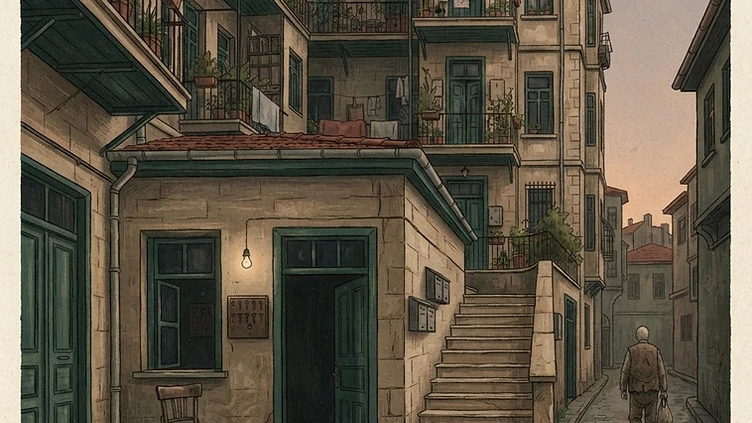
Passing through the stairwell of an apartment building today, we no longer make eye contact with anyone. That name, that voice we would search for when pressing the elevator button, standing before the mailbox, or even when we forgot our keys at midnight and found ourselves locked out, has slowly vanished. The profession we called the caretaker—sometimes renamed as the building staff, but now absent in most buildings—was not merely a job; it was a form of relationship. So, when this form of relationship disappeared, did that loose but real bond we call a neighborhood go with it, or did we simply achieve a more comfortable solitude? When I ask myself this question, I realize the answer is both yes and no; perhaps the core issue lies in that strange void between the two. ## The Man Holding the Keys In the apartment of my childhood, the caretaker was the official memory of the building. He knew who moved in when, who was late on rent, which apartment had a new baby, and which neighbor had not returned home for days. Although this knowledge sometimes turned into gossip, it was essentially a safety net; an invisible but constant early warning system. Before knocking on a door, one would ask the caretaker; when a repairman arrived, he would be notified; if an elderly neighbor had not collected their milk for three days, he was the first to notice. When I ask who performs this function today, no name comes to mind; because there is no single person gathering that information anymore. The knowledge is scattered, fragmented, and no one is responsible for it. The key in the caretaker's hand was not a technical detail; it was the physical embodiment of trust. When we handed him that key, we were essentially inviting someone into the most intimate corner of our home, but this invitation was not unreciprocated; he also felt a responsibility toward us. Now there is no one with whom we can build this relationship, because the institutional nature of modern services changes the personnel every year, sometimes every month. Commitment requires continuity, and continuity is no longer part of the definition of this job. Perhaps what we lost was not just a person, but a habit woven through time. ## When Cameras Replace Neighborliness Today, most apartment entrances have cameras, and some gated communities have uniformed security guards on duty. Technically, this seems safer; there are recordings, images, and evidence. But can we say this security replaces human familiarity? A camera does not know a stranger; it only records movement. The caretaker, however, knew a stranger because he knew their face, their voice, and their gait. There is a huge difference between someone being caught on camera and someone being recognized; one is data analyzed after the fact, the other is an instant intuition. Of course, someone might argue that cameras are more objective, that human memory is unreliable, and that a caretaker could be wrong or biased. This is true, but objectivity does not always produce trust. A camera does not notice that your neighbor hasn't gone out in three days because its duty is only to record, not to interpret. A security guard is not obliged to know the face of every resident individually, because their contract is limited to monitoring a specific area during specific hours. Thus, surveillance became functional but stripped of personality; there is an eye watching us, but no eye that knows us. This difference transforms into a chill that is not immediately noticeable in daily life but is felt in the long run. ## Gated Communities Have Divided the Neighborhood The transition from apartment caretakers to gated community security guards was not just a change in title; it also divided the space itself. In the old apartment building, the caretaker stood on the threshold between the street and the building; he would see the child going to the market, take the package left in his care, and greet the street vendor. A gated community, however, is an island turned inward; with a card reader at the entrance, walls all around, and its relationship with the outside world limited to a list in the security guard's hand. The permeable, messy, sometimes annoying but vibrant fabric we call a neighborhood turned into a sharp border with the rise of gated communities. This division is not only spatial but also deepened a class separation. Those living in the gated community began to see the outsider as a potential threat; because the security defined by the guard is merely about protecting those inside from those outside. In the old apartment, the caretaker knew the local shopkeepers and the children of the neighborhood; this familiarity created a kind of shared living space. Now, that partnership is melting away behind walls; neighborliness has come to mean people of the same socioeconomic profile living together, while the possibility of encountering the different has been reduced to a threat scenario watched by security cameras. Perhaps what we have lost most is the chance to encounter the different every day, in small and seemingly insignificant moments. The caretaker would sometimes bring us together on the same staircase with people we would never otherwise speak to; now, neither that staircase nor that meeting exists. Gated communities promised us security, but the price of this security was losing our habit of encountering difference daily. Neither cameras, nor security companies, nor building management software could fill the void left by the caretaker; because what they could not undertake was not a technical deficiency, but a human relationship. Perhaps the question we should ask is not whether we can bring this profession back, but whether we can reconstruct what it represented—the trust that works quietly within daily life—in another form. I do not know the answer to this question, but every day when I pass through the door and realize I have passed without making eye contact with anyone, I feel that this void is still there.
İlgili Denemeler
Hostile Architecture: Excluding Bodies in Public Spaces
In modern cities, a simple metal fixture added to benches silently exposes who public spaces are intended for and whose presence is systematically excluded.
The Third Place: Where Did Our Sense of Belonging Go?
Drawing on Ray Oldenburg's concept of the third place, this piece explores the societal cost of the vanishing communal spaces that once defined our daily lives.
Dunbar's Number: Why Are Our Social Connections Limited?
Robin Dunbar's discovery of the number 150 reveals that, even in the digital age, our seemingly infinite social circles are bound by strict biological limits.
Tartışma (0)
Henüz yorum yok. İlk yorumu siz yapın.
Join the Newsletter
New essays, once a week, delivered to your inbox.