Dunbar's Number: Why Are Our Social Connections Limited?
While social media promises thousands of connections, why is the number of genuine relationships the human brain can sustain still limited to a mere handful?
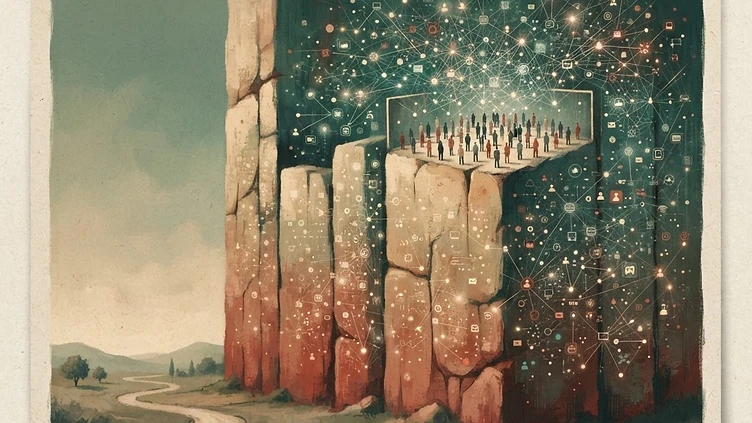
When I open my phone screen, a list of names reaching into the thousands appears before me; people who once shared a story, liked a photo, or perhaps just crossed my path because we happened to be in the same city for a day. While I should feel more connected as the number grows, the exact opposite occurs in a strange way. As names multiply, faces blur, voices blend together, and I sometimes have to look at profile photos just to remember who they are. Perhaps the real question is: how many people can we truly know, how many meaningful bonds can we form, and how many lives can we follow? The number put forward by Robin Dunbar years ago stands silently against the unlimited promises of our current screens, reminding us that biology has never kept pace with the speed of technology. ## The Boundary Drawn by the Cortex The British anthropologist Robin Dunbar noticed a striking pattern based on his observations of primates: the size of a species' neocortex determined the number of stable social relationships its individuals could maintain. While small-brained monkeys are limited to a few individuals, the human brain's massive cortex pushes this number higher, but not infinitely. According to Dunbar's calculations, this upper limit for humans rests at around one hundred and fifty; no more, no less. It is a frame drawn by the processing capacity of our minds. This number is not a random threshold; every relationship carries a genuine cognitive load, requiring us to remember who someone is, how they treat us, and who stood by us in certain moments. As we approach one hundred and fifty, our brain must remove one person to add another, as if there are a fixed number of seats in our minds and every new guest sends a previous one to the door. This is why, even as the number of people we know at school, work, or in our neighborhood increases, the number of people we truly trust or would call during a crisis remains surprisingly constant. I suspect we have all noticed this, perhaps when preparing a guest list or questioning why we haven't called an old friend we suddenly remembered. ## Three Thousand Friends, Five Confidants The follower counts on our social media accounts can reach thousands, sometimes tens of thousands; the number in the corner of the screen grows daily, giving us a sense of social abundance. Yet, the reality behind that figure is much simpler: the number of people who comment when we share a post, reply sincerely to a message, or make us feel comforted when we hear their voice on the phone is a very small fraction of those thousands. Dunbar's research shows that this core circle is layered: an innermost ring of five confidants, surrounded by a group of fifteen close friends, a wider circle of fifty acquaintances, and a broad network extending to one hundred and fifty at the outer edge. As the number grows outward, the intensity of the bond decreases in proportion. Some might object here, arguing that technology perhaps expands our brain's limits, functioning like a notebook that holds our memory externally, reminding us of birthdays and presenting old photos, thus helping us connect with more people. But there is a limit to this assistance, for remembering is one thing, while truly caring, setting aside time, and building mutual trust is another. An app reminding me of someone's birthday does not build emotional capital between us. For instance, I know a young entrepreneur with thousands of followers who receives dozens of messages every day, yet when he comes home in the evening, the number of people he calls or vents to is still limited to two or three. The screen grows, but the core remains unchanged; perhaps this is why the feeling of loneliness in the middle of a crowd is so prevalent. ## The Number Carried from Village to Army The most striking aspect of the Dunbar number is that it appears not only in individual relationships but also in the forms human communities have spontaneously taken throughout history. Huntinger-gatherer tribes, pre-agricultural villages, and even the basic combat units of modern armies have, in different eras and geographies, strangely reached similar sizes, clustering around an average of one hundred and fifty people. It is as if human society, without even knowing its own biological limit, sensed it and shaped its organization accordingly. This shows us that social structures arise more from the load our minds can bear than from top-down imposed rules. The picture that emerges when this limit is ignored is equally instructive: when a village population exceeds this threshold, people begin to act like two separate groups who do not know or trust each other, and most often, they effectively split. It is possible to look through the same frame to understand why growing companies, digital communities, or activist movements split into subgroups after a certain size, and why a shared sense of belonging dissipates into small factions. As the number grows, trust decreases; as trust decreases, the structure cracks; and a cracking structure tries to restore its former balance by dividing itself into smaller pieces. Perhaps the most painful truth the digital age teaches us is this: as our screens grow larger, our world does not shrink; it only changes which part of it we look at. As we navigate among thousands of connections, we still turn back to look at the same five, fifteen, or one hundred and fifty people, because our minds offer us no other option. Instead of seeing this as a deficiency, perhaps it is more accurate to accept it as a fundamental condition of being human. After all, every technology that grows with the promise of unlimited connection, while introducing us to a few more names, places the question of how many people we can truly carry before us again and again.
İlgili Denemeler
Doorman Culture: The Loss of Community in Cities
This essay explores how the erosion of the apartment caretaker profession has transformed urban neighborliness, trust, and the collective memory of the neighborhood.
Hostile Architecture: Excluding Bodies in Public Spaces
In modern cities, a simple metal fixture added to benches silently exposes who public spaces are intended for and whose presence is systematically excluded.
The Third Place: Where Did Our Sense of Belonging Go?
Drawing on Ray Oldenburg's concept of the third place, this piece explores the societal cost of the vanishing communal spaces that once defined our daily lives.
Tartışma (0)
Henüz yorum yok. İlk yorumu siz yapın.
Join the Newsletter
New essays, once a week, delivered to your inbox.