Universe 25: The Rise and Fall of Mouse Utopia
In a rodent community blessed with infinite food, water, and security, why did they engineer their own demise when scarcity was no longer a concern?
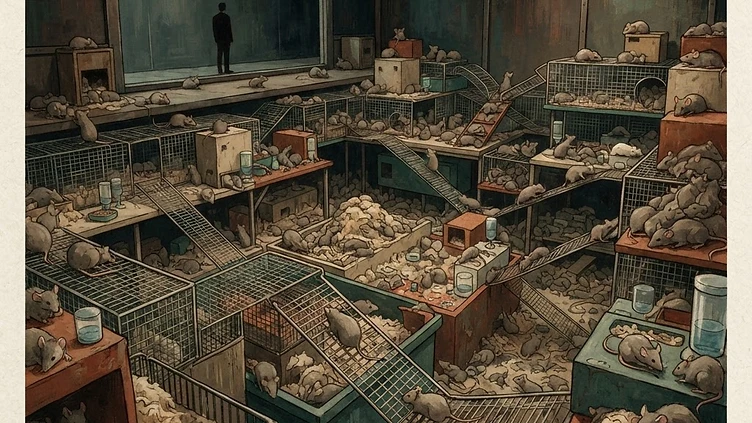
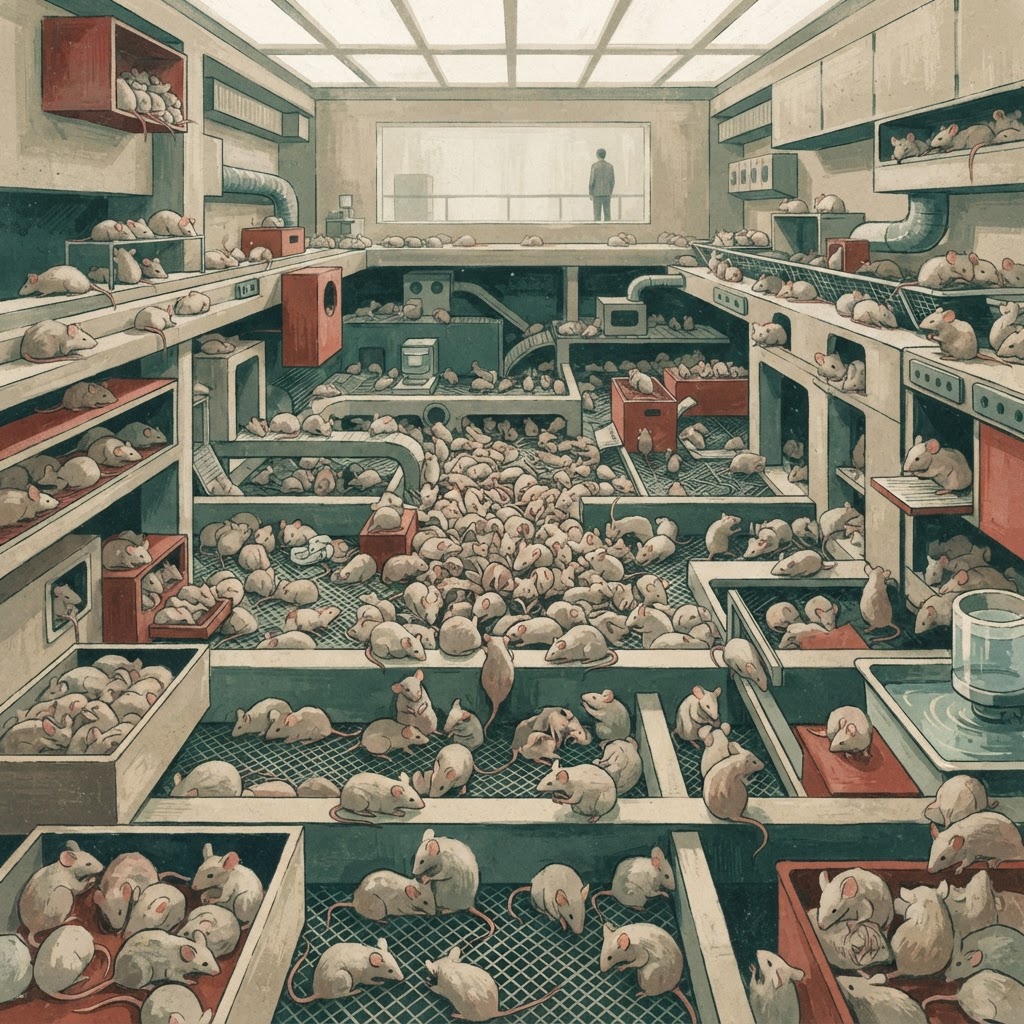
Imagine a cage with no walls and undefined boundaries, yet where every need of its inhabitants is met. Food is inexhaustible, water is constant, disease is nearly non-existent, and there are no predators or harsh temperatures. What would a society living in such a place do? Logic suggests they would grow, multiply, and thrive. However, in an experiment that began in 1968, exactly these conditions were provided, and the mice initially reproduced explosively, then suddenly stopped, and finally slowly destroyed themselves. It is a result that baffles us because it appears that abundance, not scarcity, prepared the end for a species. Psychologist John Calhoun’s experiment, named Universe 25, is still debated years later because the picture that emerged tells us more than a simple story of biology. The idea that a society could collapse even without resource shortages shakes the assumptions we hold about our own future. Perhaps the real issue was not survival, but the ability to find meaning, a role, and a place while surviving; Calhoun’s mice showed us this in a painful way. ## The Perfect Cage Calhoun’s arrangement differed from most population experiments of the time because the goal was not to measure the effects of scarcity, but to see how far a population could grow in an environment where scarcity was entirely absent. In this miniature world built inside a metal box, the mice were offered unlimited feed, constant clean water, climate-controlled air, and a disease-free environment. Founded with eight mice, the community multiplied rapidly as expected; the population reached hundreds and then thousands in a short time. Calhoun’s original expectation was that this increase would continue indefinitely as long as resources did not run out, because classical population theories assumed that the only obstacle to growth was scarcity. But when numbers reached a certain point, something unexpected happened: the reproductive rate began to decline even though resources remained abundant. Calhoun initially thought this was a measurement error, but the data persistently pointed in the same direction. While all physical needs were met, the social order of the mice was falling apart, meaningless conflicts between individuals were increasing, and some mice were becoming aggressive while others became completely passive. What emerged here was not a physical deficiency, but a limitation of space and social roles; the cage was not growing, but the population was, and this contradiction shook the foundation of everything. ## Behavioral Sink As the population grew, the daily life of the mice changed; it became nearly impossible for every individual to find a meaningful social role. In the wild, there were functions for a mouse such as building a nest, raising offspring, and establishing a place within a hierarchy, but the crowding became so intense that most of these roles disappeared. Some male mice became aggressive because they could no longer find a territory to defend, while others withdrew entirely from all social interaction into corners. Mother mice stopped caring for their young because they could not find a quiet area to protect them, and some offspring were left completely neglected. This was not just an individual deviation; it was the collapse of the community’s capacity to maintain its own functioning. One of Calhoun’s most notable observations concerned a group he later called the beautiful ones. These mice had completely detached from fighting, mating, and the struggle for hierarchy, becoming almost indifferent to the outside world and focusing only on their own grooming. They were physically healthy but socially exhausted; they were neither trying to reproduce nor interacting meaningfully with any other mouse. This picture showed that survival has a dimension beyond the physical body, as these mice were not dying from hunger or disease, but merely losing the sense of being part of a society. Over time, reproduction ceased entirely, the population aged, and the community approached its end from within, without any external threat. ## A Warning to Humanity? Since Universe 25 emerged, many interpretations have attempted to apply this experiment directly to human societies; topics like overcrowded cities, isolated individuals, and the loss of meaning are frequently mentioned alongside these mice. But one must be careful, as equating a mouse colony directly with human society ignores both the limits of the experiment and the complexity of human behavior. Unlike mice, humans can produce culture, construct meaning, and redefine their own social roles; this shows that the rigid repetition in Calhoun’s cage will not necessarily occur in the same way in human life. Still, acknowledging this difference does not mean that nothing the experiment says touches us. Because the real question Calhoun asked was not about the adequacy of resources, but about whether the individual felt like a part of a whole. In a society, everyone may be well-fed, and everyone may have a roof over their head, but if individuals can no longer connect to each other in a meaningful way, and if there is no role left for anyone to play, that society may still be standing, but it begins to hollow out from within. Today, many people speak of a strange sense of exhaustion while having no material lacks; though this does not exactly match the silent withdrawal we see in Calhoun’s mice, it brings a similar question to mind. Perhaps the real issue is not how much we possess, but how much we can remain connected to each other despite what we have. Calhoun’s cage closed a long time ago, the mice are long gone, but the question he asked seems to remain. Abundance alone is not enough to save a community, because surviving and living together in a meaningful way are not the same thing. Perhaps the most enduring mark Universe 25 left us is the reminder that the loss of connection, rather than the loss of resources, can be the beginning of an end; this remains a possibility worth considering for all of us in a world much larger than a cage of mice.
İlgili Denemeler
Can the Human Brain Detect Magnetic Fields?
Geophysicist Joseph Kirschvink's experiment at Caltech indicates that the human brain responds to magnetic fields, raising questions about a potential sixth sense.
Jan Hendrik Schön: The Physicist Who Fooled Science
The scandal of Jan Hendrik Schön's fabricated data at Bell Labs highlights the critical vulnerabilities in the scientific peer-review system.
Barry Marshall Drank Bacteria to Prove Stomach Ulcer Theory
Barry Marshall made medical history by consuming harmful bacteria to prove that stomach ulcers are caused by an infection rather than stress alone.
Tartışma (0)
Henüz yorum yok. İlk yorumu siz yapın.
Join the Newsletter
New essays, once a week, delivered to your inbox.