The Turing Test: The Hidden Philosophical Trap in Machine Thinking
Is the question posed by an article seventy years ago still unanswered today, or is it being asked incorrectly?
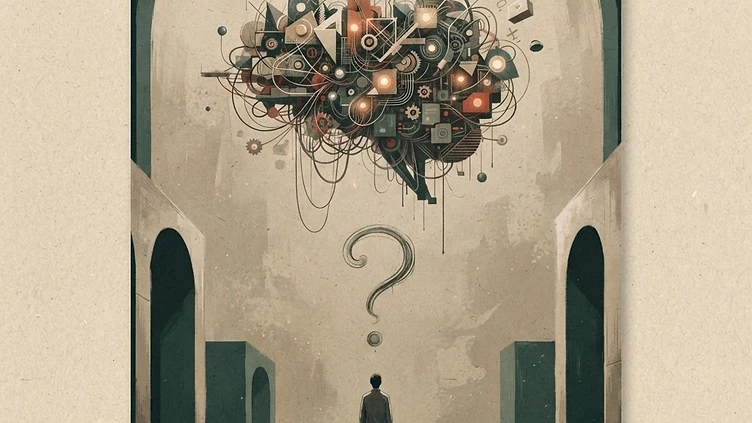
In 1950, Alan Turing posed a question that remains suspended in the air. In his article Computing Machinery and Intelligence, his query seemed simple: can machines think? Over seventy years have passed; computers are now in our pockets, talking, writing, painting, and sometimes filling the voids that make us feel lonely. Yet, the question persists, lingering with an unease that suggests it has been answered when it has not. Perhaps the real issue is not that the answer has failed to arrive, but that the question itself was formulated incorrectly from the start. Turing's cunning was as great as his intelligence; to make the question solvable, he transformed it into another, and seventy years later, we are still circling within the same trap. ## The Hidden Trick of the Imitation Game Instead of answering the question of whether machines can think directly, Turing chose a more cunning path: he set up a game. In this arrangement, which he called the imitation game, a human tries to determine whether their interlocutor behind a curtain is a human or a machine; if the machine can mimic a human well enough to deceive the other party, he considers it sufficient reason to count it as a thinking being. At first glance, this is a clever solution, as it suggests setting aside the question of what thinking is, a topic philosophy has struggled with for centuries, and focusing on measurable behavior. But there is a shift here: succeeding in imitation is not the same as thinking. A parrot can imitate the human voice and even use some words contextually, but no one claims the parrot is doing philosophy. The real trick lies here: the Turing test measures not the existence of thought, but the success of creating the impression of thought. A machine can learn to answer like a human, even making mistakes like a human, because this is also a pattern, and patterns can be learned. However, the question of whether an understanding or an intention is formed within that machine is never asked by the test, because the test relies on the judgment of an outside observer. Many people talking to AI systems today get the feeling that this thing seems to understand, but that feeling itself is not evidence; it is merely an indicator of how ready we are to be imitated. Turing invented an easier question to replace his original one, and we are still using the answer to that easier question as if it were the answer to the original. ## The Trap of the Word Thinking Why did Turing take such a path? Because the word thinking is one of the most slippery terms in philosophy, and no one has been able to produce a definition upon which all can agree. Descartes's I think, therefore I am established thinking as proof of existence, but even that sentence does not explain what thinking is; it only points to the fact that something exists. Is a person thinking while solving a math problem, or is the inexplicable chill one feels while reading a poem also a form of thinking? Is dreaming thinking, or just a nervous discharge? The answers to these questions change so much depending on who is asked that seeking a common definition is almost like spinning one's wheels. This slipperiness is the root that makes the machine intelligence debate unsolvable. If we do not know what thinking is, how will we know whether a machine thinks? It is like trying to decide whether something is heavy or light without using a scale; we have no unit of measurement, only our intuitions. Some equate thinking with consciousness, others with problem-solving skills, and others with the capacity for emotional response. Each definition paints a picture of machine intelligence to suit its own side; if you choose the definition of consciousness, no machine can think, but if you choose problem-solving, many programs are already considered to be thinking. Turing avoided this ambiguity by excluding the word entirely, but doing so was not solving the problem; it was sweeping it under the rug. ## Is the Question Still the Right One? Looking back today after seventy years, the path technology has taken is astonishing, but what is not astonishing is that the question remains in place. Computers now defeat chess champions, generate language, create art, and compose music; they process data at a speed and variety unimaginable in Turing's time. But this progress has not moved the question forward by an inch, because what is needed for the question to advance is not technology, but conceptual clarity. Technology continued on its path without waiting for the question to be resolved, leaving us alone with the old version of it. Perhaps the question that should be asked now is something entirely different. The only thing that has changed over seventy years is not just machines; man's own definition of thinking has also silently shifted. A century ago, thinking was equated with logic and abstract reasoning; today, we more easily accept that a system can be thought of as thinking if it appears creative or empathetic. Could the reason for this shift be that machines are moving closer to us, but that our standards are loosening? Fifty years ago, a child doing homework with a calculator was considered cheating; today, it does not seem strange to us at all. This shows that our definition of thinking is not fixed by technology but is stretching along with it. This demonstrates that perhaps Turing's question was never about machines; it was always about humans, and we have spent seventy years looking at the wrong subject. There is a third possibility, perhaps the most unsettling one: the question may not be unsolvable, but simply unwanted to be solved. Because creating a clear definition of thinking carries the risk of reducing humans to machines; if thinking is a measurable process, the human mind cannot escape being an algorithm in the end. Faced with this possibility, some thinkers have deliberately chosen to maintain the ambiguity, because ambiguity leaves a special space for humans, and undefinability becomes a sanctuary. This may be why the Turing test is still debated so much, because a clear answer is not something anyone truly wants, neither for machines nor for humans. Perhaps Turing's question was never asked to be answered; it was asked to continue being asked. Each generation takes that question up again with its own technology, reinterprets it, sets up a new imitation game, and eventually falls into the same void. The strange intimacy we feel when chatting with an AI today may not be proof that we are approaching an answer, but proof of how the question still haunts us. The question Turing left hanging in the air is still there seventy years later, but what it shows us now is not the limits of machines, but how loose, variable, and human our own definitions truly are.
İlgili Denemeler
Can the Human Brain Detect Magnetic Fields?
Geophysicist Joseph Kirschvink's experiment at Caltech indicates that the human brain responds to magnetic fields, raising questions about a potential sixth sense.
Jan Hendrik Schön: The Physicist Who Fooled Science
The scandal of Jan Hendrik Schön's fabricated data at Bell Labs highlights the critical vulnerabilities in the scientific peer-review system.
Barry Marshall Drank Bacteria to Prove Stomach Ulcer Theory
Barry Marshall made medical history by consuming harmful bacteria to prove that stomach ulcers are caused by an infection rather than stress alone.
Tartışma (0)
Henüz yorum yok. İlk yorumu siz yapın.
Join the Newsletter
New essays, once a week, delivered to your inbox.