The Tunguska Event: An Unsolved Siberian Mystery
Whether caused by an asteroid or a comet, this explosion has left the scientific community divided for over a century.
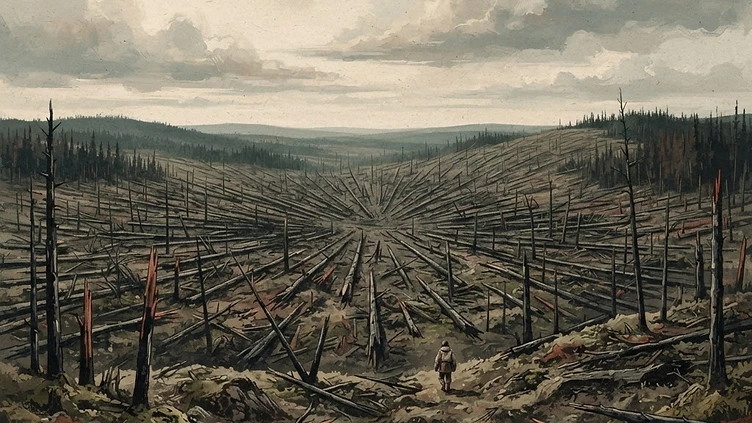
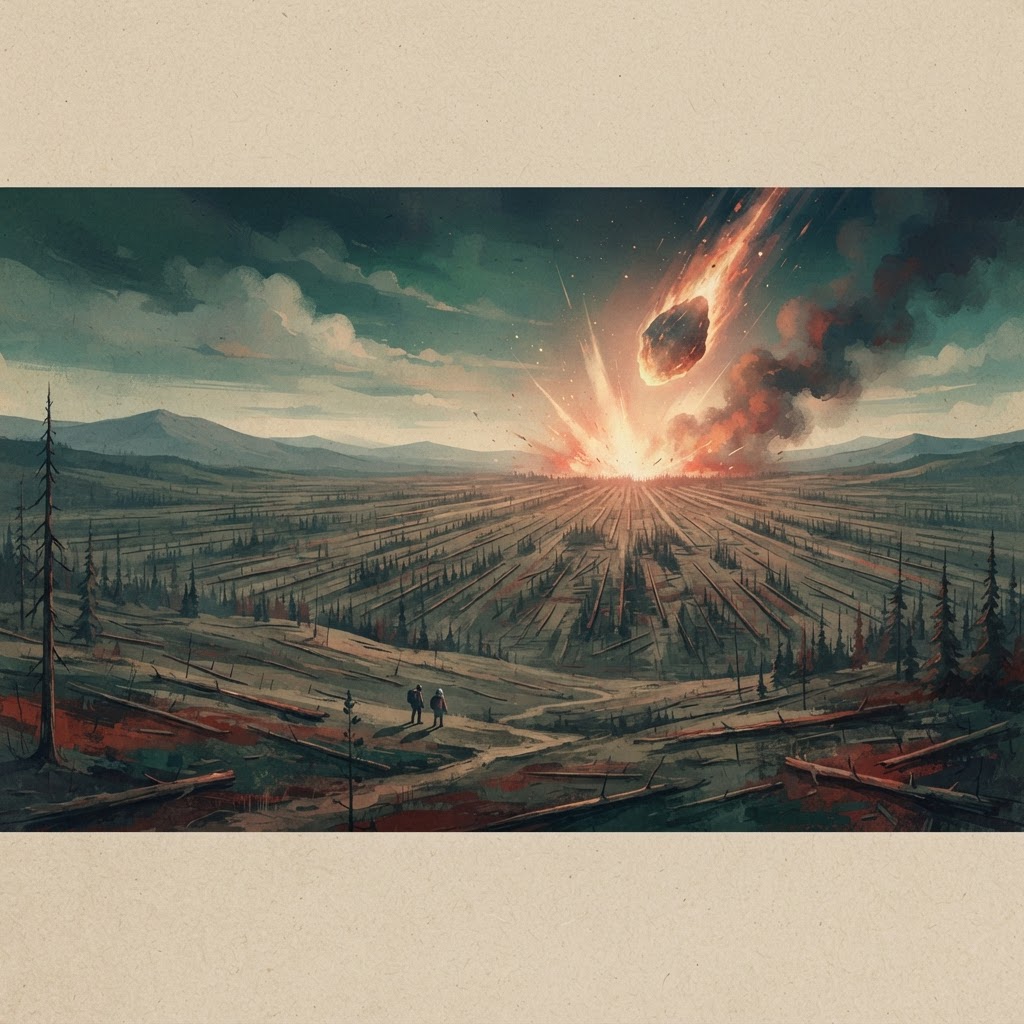
In the heart of Siberia, in a forest where human footprints were a rarity, a light brighter than the sun appeared one morning, followed by a sound heard hundreds of kilometers away. On that day, June 30, 1908, one of the most bizarre natural phenomena in human history occurred; its strangeness lay not in the magnitude of the blast, but in the lack of any trace left behind. When a meteorite strikes, we expect to find a crater, do we not? Yet, at Tunguska, there is no such hole. There are only millions of fallen trees, a scorched forest, and a question that has eluded the scientific community for over a century. In this piece, we will dissect this mystery, as sometimes the enigma of an event becomes more compelling than the event itself.## What Happened in Siberia in 1908?On that morning near the Podkamennaya Tunguska River, several local settlers reported seeing a massive fireball in the sky. The subsequent shock wave shattered windows hundreds of kilometers away, knocked people to the ground, and leveled thousands of square kilometers of taiga forest in seconds. The trees were toppled in a fan-like pattern away from the center of the blast; it was as if an invisible hand descending from the heavens had gripped the forest and flung it aside. This sight astonished researchers who reached the region years later, as such orderly destruction is rarely encountered in nature.The truly baffling aspect emerged during the expeditions led by Russian scientist Leonid Kulik in the 1920s. Kulik searched for the crater—the logical result of a meteorite impact—but found none. There was no hole in the ground, no metallic fragments, and no expected remnants. This turned the event from an ordinary meteor strike into a complete riddle. If something fell from the sky, where did it go? How could an object that vanished in the air, without striking the ground, cause such immense destruction? These questions transformed Tunguska from a mere natural event into a century-long object of curiosity.## Why Is There Still No Definitive Explanation?The theory most supported by the scientific community is that an asteroid or comet fragment entered the atmosphere and exploded at a low altitude without touching the ground. This is known as an air burst—a scenario where the object fragments and releases its energy in the air due to atmospheric friction and pressure. While this explanation sounds plausible, the failure to find the expected amount of cosmic debris prevents the theory from being fully proven. If an asteroid had shattered in the air, small particles should have been scattered across the soil, but the traces found do not fully meet this expectation.The comet theory is attractive from a different perspective, as an object made of ice and dust could vaporize in the atmosphere much more easily without leaving traces. However, this theory also has its dilemmas, particularly in reconciling the energy produced by the blast with the scale of the observed destruction. Some researchers propose the possibility of an object of different size and entry angle, while others have opened the door to entirely alternative scenarios, such as subterranean gas explosions. The existence of so many theories is the clearest indicator of how uncertain science is on this matter. If a single explanation sufficed, we would not still be having this debate today.One must also ask: why have we not solved a seemingly simple question in a century? The answer lies partly in geography. Tunguska is a remote, difficult-to-access region; the first serious scientific expedition could only occur nineteen years after the event. Over that time, wind, snow, rain, and vegetation may have largely erased the evidence, if it ever existed. Thus, the evidence at hand consists not of the event itself, but of its faint echoes, making every theory simultaneously possible and incomplete.## Why Does Tunguska Matter Today?Viewing Tunguska merely as a strange story from the past would mean missing the crux of the matter. This event serves as the first major warning of how vulnerable humanity is to celestial objects. If a blast of similar magnitude had occurred over a populated city instead of a deserted Siberian forest, the consequences would have been severe enough to alter the course of history. This awareness has directly contributed to the establishment of modern planetary defense programs monitoring celestial objects since the second half of the twentieth century.The meteor that exploded over Chelyabinsk in 2013 was a painful reminder that this threat remains current. That event was on a much smaller scale than Tunguska, yet thousands of buildings were damaged and hundreds of people were injured. Such examples show scientists clearly: the sky is not as quiet and safe as we thought. Today, space agencies track thousands of near-Earth objects, model potential collision scenarios, and even test technologies to deflect them. At the root of all these efforts lies that mysterious, still-ununderstood event that exploded in the middle of Siberia a century ago.## ConclusionPerhaps the most striking thing Tunguska teaches us is that it shakes our comfortable belief that science can explain everything. For over a century, the brightest minds have dissected this event, generated theories, and combed the soil with their own hands, yet there is still no clear answer. This is not a failure of science, but rather its honesty; instead of forcing existing evidence to produce a false certainty, it chooses to leave the question open. Perhaps the true value of Tunguska is that it reminds us of how unpredictable the cosmos remains and that the childlike curiosity we feel when looking at the sky is entirely justified.
İlgili Denemeler
Can the Human Brain Detect Magnetic Fields?
Geophysicist Joseph Kirschvink's experiment at Caltech indicates that the human brain responds to magnetic fields, raising questions about a potential sixth sense.
Jan Hendrik Schön: The Physicist Who Fooled Science
The scandal of Jan Hendrik Schön's fabricated data at Bell Labs highlights the critical vulnerabilities in the scientific peer-review system.
Barry Marshall Drank Bacteria to Prove Stomach Ulcer Theory
Barry Marshall made medical history by consuming harmful bacteria to prove that stomach ulcers are caused by an infection rather than stress alone.
Tartışma (0)
Henüz yorum yok. İlk yorumu siz yapın.
Join the Newsletter
New essays, once a week, delivered to your inbox.