Trofim Lysenko: How a Scientist Destroyed Soviet Genetics
The fraudulent theories of an agronomist backed by Stalin banned genetics, ruined the careers of thousands of scientists, and devastated millions of lives.
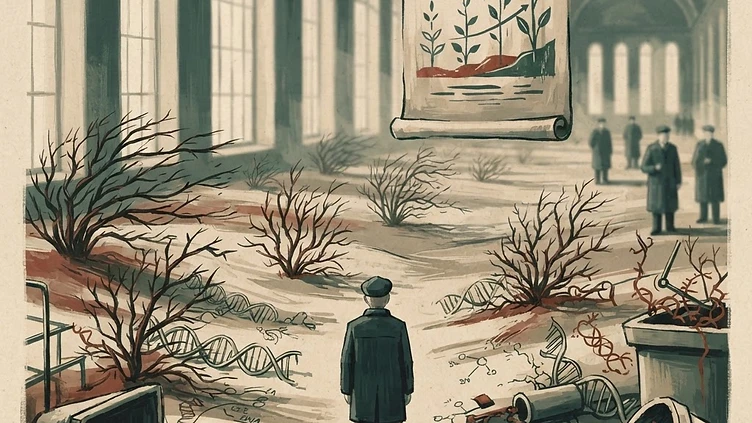
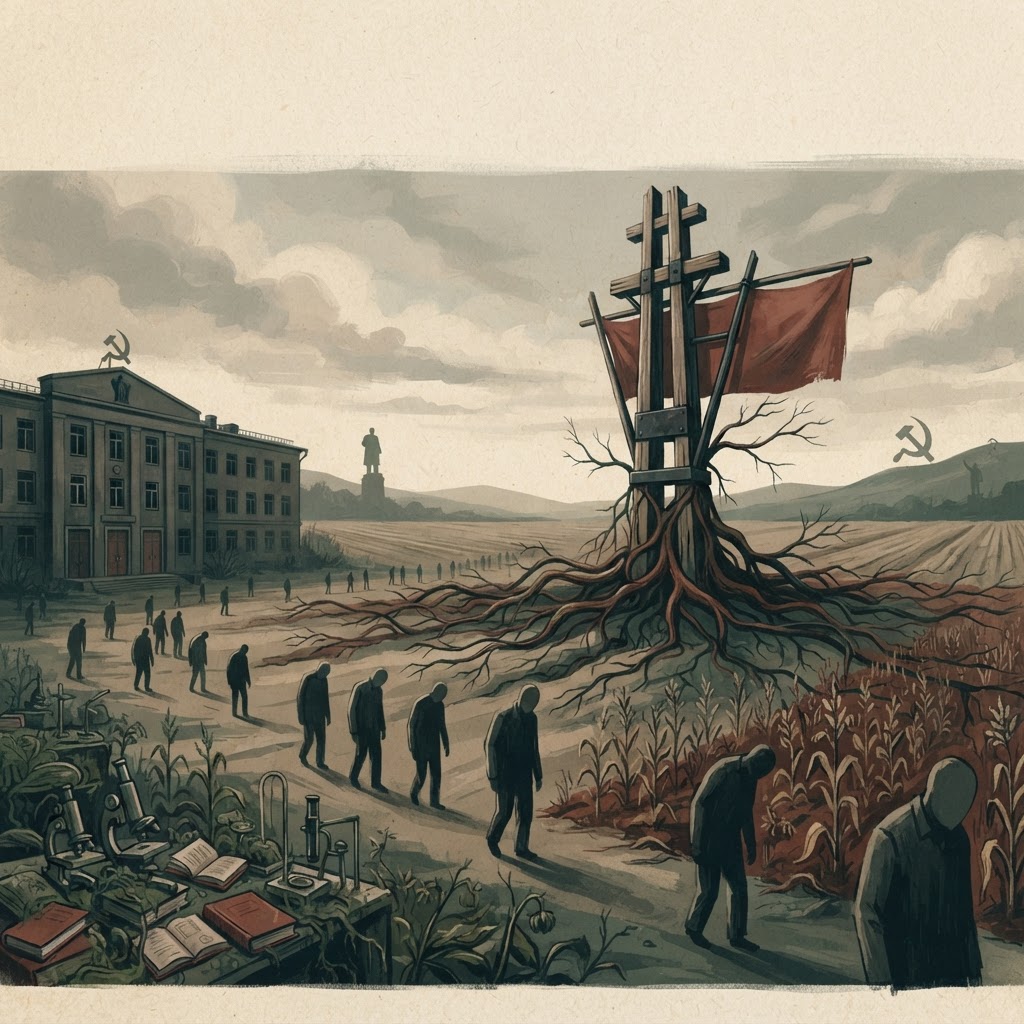
It is chilling to contemplate that a lie can persist for half a century, especially when tied to the sustenance of millions. The story of Trofim Lysenko illustrates precisely this: can a reality be constructed that is determined not by scientific evidence, but by ideological desire? For over thirty years in the Soviet Union, the answer was yes, giving rise to one of the most painful lessons in the history of science and a harrowing example of how power can distort the truth. Lysenko’s name is remembered today as a stain on the history of genetics, but his true legacy serves as a warning of what becomes possible when science is surrendered to politics. ## The Lie of Acquired Characteristics Lysenko’s central claim was that characteristics acquired by an organism during its lifetime could be directly and rapidly inherited. If you expose a plant to cold, its seeds would carry that resilience; if you alter environmental conditions, you alter heredity. This assertion was a resurrection of a nineteenth-century idea proposed by Lamarck, which had long been scientifically discarded. At a time when Mendelian genetics and the chromosome theory were supported by increasingly robust evidence, Lysenko ignored this body of knowledge and grounded his thesis not in the microscope, but in political discourse. Why? Because the inheritance of acquired characteristics aligned perfectly with the promises of Soviet ideology: both humans and nature could be rapidly transformed if the right conditions were provided. Genetics, however, argued the exact opposite; traits were inherited through slow, random mutations over generations, establishing a deterministic limit. For a regime, admitting that nature was so stubborn and slow would mean acknowledging the limits of its own promises. What is interesting is that Lysenko presented this not merely as a political ploy, but as a truth he genuinely believed. He repeated his experiments until they yielded the desired result, ignored those that failed, and turned a single piece of positive data into a general law. This was the exact opposite of the scientific method: instead of testing a hypothesis, he sought data to confirm it. One might wonder: perhaps the scientific tools of the era were insufficient, or perhaps Lysenko was truly misunderstood? But no, even among his contemporaries, there were serious Soviet scientists who followed the genetic consensus and clearly saw the inconsistency of Lysenko’s claims. The issue was not a lack of knowledge; the issue was the clash between knowledge and power. ## A Dictator’s Choice of Science Stalin’s support for Lysenko was no coincidence; on the contrary, it was a highly calculated choice. Soviet agriculture was in severe crisis following the collectivization policies of the 1930s, famine was imminent, and the regime demanded quick, visible solutions. Lysenko promised to transform crops within a few years—a much more appealing rhetoric than the slow, cautious breeding programs proposed by geneticists. Moreover, Lysenko’s theory could easily be paired with Marxist dialectical materialism: nature, like history, could be rapidly reshaped by human intervention. This alignment provided Lysenko with not just a scientific platform, but a political shield. Criticizing him was no longer a matter of scientific debate, but an opposition to the party line. The most painful result of this shield is seen in the fate of Nikolai Vavilov. Vavilov was a world-renowned plant geneticist who had collected thousands of seed samples and established the foundations of scientific breeding on solid data. With the rise of Lysenko, Vavilov’s position became increasingly dangerous; every principle of genetics was now branded as bourgeois heresy. Vavilov was arrested and died in prison, witnessing his own field of expertise effectively erased from Soviet science. What happened to him was not an isolated case; many researchers interested in genetics were removed from their posts, some were sent to labor camps, and others were forced to abandon their careers in silence. In a system where an entire scientific discipline could be banned, speaking the truth was no longer a matter of courage, but of survival. The question to be asked here is: is an idea considered true simply because power stands behind it? The example of Lysenko demonstrates, quite painfully, that the answer can be yes, at least for a time. ## Disaster Spilling from the Lab to the Field If Lysenko’s theories had remained in the laboratory, they might today be merely an interesting footnote in the history of science. Instead, these theories were directly translated into agricultural policy and applied across millions of hectares of arable land. Methods such as "training" seeds by exposing them to specific temperatures and moisture, or planting crops in tight clusters to increase yield, were based on assumptions with no scientific foundation and failed repeatedly in the field. But failure did not shake Lysenko’s position; on the contrary, failures were often presented as the fault of local practitioners, and the theory itself was never questioned. This is the most dangerous characteristic of ideological science: it lacks a self-correcting mechanism because every failure is discarded to preserve the purity of the theory. The result was a decades-long agricultural stagnation. Despite having some of the world's largest farmland, the Soviet Union experienced periods where it had to import grain; this was an indirect result of a science policy shaped by Lysenko’s influence. An even deeper loss was the wasted time: while genetics in the rest of the world evolved into molecular biology, Soviet science remained largely closed off from this transformation. Even when Lysenko’s influence officially ended, filling the void left behind was not easy; a generation of scientists had been severed from the global scientific flow and had to make an extra effort to reconnect. Looking at this story today, the question we must ask is not just "how could Lysenko go so far," but also "is a similar dynamic, in a different form, possible today?" We know science cannot be completely isolated from politics, but the moment politics begins to dictate not just the consequences of science but its very methods, we arrive at the brink of danger. Lysenko’s story cannot simply be reduced to a narrative of a "bad scientist"; he was a figure produced by a system, and one who fed that system. In any environment where reality is accepted because it suits the needs of power, a similar Lysenko can emerge; the difference might only be in scale and form. Thus, remembering this story is not merely a matter of historical curiosity, but a constant reminder of the fragility of science and how delicate the institutions that protect it truly are. The endeavor to seek the truth is tested most severely when those who do not want to hear it hold the power; the destruction experienced by Soviet genetics shows just how heavily that test can be failed.
İlgili Denemeler
Can the Human Brain Detect Magnetic Fields?
Geophysicist Joseph Kirschvink's experiment at Caltech indicates that the human brain responds to magnetic fields, raising questions about a potential sixth sense.
Jan Hendrik Schön: The Physicist Who Fooled Science
The scandal of Jan Hendrik Schön's fabricated data at Bell Labs highlights the critical vulnerabilities in the scientific peer-review system.
Barry Marshall Drank Bacteria to Prove Stomach Ulcer Theory
Barry Marshall made medical history by consuming harmful bacteria to prove that stomach ulcers are caused by an infection rather than stress alone.
Tartışma (0)
Henüz yorum yok. İlk yorumu siz yapın.
Join the Newsletter
New essays, once a week, delivered to your inbox.