Thwaites Glacier: Why is the Doomsday Glacier Melting?
As the world's fastest-melting glacier, its potential collapse alone could raise sea levels by several meters.
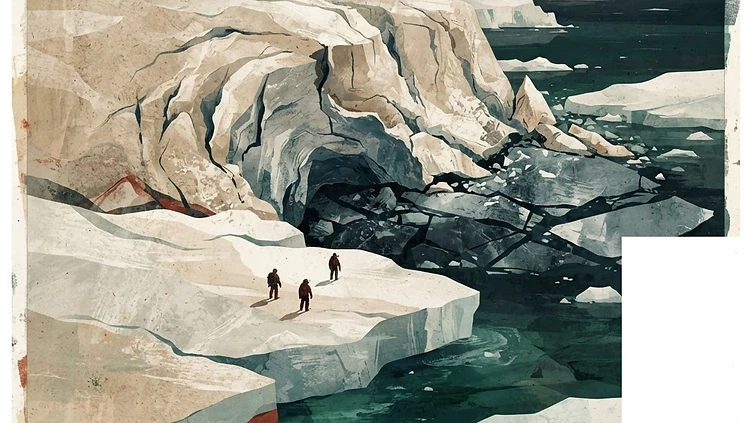
Ice has always been a symbol of stillness, patience, and even immortality in the human mind. Yet, in West Antarctica, a glacier named Thwaites is overturning this calm imagery. This mass, which scientists have been monitoring for years, is melting not slowly, but with a sense of urgency. Moreover, this is not merely a regional event; it is an issue concerning the future of coastal cities across the globe. The story of Thwaites actually reveals that strange threshold where human efforts to measure nature encounter the limits of knowledge.
The Origin of the Doomsday Glacier Label
Calling a glacier doomsday may seem like journalistic hyperbole at first glance. But in the case of Thwaites, this moniker is confirmed by the cold language of scientific data. The glacier is roughly the size of Great Britain; if it were to collapse on its own, it holds enough water to raise global sea levels by up to sixty-five centimeters. The number may sound cold, but consider this: many of the world's major cities are built only a few meters above the coastline. Sixty-five centimeters means water entering the doorsteps of homes in some places.
The truly terrifying aspect is that Thwaites is not alone, but rather the first link in a chain. The collapse of the glacier could destabilize other surrounding ice masses; scientists refer to this possibility as chain-reaction disintegration. If this scenario unfolds, the total impact could result in a sea-level rise measured in meters. The interesting part here is that while Thwaites itself might not raise sea levels significantly on its own, it could act as a domino triggering its neighbors. Thus, the doomsday label stems not from the glacier's own mass, but from the potential chain reaction it might trigger.
The Real Threat Is Not on the Surface, but Below
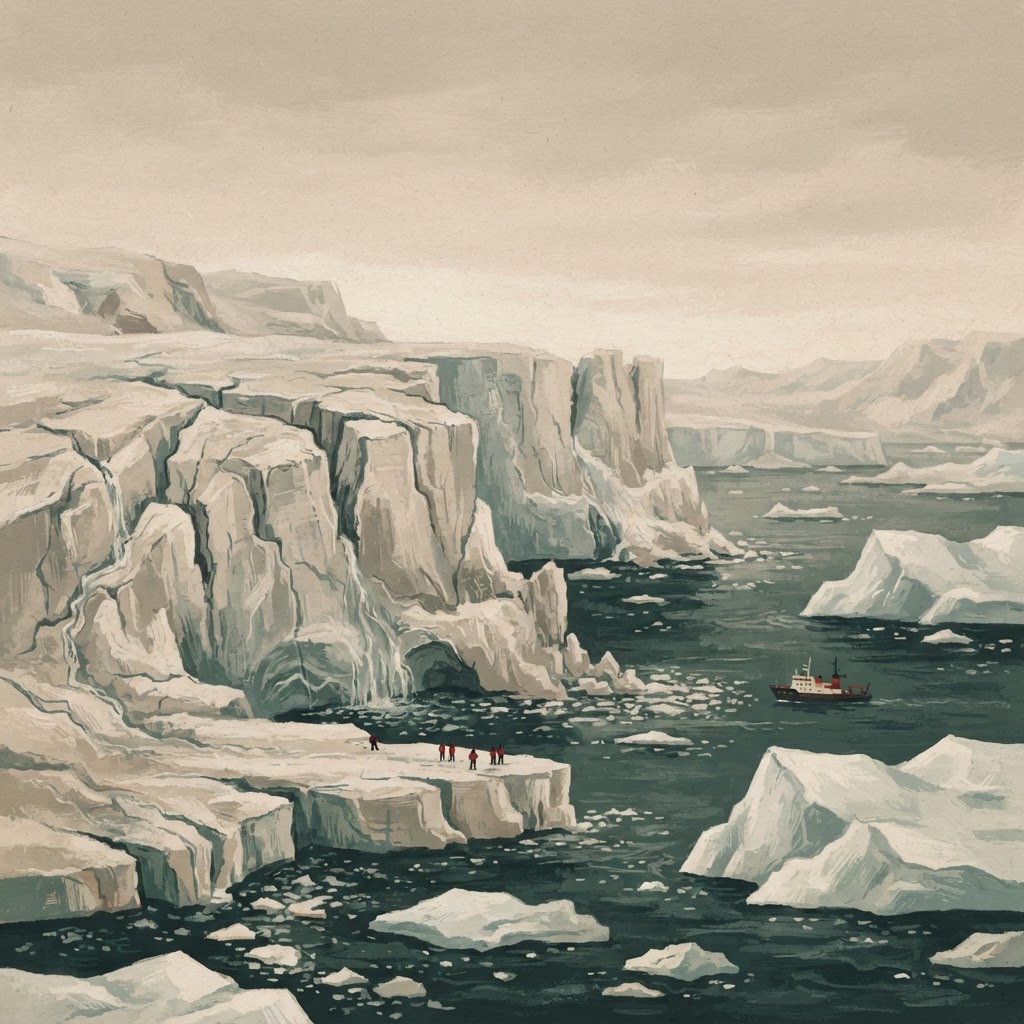
Human intuition trusts what it sees. When we think of a glacier melting, we imagine a surface glistening and dripping under the sun. But the real drama at Thwaites occurs in a layer hidden from sight. The base of the glacier is constantly washed by water currents coming from the deep ocean that are warmer than normal. This warm water carves the ice from below, much like destroying the foundation of a building from the inside without ever touching its walls.
This basal erosion is far more dangerous than surface melting because it cannot be tracked by eye. You can see a crack in a building's roof, but you need special tools to notice the decay in its foundation. The situation at Thwaites is similar: scientists are trying to reach the glacier's base using underwater robots and remote sensing techniques. This makes the process both technically difficult and risky in terms of interpretation, as estimating how fast something hidden progresses carries much more uncertainty than measuring what is visible.
One might counter-argue here that if the melting is at the base rather than the surface, perhaps its effect remains limited. But reality points in the opposite direction. The base of the glacier is also the part that connects it to the rocky ground and holds it in place. When this connection weakens, the glacier slides faster and flows into the ocean more quickly. Therefore, what is invisible becomes more decisive than what is visible; the true source of danger is hidden in those very depths that escape our view.
Why Science Cannot Provide a Definite Date
When faced with a danger, humans first want to ask when. This is the question on everyone's mind for Thwaites as well: exactly when will the glacier collapse? But the answer scientists provide is not a comforting date, but a range; a wide band of uncertainty that sometimes spans decades. This is not due to a failure of science, but the complexity of nature. Factors such as the rock structure at the base of the glacier, the variability of ocean currents, and even seasonal wind patterns intermingle, making it almost impossible to provide a clear date.
There is an interesting tension here: measurement technology has improved incredibly, with satellites now recording even millimeter-scale movements on the glacier's surface. Yet, this wealth of data does not strangely increase certainty; on the contrary, it shows more strikingly how complex the system is. It is as if you can measure a patient's pulse thousands of times a second but still cannot predict when the illness will progress. Modern climate science is experiencing that exact strange gap between its power to measure and its power to predict.
This uncertainty may be seen by some as an excuse for inaction; one might think why worry now if there is no definite date yet. But uncertainty does not mean the absence of danger; rather, it indicates that we need to be better prepared for something whose arrival time we do not know. A similar logic exists in seismology: not knowing when a fault will break does not mean that fault is harmless. In the case of Thwaites, the uncertainty is precisely what makes it terrifying; because once the threshold is crossed, there is no turning back, but no one can say exactly where that threshold lies.
Thwaites' story reminds us that nature does not conform to human perception of time. We are accustomed to thinking in terms of calendars, deadlines, and clear answers; yet the glacier moves to its own rhythm, independent of the clarity humanity expects. Perhaps the real lesson is how to live at peace with this uncertainty itself. For what the doomsday glacier teaches us is not just a story of melting, but what it means to remain cautious even while accepting the limits of knowledge.
İlgili Denemeler
Can the Human Brain Detect Magnetic Fields?
Geophysicist Joseph Kirschvink's experiment at Caltech indicates that the human brain responds to magnetic fields, raising questions about a potential sixth sense.
Jan Hendrik Schön: The Physicist Who Fooled Science
The scandal of Jan Hendrik Schön's fabricated data at Bell Labs highlights the critical vulnerabilities in the scientific peer-review system.
Barry Marshall Drank Bacteria to Prove Stomach Ulcer Theory
Barry Marshall made medical history by consuming harmful bacteria to prove that stomach ulcers are caused by an infection rather than stress alone.
Tartışma (0)
Henüz yorum yok. İlk yorumu siz yapın.
Join the Newsletter
New essays, once a week, delivered to your inbox.