Thomas Midgley: The Man Who Harmed the Planet
The ironic legacy of the man who invented leaded gasoline and the ozone-depleting CFCs in the history of science.

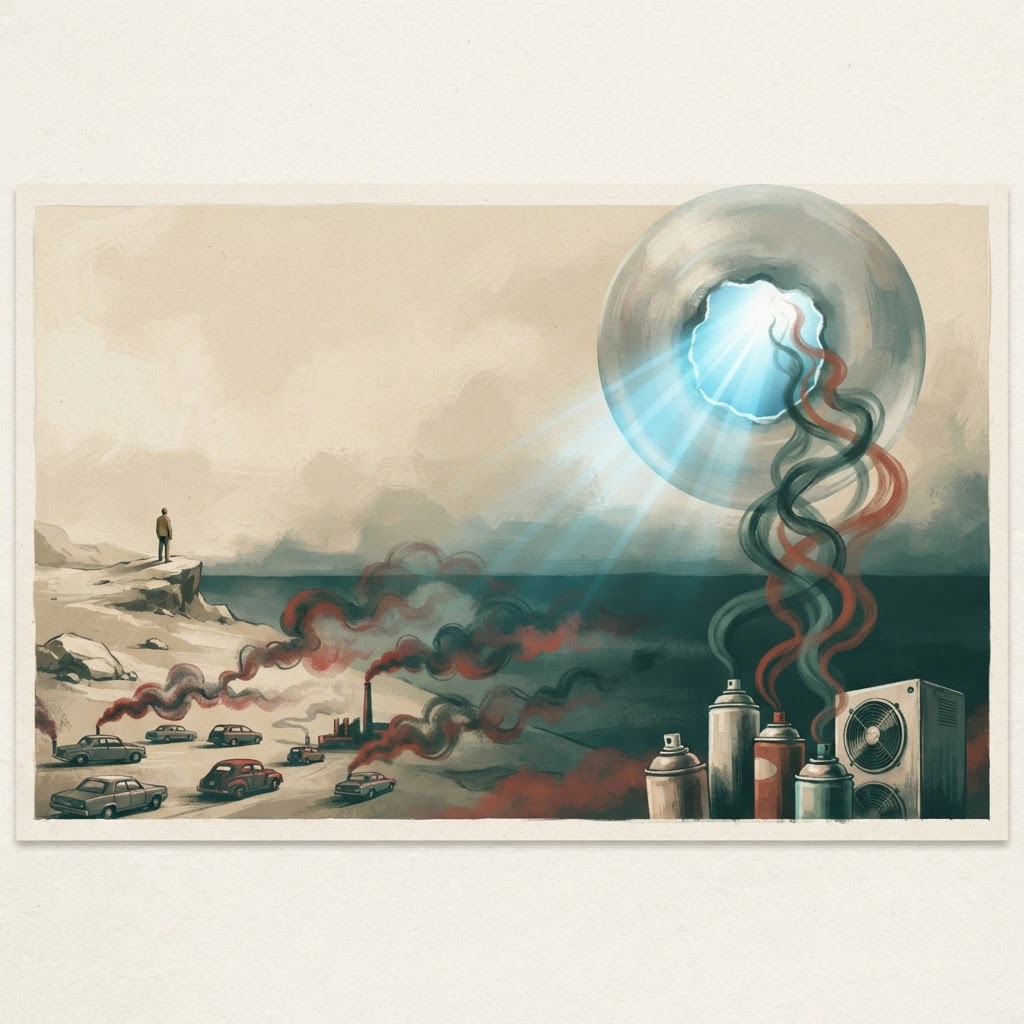
If you were to ask if there is any other scientist in human history whose inventions poisoned millions and then pierced the planet's protective layer, the answer points to a single, surprising name: Thomas Midgley. As a chemist, he achieved two of the most brilliant engineering triumphs of the twentieth century, yet each of these victories later went down in history as a catastrophe. His story is perhaps the most striking example of how science, setting out with good intentions, can drift so far in the wrong direction. How, then, can a person manage to cause such great harm to the world, all while being applauded at every turn? ## Leaded Gasoline: A Clever Solution, A Silent Disaster In the early 1920s, the most annoying problem for the automotive industry was that strange, metallic knocking sound engines made while running. Engineers knew this sound was caused by the fuel burning prematurely and irregularly in the engine, but finding a solution was not easy. Midgley, working at General Motors, found an answer after long efforts: tetraethyl lead. This compound added to gasoline almost magically eliminated engine knocking. For the company, this was a massive success in both technical and commercial terms; Midgley became the apple of the industry's eye overnight. However, there was a hidden price for this victory. Lead is a heavy metal that damages the nervous system when it enters the human body and can impair intellectual development, especially in children. Even Midgley himself was poisoned during the production of tetraethyl lead, received long-term treatment, and went to great lengths to perform a demonstration to the public to prove the substance was safe. Yet, factory workers were dying, and some were falling ill and losing their sanity. The company chose to cover up this reality because there was both a patent and a market worth millions of dollars at stake. The result was a silent contamination that would last for decades. Leaded gasoline was used all over the world, and lead particles scattered from exhaust pipes mixed into the soil and water of cities and into the blood of people. Scientists only understood the extent of this damage years later by examining lead levels in bones and blood. We know today that this single additive turned into one of the greatest public health scandals of the century; yet, in the beginning, it was just a small solution to silence an engine. ## CFC Gases: The Safe Face of Cooling, The Secret Enemy of the Atmosphere While debates over leaded gasoline were still fresh, Midgley found himself faced with a new problem. The refrigerant gases used in refrigerators at the time, such as ammonia and sulfur dioxide, were both toxic and explosive, leading to serious accidents in homes. Midgley was asked to find an alternative that could replace these dangerous gases without harming humans. In a short time, he developed chlorofluorocarbons, or CFCs. These gases were non-flammable, non-toxic, and odorless; furthermore, they were chemically extremely stable. When Midgley gave a demonstration to prove this, he inhaled the gas directly and extinguished a candle flame, offering tangible proof of safety to the scientists who watched the hall in awe. CFCs were indeed revolutionary in terms of human health; there was no doubt about that. Refrigerators could now be used safely in homes, and subsequently, they became widespread in air conditioners, spray cans, and foam production. But the real danger of these gases was not to the human body, but to the upper layers of the atmosphere, and it took nearly half a century for this fact to emerge. Their stability—that is, their ability to exist for a long time without breaking down—returned as their greatest flaw: CFC molecules released into the atmosphere rose for years, finally reaching the stratosphere, where they were broken down by the effect of sunlight, releasing free chlorine atoms. These chlorine atoms initiated a chain reaction that destroyed ozone molecules. When scientists in the 1970s noticed a serious thinning of the ozone layer over Antarctica, they began to investigate the source of the problem, and as they followed the trail, they kept encountering the same class of chemicals. The gas Midgley presented as a symbol of safety was actually piercing the planet's protective shield against harmful ultraviolet rays from the sun. This discovery turned into a global alarm, as the thinning of the ozone layer could trigger many consequences, from increased skin cancer rates to reduced agricultural yields. The solution Midgley found to make human life easier was now threatening the very planet humanity inhabited. ## The Limits of Scientific Good Intentions: Why Couldn't Anyone Stop Midgley? We need to pause here and ask: Was Midgley a malicious man? No, on the contrary, in both of his inventions, he was trying to solve a real problem, and he did so quite successfully with the knowledge of the time. The problem was not his intentions, but the way science and industry operated at the time. When a new substance was launched, the question asked was usually: Does this solve the current problem? But the unasked question was far more important: How will this solution affect which systems decades later? The effect of lead on the nervous system and CFCs on the atmosphere was not something that could be seen with the measurement tools of that era; these risks only emerged over time, sometimes in tragic ways. A counter-argument might come to mind here: perhaps the history of technology always works this way, every innovation provides a benefit first and then brings an unexpected cost; this is an inevitable cycle. But the Midgley example does not fully confirm this view because there are moments here where corporate profit motives suppressed known risks and ignored warning signs. The fact that the company gave public assurances while workers were dying from leaded gasoline shows that this was not just a result of a lack of knowledge, but of a conscious choice. So, the issue is not just the limits of science, but how science creates blind spots when combined with economic interests. Midgley may not have seen the long-term results of his own invention, but the institutions that could have stopped him did everything they could to avoid noticing these results. The end of Midgley's own life adds a bitter irony to this story. When he contracted polio and lost his mobility, he designed a special lifting mechanism for himself; one day, he died of strangulation after becoming entangled in the ropes of this device. The fact that his life was ended by a mechanism that was a product of his own intelligence stands as a metaphor for his entire career: within everything offered as a solution, an invisible trap can reside. After reading Midgley's story, one cannot help but ask: how many technologies we use today, which we think are safe and harmless, are already carrying the seeds of a price that will emerge decades later? This question is asked not to drive us into paranoia, but for more careful curiosity. This strange figure of scientific history reminds us that evil does not always come from bad intentions, and sometimes even the most well-intentioned solutions can turn into the greatest harms over time. Perhaps the real issue is to never forget to ask about the shadow we cannot see while applauding every innovation.
İlgili Denemeler
Can the Human Brain Detect Magnetic Fields?
Geophysicist Joseph Kirschvink's experiment at Caltech indicates that the human brain responds to magnetic fields, raising questions about a potential sixth sense.
Jan Hendrik Schön: The Physicist Who Fooled Science
The scandal of Jan Hendrik Schön's fabricated data at Bell Labs highlights the critical vulnerabilities in the scientific peer-review system.
Barry Marshall Drank Bacteria to Prove Stomach Ulcer Theory
Barry Marshall made medical history by consuming harmful bacteria to prove that stomach ulcers are caused by an infection rather than stress alone.
Tartışma (0)
Henüz yorum yok. İlk yorumu siz yapın.
Join the Newsletter
New essays, once a week, delivered to your inbox.