Tarrare: The Man Who Could Never Stop Eating
Forgotten by the French army, this man turned the human body into a mystery that still challenges our understanding of the limits of hunger.
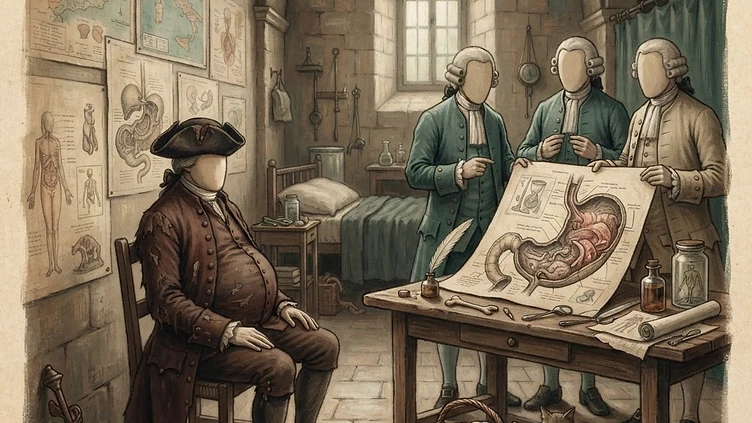
Human hunger is typically a bodily warning; it fades once satiated. Yet, in a corner of history lived a man for whom this signal never ceased. This soldier, recorded in the French army, transformed the act of eating from a mundane necessity into a riddle; so much so that the physicians who examined him were left with more questions than answers. The story of Tarrare stands as a strange mirror for anyone curious about the limits of the human body: we look, but we cannot be certain of what we see. ## A Record of Unlimited Hunger According to his contemporaries, Tarrare's capacity for consumption far exceeded simple loss of appetite or gluttony. Those who knew him claimed he could easily consume amounts many times what an average person could eat in one sitting; it was as if his body functioned like a machine that never received the signal to stop. This was not limited to quantity. According to reports, he could swallow live animals, and the ability of his digestive system to handle such raw, unprocessed material was seen as a peculiarity in itself. We must pause here to ask: how does a human body sustain such extreme intake? Normally, stomach capacity, intestinal absorption speed, and the metabolic processing of energy are part of a fixed, interconnected system. Tarrare's case suggests that this system might be more flexible than we imagine; yet, it remains unclear whether this flexibility is a talent or a disease. To his contemporaries, he was both a natural wonder and a frightening anomaly. Perhaps most striking was that this condition brought him no benefit, only constant suffering; his infinite capacity for eating gave him no peace, only an endless hunger. ## How Science Observed Him Military physicians of the era did not view Tarrare as a simple soldier, but as a case to be studied. They observed him under controlled conditions, offered him various foods, and recorded his reactions. This was an unconventional approach for the medicine of that time; for science did not yet possess the tools to measure and categorize human metabolism as we do today. Physicians tried to explain what they saw using existing concepts, but the frameworks available to them were insufficient to address such an extreme example. Experiments were conducted and observations repeated, but no satisfying conclusion was reached. What is interesting here is not the failure of the physicians, but the mark that failure left behind. Because being unable to explain a case sometimes says more than explaining it; in the history of science, gaps are as valuable as knowledge. The physicians standing before Tarrare also revealed the limits of their own era: they had to admit that their existing set of theories lacked the depth to encompass this human being. Perhaps this is one of the most honest moments in medical history; science that admits it does not understand a phenomenon is more reliable than that which pretends it does. ## A Question Left for Today's Medicine Modern medicine can now map the mechanisms of hunger and satiety in much greater detail; hormones, neural signals, and interactions between brain regions are now standard textbook subjects. Yet, it is still difficult to say that we have fully resolved the condition known as hyperphagia, or extreme and uncontrollable hunger. An extreme example like Tarrare stands as a historical reference point for researchers in this field; his case offers an early testament to how far the normally accepted limits of the human body can expand. If we encountered such a case today, could we understand much more? Likely yes, but not entirely. Because extreme eating disorders vary so greatly from person to person even today, it is difficult to reduce them to a single mechanism. For this reason, Tarrare's story is not just a strange anecdote from the past; it is a warning that reminds today's researchers that the human body remains an unsolved text. Perhaps the real lesson is to see that every era is limited by its own knowledge, but the question standing beyond that boundary may remain the same. Tarrare's name stands like a small note on the margins of history; but within that note lies a vast question about the unknown nature of the human body. His hunger is both a tragic medical story and a moment where science confronted its own limitations. Perhaps this is why remembering him is not just a look into the past, but a gentle reminder to today's medicine: underneath everything we think we understand, there may still lie an unanswered question.
İlgili Denemeler
Can the Human Brain Detect Magnetic Fields?
Geophysicist Joseph Kirschvink's experiment at Caltech indicates that the human brain responds to magnetic fields, raising questions about a potential sixth sense.
Jan Hendrik Schön: The Physicist Who Fooled Science
The scandal of Jan Hendrik Schön's fabricated data at Bell Labs highlights the critical vulnerabilities in the scientific peer-review system.
Barry Marshall Drank Bacteria to Prove Stomach Ulcer Theory
Barry Marshall made medical history by consuming harmful bacteria to prove that stomach ulcers are caused by an infection rather than stress alone.
Tartışma (0)
Henüz yorum yok. İlk yorumu siz yapın.
Join the Newsletter
New essays, once a week, delivered to your inbox.