Guinness: The Story of the 9,000 Year Lease Signed in 1759
A brewer's 9,000-year act of courage still froths in Dublin today.
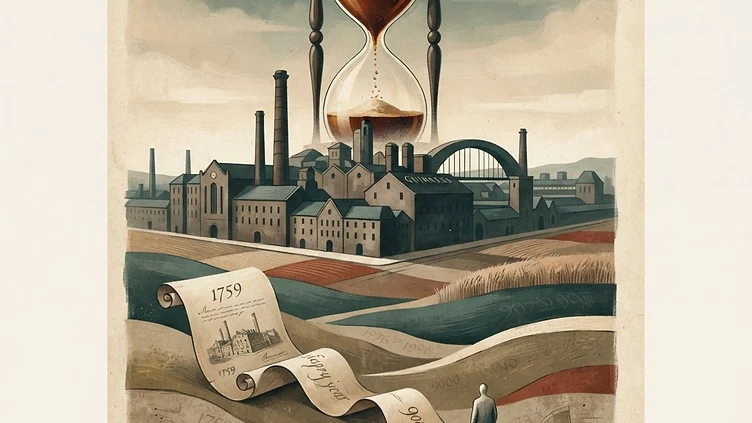
Can a human mind imagine eight thousand years beyond its own lifespan? Most would shrug at the question, as the mind struggles to operate outside its own scale. Yet in 1759, a man in Dublin decided to do business on exactly that impossible scale. Arthur Guinness signed a nine-thousand-year lease for his small brewery at St. James’s Gate. Reading that number today, one might first mistake it for a joke, but as the gravity of the commitment sets in, a strange sense of wonder emerges. For there, on paper, lies a courage that defies time itself. ## A Man Signing for Eternity The signature Arthur Guinness placed on that contract was far from that of an ordinary tenant. In eighteenth-century Dublin, trade was fraught with uncertainty; economic volatility, political strife, and the unpredictability of daily life could sink a business within a year. Entering into a nine-thousand-year obligation in such an environment might seem absurd. But perhaps the true absurdity was thinking of the future in such short terms. Guinness made a promise far beyond his own lifetime, and the very oddity of that promise became his strength. We must stop and ask ourselves: why would a person commit so deeply to a future they will never witness? The answer may not be about faith, but about trust. Guinness may have felt that St. James’s Gate was not just a building, but a foundation. Some decisions are not made through profit calculations, but through the spirit of a place. That signature was less an investment in the future and more a personal challenge against time itself. And it is this challenge that became the core of a legend still discussed today. ## The Number Itself Was an Advertisement A figure like nine thousand years is a magnitude difficult to comprehend; the human brain cannot conceptualize such a span. Yet, this very incomprehensibility served a unique function in the brand's memory. Guinness's promise of continuity evolved over time into a narrative even more memorable than the product itself. When you drink a beer, you usually remember its taste, but in this case, people are drinking in a story along with the flavor; it is as if the shadow of that signature lingers in every sip. One must ask: was the marketing power of such a duration accidental, or was it a conscious strategy? Perhaps neither is entirely correct. In the eighteenth century, no one spoke of brand perception as a concept, but the human mind works the same in every age; we cling to what is grand and inexplicable. Nine thousand years was more a declaration of confidence than a rational calculation, and over time, this declaration became its own advertisement. Today, anyone hearing this story, before even questioning the brand's reliability, cannot help but feel a sense of respect under the weight of that number. This produced a more effective result than any calculated marketing tactic, because it borrowed its credibility from time itself. ## Time Flowing Through the Same Gate Today, when you visit St. James’s Gate, you see that production spanning over two centuries continues at the same address. This means more than just geographical stability; it signifies cultural continuity. A brand maintaining its roots where it was born for so long is almost anachronistic in today's fast-paced business world. In an era where factories are relocated, companies merge, and brands are repositioned, this timeline flowing through the same gate feels, in a sense, like an act of resistance. Is this continuity merely a nostalgic detail, or does it produce real value? I believe they nourish one another. Nostalgia is an emotional thread that connects a person to a place, but over time, this thread can also transform into economic capital. The fact that Guinness still brews at the same address tells the consumer: nothing has changed here, the past and present breathe the same air in this place. This feeling often feeds a consumer's trust more deeply than rational arguments. For humans seek belonging before they seek reason, and the strongest nourishment for this sense of belonging is the place itself. The practical meaning of a nine-thousand-year contract may never be fully realized; who knows, perhaps in a thousand years there will be a different structure, a different company there. Yet even this possibility does not diminish the power of the story, for the point is not whether it will come to pass, but the mark it has left on the human mind. The signature Arthur Guinness left behind was not merely a trade document, but a bold vow spoken against time. And today, we are still drinking the foam of that vow; in every glass, we are tasting a bit of the past's confidence.

İlgili Denemeler
The Mechanical Turk: History's Chess-Playing Mystery
The chess-playing automaton known as the Mechanical Turk deceived figures like Napoleon and Benjamin Franklin, masking a hidden human operator as a machine.
Bournville: The Utopian Town Built by Chocolate
The streets, gardens, and teetotal order of Bournville reveal how the Quaker faith imprinted a distinct form of morality upon the foundations of industry.
Levi's: The Story of Riveted Jeans Born from Gold Rush
In 1873, a tailor's discovery of a riveted solution for torn pockets redirected the true fortune of the gold rush toward the enduring garment industry.
Tartışma (0)
Henüz yorum yok. İlk yorumu siz yapın.
Join the Newsletter
New essays, once a week, delivered to your inbox.