The Mechanical Turk: History's Chess-Playing Mystery
Who was truly hiding inside the box that was hailed as Europe's most brilliant machine?
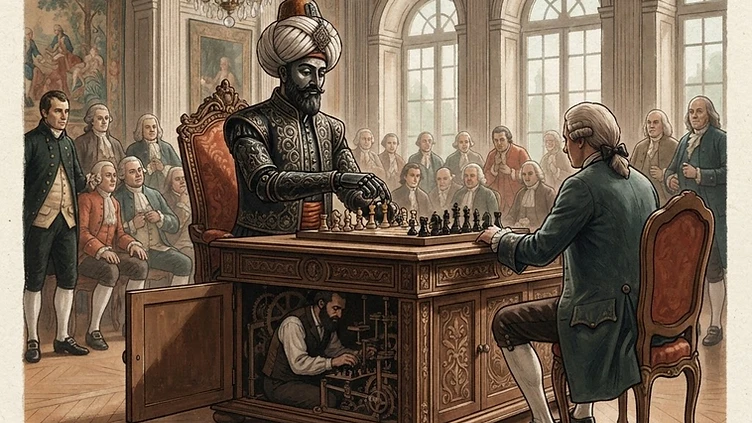
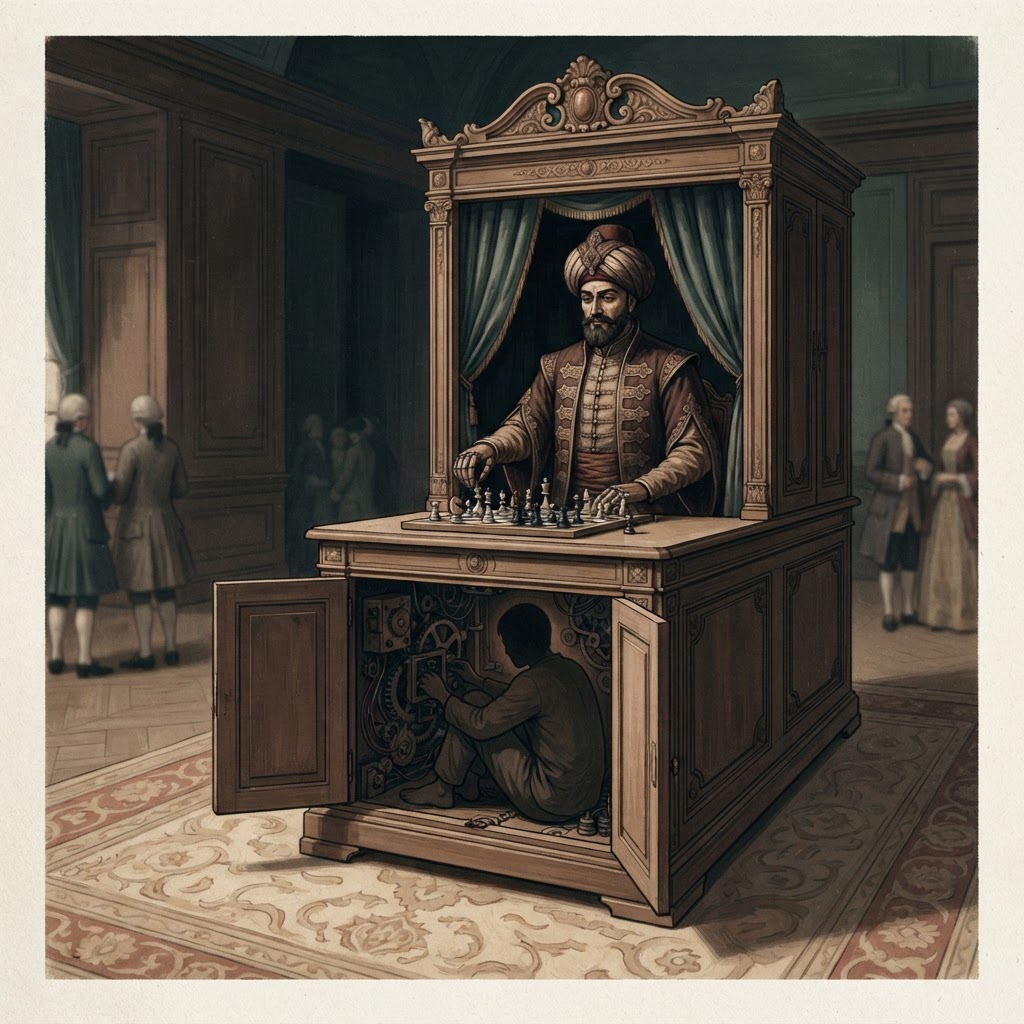
Imagine in the late 18th century, a wooden figure dressed in Ottoman garb placed in the center of a salon. As soon as a guest sitting across from it places an ivory king on the board, this strange figure narrows its eyes, slowly raises its arm, and slides a pawn. The room holds its breath, assuming that what sits there is not a human, but a machine. Did this box truly think, or had it merely learned to appear as if it were thinking? Named the Mechanical Turk, this automaton led the sharpest minds of Europe to chase this question for two centuries, and the answer was hidden in a place far more human than anyone suspected. ## Kempelen's Deception The story of Hungarian inventor Wolfgang von Kempelen begins not with a brilliant invention, but with a minor embarrassment. After watching a magic show at the Habsburg court, Kempelen, unimpressed by the mediocrity of the tricks, boasted that he could do something far more astonishing. From that moment on, he was committed to a path of no return, dedicating months to designing a device that would bring his claim to life. The result was not the ordinary toy the court expected, but a figure capable of sitting at a chessboard and defeating its opponent, its gears and cogs working in full view. But the primary duty of these cogs was to distract the observer. Inside the box, hidden by mirrors and a cleverly partitioned space, sat a human who was a true master of chess. As Kempelen opened the cabinet doors one by one to show the mechanism, he offered the audience a feat of transparency, while every corner he revealed was carefully kept away from the space where the hidden master resided. The smoke of the candles, the creaking of the hinges, and the heavy, mechanical movements of the automaton were all part of this small theater, and the audience was already more than willing to be convinced that what they saw was a thinking machine. ## Europe's Artificial Intelligence Dream The reason the Mechanical Turk was so easily believed lies not only in Kempelen's skill but in the mindset of the era. The Enlightenment was filled with thinkers who viewed the universe as a clockwork mechanism and considered the intellect to be part of that same machinery. If planets moved in regular cycles like gears, why could the human mind not one day be imitated? In this climate, a chess-playing box did not seem like science fiction, but like the logical next step. When viewers sat down across from the automaton, they were essentially sitting down ready to confirm the greatest dream of their age: the idea that machines could reason. This expectation was so powerful that even the sharpest minds of the time could not help but fall for it. It is known that Napoleon played against the automaton, even trying to cheat by moving out of turn, and Benjamin Franklin watched the machine with fascination, spending hours engaged with it. The presence of such figures solidified the show's reputation, for if an emperor or a scientist sat before this box and took it seriously, people assumed there must truly be something inside. As the Mechanical Turk traveled from city to city across Europe and America for decades, it carried not a chessboard, but an era's own vanity regarding its intelligence. ## The Revelation of the Secret and Today's Echo The secret was unraveled not in a single day, but over years, bit by bit. As ownership of the automaton changed, rumors spread among those managing the shows; some former employees hinted at what was inside, while some observers noticed strange delays in the figure's movements. The reality that eventually emerged was much simpler than expected, as the force driving the machine was not revolutionary computing power, but a chess master who agreed to sit curled up inside for hours. This revelation is perhaps the most human moment of the story, for what remained when the spell was broken was not a trick, but the patience of a human. Looking at this story today, it is difficult to see it merely as an old curiosity, as it is no coincidence that Amazon named its platform for human-based micro-tasks the Mechanical Turk. On that platform, thousands of people work behind supposedly automatic systems, tagging images, auditing texts, and filling the gaps that algorithms cannot understand. A significant portion of what we call artificial intelligence works in a way similar to that old box, where someone is still sitting in a dark compartment waiting for their turn to move—only the compartment is now wider, more scattered, and far more invisible. The value of retelling the story of the Mechanical Turk today is not just to satisfy a historical curiosity; it reminds us of a question we still ask. Does the system before us truly think, or are we once again looking at the gears of the box while ignoring the corner where the actual labor is hidden? Perhaps every age has its own Mechanical Turk, and our task is to remember to ask who is inside before we succumb to the splendor of the elegant box.
İlgili Denemeler
Bournville: The Utopian Town Built by Chocolate
The streets, gardens, and teetotal order of Bournville reveal how the Quaker faith imprinted a distinct form of morality upon the foundations of industry.
Levi's: The Story of Riveted Jeans Born from Gold Rush
In 1873, a tailor's discovery of a riveted solution for torn pockets redirected the true fortune of the gold rush toward the enduring garment industry.
Kurukahveci Mehmet Efendi: A Brand Story
This essay explores how a small shop established in 1871 Istanbul turned a simple name into an enduring brand of trust through the consistency of coffee production.
Tartışma (0)
Henüz yorum yok. İlk yorumu siz yapın.
Join the Newsletter
New essays, once a week, delivered to your inbox.