Levi's: The Story of Riveted Jeans Born from Gold Rush
While prospectors in the 1873 California mountains failed to strike it rich, the tailor who mended their trousers carved his name into history.
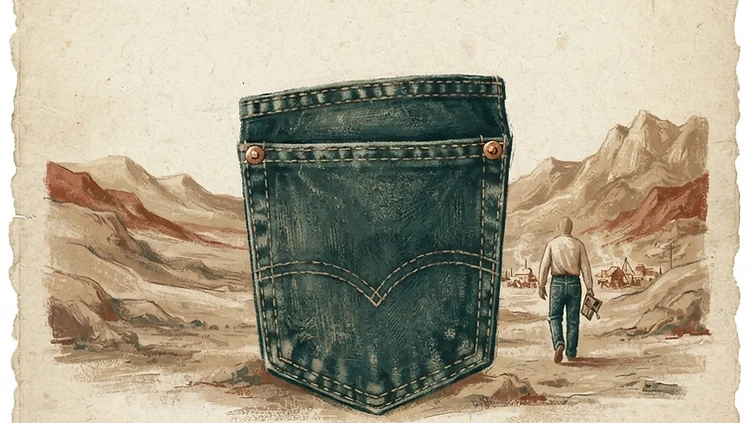
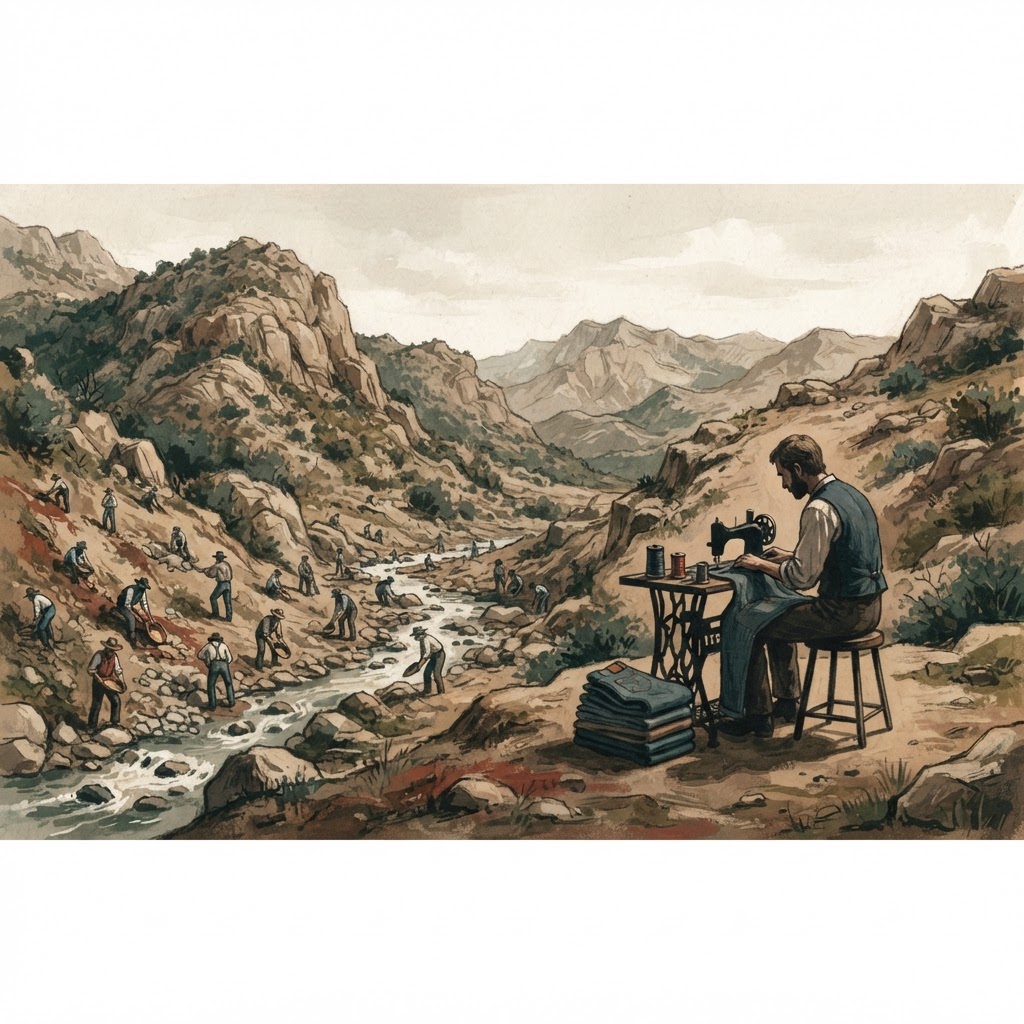
When we think of the California Gold Rush that began in 1848, we always envision the same scene: a man standing knee-deep in water, pickaxe in hand, searching for a glimmer of hope. Yet, real history does not favor this romantic imagery, as the vast majority of the thousands who knelt in those riverbeds returned home penniless. It has always made me wonder whether a more accurate reading of history lies not in who stands at the center of grand narratives, but in who is quietly profiting on the sidelines. A small solution found in 1873 holds one of the clearest answers to this question; for the wealth that could not be found in the gold mines eventually emerged at the tip of a tailor's needle. ## Gold of the Fabric, Not the Excavation The people who flocked to California had only one idea in mind: to find the shimmer in the riverbed and change their lives overnight. But prospecting for gold was not the poetic endeavor described in novels. Bending over for hours in the water, sleeping in the cold, battling disease, and ultimately leaving the region with nothing was the common fate of most miners. Competition was so intense that the value of the gold found often failed to compensate for the effort and time expended. So why did so many people still go there? Because the story was more powerful than the statistics; the news of one person striking it rich was enough to overshadow thousands of failure stories. The true winners were not those who dug the earth, but those who sold goods to those heading for it. Pickaxes, shovels, boots, flour, fabric... Regardless of what the miner found, these materials were needed every day. For a merchant, it did not matter if gold was discovered; what mattered was capturing the last bit of money left in the miner's pocket. Levi Strauss, who ran a small dry goods business in San Francisco, was one of the names who acted on exactly this logic. His concern was not to dig the earth, but to clothe those who were digging, and this distinction would form the foundation of one of the most lasting brands of the following years. ## The Tearing of a Pocket Jacob Davis, a tailor working in Reno, Nevada, heard the same complaint from his customers constantly. When miners and railroad workers placed their heavy tools in their trouser pockets, the seams could not withstand the weight, and the corners of the pockets would tear rapidly. This was not a major engineering problem; it was an annoying, recurring, minor glitch of daily life. Yet, it was precisely in this mundanity that an opportunity lay, because no one took this simple tear seriously. Davis was perhaps the only one who listened to his customers' complaints and viewed them as a problem to be solved. The solution, as one might expect, did not come from a complex design. Davis took copper rivets used in carriage repair and hammered them into the points of the fabric under the most tension, specifically at the pocket corners and seam junctions. The result was surprisingly durable: trousers would no longer tear even under the heaviest use. We must stop here and ask: how true is the idea that great inventions always arise from grand visions? Davis's story shows the complete opposite. He was not thinking of changing the world; he was only trying to quiet the complaints of the customer in front of him. Change often seeps through such small, patient observations rather than moments of heroism. ## The Partnership of Tailor and Merchant Davis had a functional method, but he lacked the money to protect it. A patent application was expensive, and for a provincial tailor, this was an unattainable threshold. At this point, he thought of his supplier from whom he regularly bought fabric: Levi Strauss. Davis wrote him a letter, explained his idea, and proposed a partnership. Strauss accepted the offer immediately; because in his eyes, this small rivet was not just a mundane repair, but a product he could sell. The patent filed under both their names in 1873 is considereddd.d the official birth certificate of the jeans we know today. This partnership causes us to question the monochromatic narrative regarding how brands are built. We usually like to attribute lasting successes to the enlightenment moment of a single genius; yet here, two different people with two different talents came together. One was the tailor who saw the problem concretely and found a practical solution, and the other was the merchant who had the resources and network to turn this solution into a market. Without the hands of one, the other's idea would have remained in a workshop; without the other's idea, one's resources would have been limited to merely selling fabric. We still see the same pattern today: even in the tech world, an engineer's idea in a garage only transforms into a product with the support of someone who provides capital and distribution. The story of Davis and Strauss stands as the simplest example of this cooperation logic from a hundred and fifty years ago. It seems the true mine of the gold rush was hidden not at the bottom of the rivers, but in the seams of the fabric people wore every day. While thousands chased the same dream, wealth was quietly accumulating in the pocket of the trousers that carried that dream. When we wear a pair of jeans today, we may unknowingly be carrying the legacy of a tailor who mended a torn pocket, rather than that of a gold-seeking miner. And this always reminds me: sometimes the greatest fortunes are hidden in the solutions to the most unglamorous problems.
İlgili Denemeler
The Mechanical Turk: History's Chess-Playing Mystery
The chess-playing automaton known as the Mechanical Turk deceived figures like Napoleon and Benjamin Franklin, masking a hidden human operator as a machine.
Bournville: The Utopian Town Built by Chocolate
The streets, gardens, and teetotal order of Bournville reveal how the Quaker faith imprinted a distinct form of morality upon the foundations of industry.
Kurukahveci Mehmet Efendi: A Brand Story
This essay explores how a small shop established in 1871 Istanbul turned a simple name into an enduring brand of trust through the consistency of coffee production.
Tartışma (0)
Henüz yorum yok. İlk yorumu siz yapın.
Join the Newsletter
New essays, once a week, delivered to your inbox.