Schmidt Sting Pain Index: Testing Pain for Science
Justin Schmidt subjected himself to dozens of stings to transform a subjective sensation into a scientific scale.

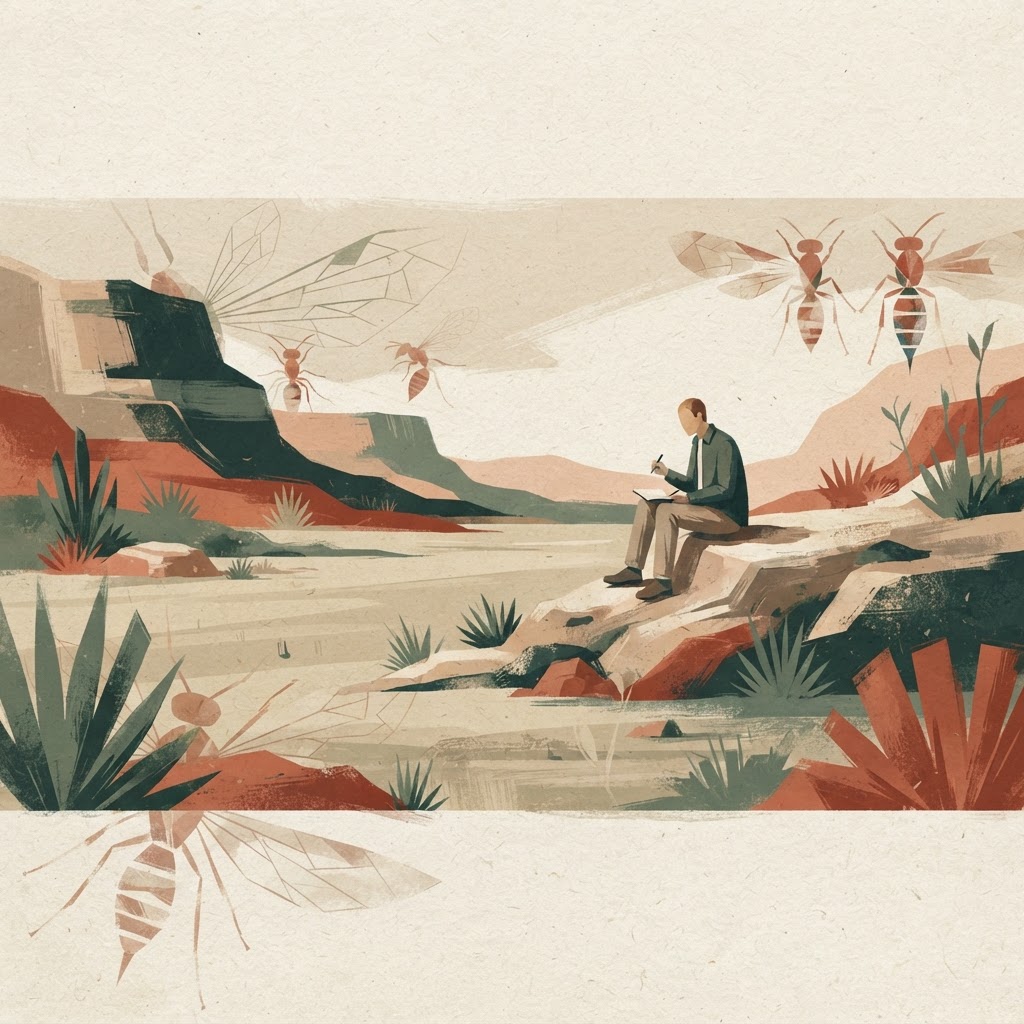
When a person offers their own body to the service of science, it is often told through tales of heroism; yet in Justin Schmidt's story, there is more curiosity than heroism, and perhaps a touch of stubbornness. When he began his career as an entomologist, the question before him seemed simple: how does one measure the pain felt when an insect stings? However, this simple question opened into a realm that science most avoids, for pain is entirely subjective, varies from person to person, and can only be partially conveyed through language. To eliminate this ambiguity, Schmidt chose an unusual path: rather than distributing surveys or relying on the accounts of others, he let himself be stung. Over the years, he exposed his own body to the stings of dozens of different species and recorded each one with the same rigor. This text explores how a scientist transformed a subjective sensation into data, and what this process contributed to both science and himself. ## A Scientist's Body Becomes a Laboratory The classic rule of the scientific method is that the researcher should remain as detached as possible from what is observed. The experimenter stays outside the experiment, not becoming part of what is measured. Schmidt reversed this rule. When he wanted to measure the pain of insect stings, he realized that having people fill out surveys was unreliable, as the threshold for pain differed so greatly between individuals that one person's unbearable was not the same as another's mild. The only way to correct this cacophony was to find a single reference point: a single body, a single nervous system, a single observer recording all stings with the same sensitivity. Schmidt became that observer. His laboratory was no longer a room with four walls; it was his arm, his leg, and sometimes his lip. This choice might seem strange or even extreme at first glance. Why would a human subject themselves to pain repeatedly for the sake of science? The objection that comes to mind is this: is individual experience a sufficient foundation for a generalizable scale? How does one person's perception of pain extend to the species as a whole? The answer Schmidt provided was not to offer a perfect generalization, but a consistent comparison. His goal was not to declare, objectively, that a sting causes this much pain; his goal was to be able to say, this sting is more intense compared to that one. This distinction may seem small, but it is revolutionary in a scientific sense, because instead of trying to eliminate subjectivity, he chose to measure it from a fixed point. By making his own body that fixed point, he reduced variability and made comparison possible. ## From 1 to 4: The Poetic Language of Pain The scale Schmidt developed was a numerical four-point system; the mildest sting was classified as one, and the most severe as four. But these numbers, on their own, conveyed nothing. A number cannot communicate what a sensation feels like; saying three does not teach anyone what a burning sensation is truly like. Schmidt filled this void with literary intuition. He defined each sting not only with a number, but with a vivid, visual, and sometimes surprisingly poetic description. In his hands, pain was no longer a cold data point; it transformed into an image, a metaphor, or even a short story. This approach defended something that science often rejects: the idea that language can reach where numbers cannot. What is interesting here is that Schmidt effectively blurred the sharp line drawn between science and literature. Scientists usually find metaphor unreliable because metaphor is open to subjective associations and does not evoke the same thing for everyone. However, Schmidt's descriptions worked precisely by embracing this subjectivity; because instead of getting lost in the coldness of a number, the reader could imagine the pain in the warmth of an image. This shows us that science is not always made reliable by retreating into abstraction; sometimes a concrete image can be a more honest tool for communication than a number. For this reason, Schmidt's scale can be read both as a scientific document and as a short literary text; the tension between the two forms the strength of the work. ## The Trace Left on Modern Pain Science Schmidt's method may have seemed strange or perhaps even amateurish in his own time. Yet, today's pain science is grappling with the very problem he encountered: how to measure and standardize pain, and how to convey one person's experience to another. In modern clinical settings, patients are still asked to express their pain on a scale from one to ten; this simple scale suffers from the same limitation that Schmidt recognized years ago. A number cannot describe the texture, color, or rhythm of what is being felt. That is why, in recent years, pain researchers have begun to add descriptive language alongside purely numerical scales, allowing patients to describe their pain in their own words. This can be read as a gradual acceptance in scientific literature of what Schmidt did intuitively. The ethics of self-experimentation opens a separate area of debate. A scientist repeatedly risking themselves is a practice that today's ethics committees would find difficult to approve. But does this diminish the value of Schmidt's method? A counter-argument that comes to mind is that individual sacrifice is not necessary for scientific validity and, on the contrary, sets a dangerous example. But Schmidt's case was unique; he did not risk anyone else, he used only his own body, with his own consent, under controlled conditions. This reminds us that science sometimes progresses by stepping outside the rules; every great methodological innovation may appear strange, or even objectionable, at the start. In time, that strangeness can become the foundation of a new norm. Schmidt's story raises a larger question about science itself: is that which is subjective scientifically worthless? Most of the time, science views that which is measurable as valuable, and that which is immeasurable as noise that must be excluded. But experiences like pain, dreams, pleasure, and fear live right within that noise; to exclude them is to push a significant part of human experience outside the realm of science. By turning his body into a laboratory, Schmidt partially reversed this exclusion; instead of rejecting subjectivity, he gave it a framework. This framework was not perfect, nor could it ever be; but at the very least, it offered a starting point, created the possibility for comparison, and showed that language is indebted to science, and science to language. Someone reading his scale today might smile at the description of a bee sting or shiver at the description of a hornet. But what remains is the persistent curiosity behind these descriptions: the effort of a person to translate their own pain into a language that other people can understand. Science can sometimes seem like it consists only of cold numbers, yet Schmidt's legacy reminds us that even the most personal experiences can, with the right patience, be transformed into a shared understanding. Perhaps the most human side of science is hidden right here: in the effort to turn the singular pain of one person into knowledge that everyone can share.
İlgili Denemeler
Can the Human Brain Detect Magnetic Fields?
Geophysicist Joseph Kirschvink's experiment at Caltech indicates that the human brain responds to magnetic fields, raising questions about a potential sixth sense.
Jan Hendrik Schön: The Physicist Who Fooled Science
The scandal of Jan Hendrik Schön's fabricated data at Bell Labs highlights the critical vulnerabilities in the scientific peer-review system.
Barry Marshall Drank Bacteria to Prove Stomach Ulcer Theory
Barry Marshall made medical history by consuming harmful bacteria to prove that stomach ulcers are caused by an infection rather than stress alone.
Tartışma (0)
Henüz yorum yok. İlk yorumu siz yapın.
Join the Newsletter
New essays, once a week, delivered to your inbox.