Rosalind Franklin: The Unsung Hero of DNA
The scientist who captured the photograph that made the double helix visible was quietly pushed to the edges of history before the awards ceremony.
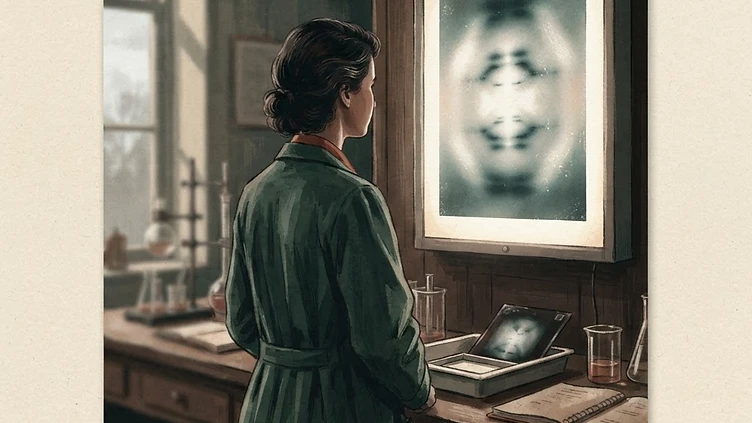
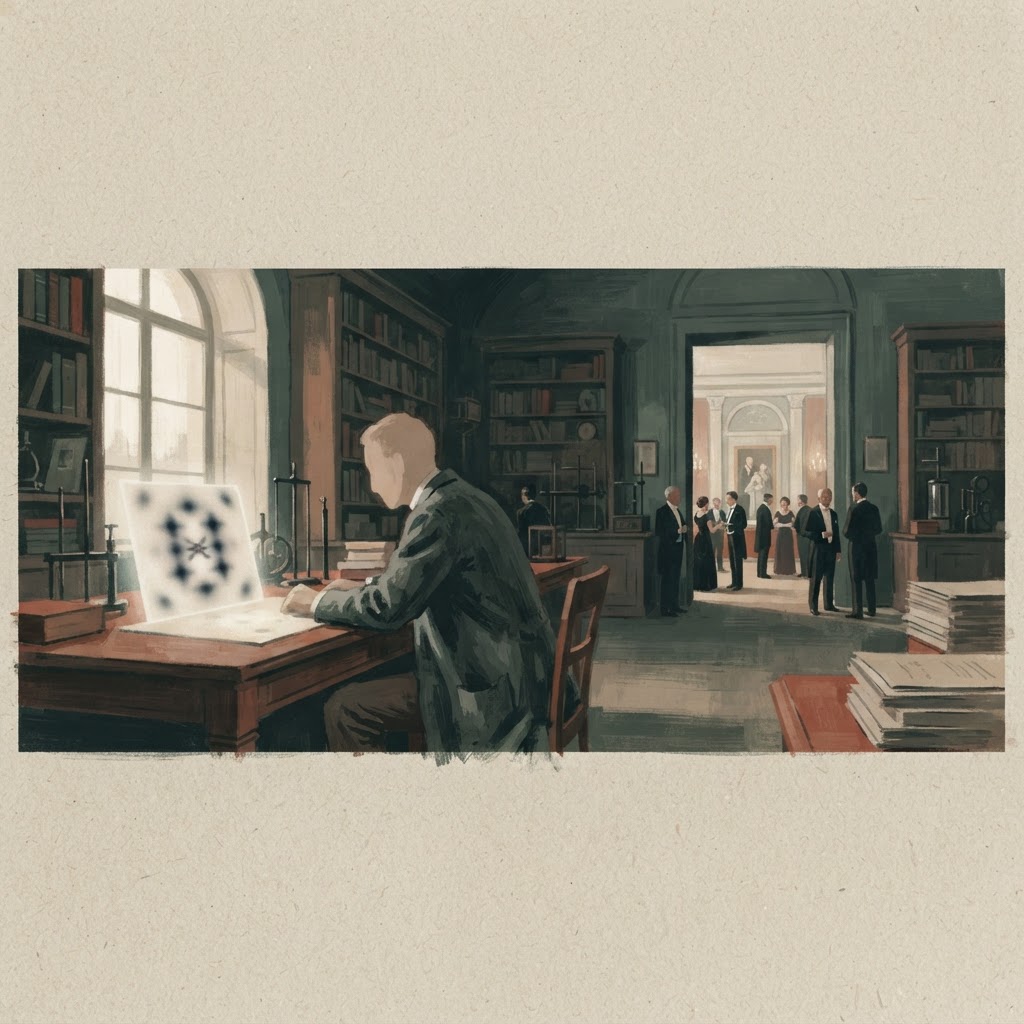
Can a person's name be less remembered than their discovery? Rosalind Franklin's story makes me ask this question every time. A photograph she captured in 1953 revealed the most fundamental code of life; yet, the name behind that photograph was absent even from the awards ceremony hall. The history of science usually recounts the discovery itself, long having forgotten to whom the hand that made the discovery belonged. Franklin's story shows us exactly how this oblivion functions, who is made visible, and who is quietly pushed aside. ## Photograph 51: The First Image of the Helix X-ray crystallography is a technique that makes structures too small to be seen by the eye visible; yet this visibility never comes about on its own. Through months of meticulous work in her laboratory at King's College, Franklin crystallized DNA molecules, diffracted the beam at the correct angle, and produced the image known as Photograph 51. The X-shaped pattern in the image revealed the existence of a helix with mathematical precision; this was not a guess, but measurable evidence. What Franklin did here was not just a technical achievement, but an example of scientific patience and methodological rigor; because while many researchers at the time were trying to solve the structure of DNA through intuition, she prioritized the data. So why was this image so decisive? Because it allowed for the direct calculation of the helix's angle, diameter, and the length of its repeating units; meaning it relied on measurement, not speculation. Franklin's approach reflected a discipline rare in the scientific understanding of the era: data first, interpretation second. The model that Watson and Crick later developed was, in fact, largely fueled by the mathematical deductions of this photograph. What is interesting here is that the most concrete evidence produced by a scientist is combined with the imagination of other names to transform into an entirely different story. Franklin herself may not have been aware of this yet; but history would pay her back for this lack of awareness very harshly. ## The Unclaimed Journey of Data The question of who scientific knowledge belongs to is often asked after the results have become clear; but the real issue is whose hands the data passes through during its journey. That Watson and Crick accessed Photograph 51 without Franklin's knowledge or explicit consent remains an issue still debated in the scientific community. Did this access stem from the ambiguous boundaries of a laboratory culture of sharing, or was it a conscious disregard? It is difficult to find a definitive answer; but the result is clear: the data produced by Franklin's labor became the cornerstone of another narrative without her consent. A counter-argument might come to mind here: science is a collective effort, data should be shared, and a discovery is not anyone's private property. While this argument sounds reasonable, it ignores the visibility of labor. Because the line between sharing and claiming lies in not just the use of data, but in whose name is mentioned while it is being used. In Watson and Crick's article, Franklin's contribution remained at the level of a footnote; yet her data formed the mathematical skeleton of the model. This points to a pattern frequently seen in the history of science: a woman's labor quietly integrates with the victory of other names, and this integration often occurs without being noticed. ## Nobel's Silent Rule In 1962, Watson, Crick, and Wilkins received the Nobel Prize in Physiology or Medicine for revealing the structure of DNA. Franklin was not at this ceremony because she had passed away in 1958 at the age of thirty-seven. The Nobel Committee has a strict rule: the prize is awarded only to living scientists. This rule, in a discipline that claims scientific contribution should not be dependent on time, strangely makes time a determinant. Franklin's premature death seems to have removed her not just from this race, but from the record of history itself. The question that must be asked at this point is: does a rule being impartial mean its outcomes are also impartial? The Nobel principle of being awarded to the living is a principle applied equally to everyone on paper; but in practice, who is alive and who is not is not merely a matter of chance. Franklin's death at a young age due to cancer is also linked to radiation exposure in laboratory conditions; meaning her absence was, in a sense, the price of the work she did. This rule separated her first from her scientific contribution, and then from the recognition of that contribution. Thus, Franklin's invisibility became part of a result produced not just by an oversight, but by the system itself. Retelling Franklin's story today is not just about paying a debt to the past. It means questioning how science is written, who is the narrator, and who is the material. Photograph 51 is still used in textbooks to explain the double-helix structure of DNA; but the hands that captured it often remain in the footnotes. Perhaps the real issue is not who is given an award, but how labor is remembered. Although Franklin's name is written more frequently in the history of science today, that silent exclusion still tells us something about how science constructs its own myth.
İlgili Denemeler
Can the Human Brain Detect Magnetic Fields?
Geophysicist Joseph Kirschvink's experiment at Caltech indicates that the human brain responds to magnetic fields, raising questions about a potential sixth sense.
Jan Hendrik Schön: The Physicist Who Fooled Science
The scandal of Jan Hendrik Schön's fabricated data at Bell Labs highlights the critical vulnerabilities in the scientific peer-review system.
Barry Marshall Drank Bacteria to Prove Stomach Ulcer Theory
Barry Marshall made medical history by consuming harmful bacteria to prove that stomach ulcers are caused by an infection rather than stress alone.
Tartışma (0)
Henüz yorum yok. İlk yorumu siz yapın.
Join the Newsletter
New essays, once a week, delivered to your inbox.