Roman Concrete: Why Does It Last Thousands of Years?
While two-thousand-year-old Roman structures remain standing, an MIT team discovered that lime clasts are the reason modern concrete begins to crack within fifty years.
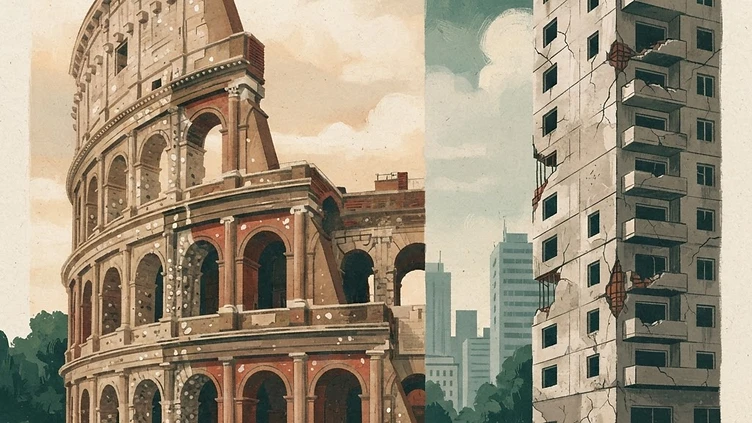
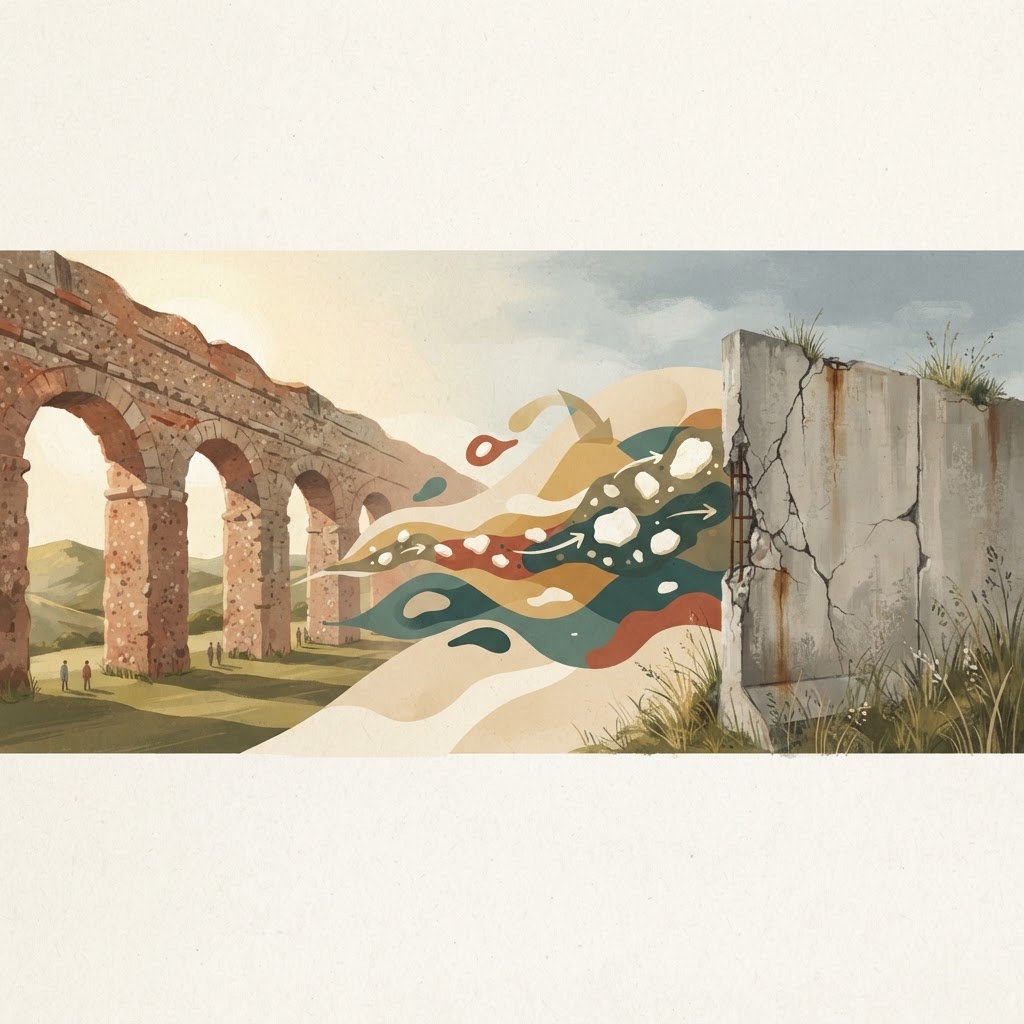
Walking under an ancient aqueduct in Rome, a strange question inevitably crosses one's mind: how does this pile of stone still stand? Is a mortar mixed two thousand years ago stronger than a highway bridge poured yesterday? The question may sound hyperbolic, but when an MIT team seeking answers placed ancient Roman concrete under a microscope, they found something truly unexpected: tiny, whitish lime clasts. For years, these particles were dismissed as flaws or signs of poor workmanship. In reality, they were the structure's self-healing mechanism. This article is a journey of thought starting from those small particles, moving to why the modern construction industry lacks the same patience, and finally reaching the building materials of the future. ## The Secret Power of Lime Clasts Consider a crack: concrete always cracks, which is an inevitable fact, as the material stretches over time, temperatures fluctuate, and the ground shifts. What matters is not the crack itself, but what happens after it forms. In modern concrete, a crack is like a wound that does not heal on its own; it grows over time, draws in water, and rusts the internal iron. In Roman concrete, however, the same crack tells a different story. As soon as water seeps in, it encounters the lime clasts within, and a simple yet ingenious chemistry kicks in: the lime reacts with the water to form a solid substance, filling the crack and essentially mending the structure itself. Thus, Roman concrete does not act as a passive material, but as an organism with a survival reflex. The striking point here is that this feature was not accidental. Researchers suggest that the Romans may have deliberately incorporated these lime clasts as a production choice, combining quicklime with water and volcanic ash while hot to imbue the material with this self-renewal capacity from the start. Reading this, one cannot help but wonder: did the Romans possess this exact chemical knowledge, or did they reach a form of empirical mastery through trial, observation, and avoiding past mistakes? Perhaps this was the gap that craftsmanship filled in the absence of formal science. Today, we need laboratories, formulas, and simulations to achieve the same result; they reached the same destination by listening to the language of stone, water, and fire. ## The Short Life of Modern Concrete A legitimate objection arises here: is it fair to compare a building material from two thousand years ago with today's massive construction demands? Rome was building a temple or an arch, while we are expanding cities, trying to support bridges, skyscrapers, and highways all at once. There is some truth to this, but it masks the fundamental issue in modern concrete's design philosophy. The production system built around Portland cement prioritizes speed and cost, leaving durability as someone else's problem. Concrete is poured, the formwork is removed, the building is handed over, and no one thinks about who will be responsible in fifty years because those fifty years are not a cost item in today's balance sheet. This issue of a short lifespan is not merely an engineering choice; it is a problem of time perception. The modern construction industry views a building as an investment vehicle, and since the return on investment usually spans ten to twenty years, the material only needs to be durable for that duration; what happens afterward is a concern for a different budget and a different generation. In Rome, a temple or a port was considered a shared heritage of generations, which is perhaps why the material was produced with such long-term thinking. The matter of closing a crack actually reveals how a civilization relates to time. We are more accustomed to tearing down a structure and building a new one rather than repairing the crack, which inevitably means we expend resources, energy, and labor repeatedly. ## Building the Future with Ancient Knowledge So, what does this knowledge tell us today, beyond nostalgic admiration? This is where the matter becomes truly interesting, as the Roman hot-mixing technique is not just a subject of curiosity about the past, but could be a concrete source of inspiration for the future construction industry. Cement production is responsible for a significant portion of global carbon emissions today, as firing limestone at high temperatures is an energy-intensive process. If we can carry the self-healing logic of Rome into modern materials, we will not have to demolish and rebuild every cracked building, which in the long run means less production, less energy, and less carbon. A counter-argument arises here as well: copying the ancient technique exactly does not fit today's scale or building standards, and that is true. But no one is suggesting an exact copy; the suggestion is to graft that logic, that principle of self-renewal, into modern materials science. Indeed, some researchers are working on additives that mimic the function of lime clasts, aiming to embed microcapsules into concrete that burst to release a repairing agent when a crack occurs. This is like translating the wisdom of Rome into the language of modern chemistry; looking at the past is not about staying there, but extracting a principle that can be brought into the present. Ultimately, one realizes that the secret of Roman concrete is not hidden in a single material, but in a way of thinking. They did not design a structure as an object to be built once and forgotten, but as an entity that lives with time and heals its own wounds. We, however, under the pressure of speed and efficiency, shape materials only according to today's needs, without thinking of tomorrow's cracks. Perhaps the real question is this: in order to place durability back at the center, we must first re-establish our relationship with time. Stone does not speak, but by remaining standing for two thousand years, it is constantly telling us something; we just need to know how to listen.
İlgili Denemeler
Can the Human Brain Detect Magnetic Fields?
Geophysicist Joseph Kirschvink's experiment at Caltech indicates that the human brain responds to magnetic fields, raising questions about a potential sixth sense.
Jan Hendrik Schön: The Physicist Who Fooled Science
The scandal of Jan Hendrik Schön's fabricated data at Bell Labs highlights the critical vulnerabilities in the scientific peer-review system.
Barry Marshall Drank Bacteria to Prove Stomach Ulcer Theory
Barry Marshall made medical history by consuming harmful bacteria to prove that stomach ulcers are caused by an infection rather than stress alone.
Tartışma (0)
Henüz yorum yok. İlk yorumu siz yapın.
Join the Newsletter
New essays, once a week, delivered to your inbox.