Richard Lenski and the Long-Term E. coli Experiment
By observing the same bacteria over thousands of generations, a scientist succeeded in capturing evolution in real time within a laboratory setting.
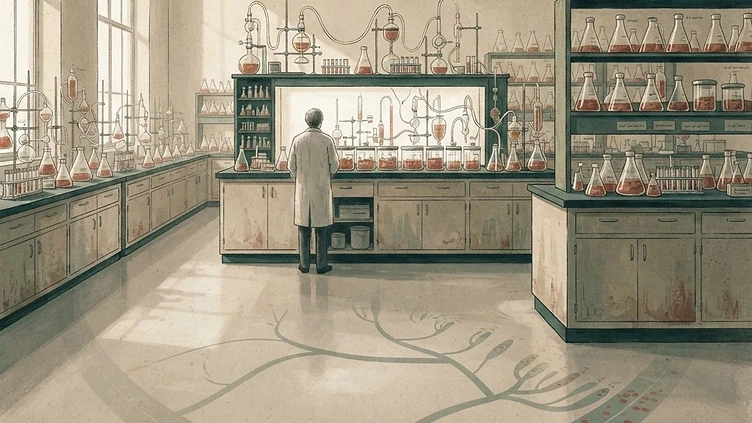
When we think of evolution, we typically imagine millions of years, fossilized bones, and skeletons behind museum glass. Yet one scientist, Richard Lenski, attempted to compress this ancient process into a human lifespan, observing the same bacteria under identical conditions for over three decades and thousands of generations. What emerged was not merely an experiment, but tangible proof of what evolution truly entails. How can a scientist find an answer to a profound question by monitoring an organism too small to see? Tracing this inquiry is the surest way to understand both the patience of science and the subtlety of nature. ## Twelve Flasks, One Question The experiment Lenski designed was based on a seemingly simple premise: dividing the same E. coli colony into twelve separate flasks and culturing each in an identical nutrient environment, at the same temperature, and with the same timing. The ritual was repeated every day; the bacteria would grow slightly, a portion would be transferred to a new flask, and the cycle would begin anew. While this repetition might appear monotonous at first glance, it offered an opportunity rare in the history of science: the ability to observe evolution in a controlled, real-time environment. In nature, evolution unfolds on a complex stage where millions of variables interact simultaneously; in the laboratory, this complexity is largely removed, leaving only a pure question: Where do time and chance lead twelve different lines starting from the same point? What is truly striking here is the duration of the experiment. That a human would pursue an idea with the same rigor for thirty years is a testament to a specific mindset; for scientific curiosity to transform into such prolonged patience is rare. Some might argue that such a simple experiment cannot explain a concept as vast as evolution, as bacterial evolution and human evolution do not occur on the same scale. Yet, Lenski's intent was never to explain humanity; his goal was to see if the mechanics of evolution—natural selection, random mutation, and the cumulative effect of time—functioned even on a small scale. And as the years passed, the twelve flasks began to write twelve distinct evolutionary stories that diverged from one another. ## Unexpected Mutation Thousands of generations later, something unexpected occurred in one of the lines: the bacteria developed the ability to utilize citrate from their environment. While E. coli normally cannot process this substance, small changes that had accumulated over a long period reached a threshold, and a brand-new capability emerged. This moment was perhaps the most debated point of the experiment, as it demonstrated that both chance and necessity were at play simultaneously. The mutation had appeared spontaneously and unpredictably, but once it emerged, natural selection immediately seized and propagated it. Thus, evolution was neither a complete game of chance nor a pre-written script; it was a balance forged by time between the two. An objection immediately springs to mind: If mutation is random, would we get the same result if we ran the experiment again? Thanks to Lenski's frozen samples, this question could also be answered. When samples from past generations were revived, it was observed that similar mutations tended to reappear after a certain point. This showed that evolution is not merely a blind coincidence but carries patterns capable of repeating themselves under specific conditions. In other words, when the foundation is prepared, chance opens a door; whether that door is passed through depends somewhat on time and accumulation. This dual structure is perhaps what makes evolution both poetic and mathematical: unexpected, yet not entirely meaningless. ## The True Value of the Experiment The true worth of Lenski's experiment lies less in proving evolution than in prompting us to rethink how we can observe it. For a long time, evolutionary biology was considered the domain of fossils, paleontologists, and inferences about the past. This experiment, however, demonstrated that evolution can be observed here and now, inside a petri dish. In terms of the philosophy of science, this was a small but profound rupture: we were no longer just interpreting evolution, but testing it in a living system. There is a vast difference between searching for the truth of an idea in the traces of the past and reproducing it now to observe it; the latter grants science a sense of near-physical certainty. Furthermore, another value of the experiment was in showing how science grows with patience. Repeating the same process every day might seem meaningless to many; yet, within that repetition, the small differences accumulated by time eventually transformed into major change. This reminds us that scientific discovery is not always a sudden moment of enlightenment, but often a methodical accumulation awaited with patience. Lenski's experiment functions like a mirror for understanding both evolution and science itself, for both are shaped by time, repetition, and small deviations. Looking back at this long experiment today, we are reminded of a simple truth: time, when combined with the right conditions, becomes a power capable of transforming even the smallest living thing. Lenski's twelve flasks showed how patience on a human scale can touch the secrets of nature on a grand scale. Perhaps the most effective way to understand evolution is not to observe it from afar, but to ask the same question patiently, year after year.
İlgili Denemeler
Can the Human Brain Detect Magnetic Fields?
Geophysicist Joseph Kirschvink's experiment at Caltech indicates that the human brain responds to magnetic fields, raising questions about a potential sixth sense.
Jan Hendrik Schön: The Physicist Who Fooled Science
The scandal of Jan Hendrik Schön's fabricated data at Bell Labs highlights the critical vulnerabilities in the scientific peer-review system.
Barry Marshall Drank Bacteria to Prove Stomach Ulcer Theory
Barry Marshall made medical history by consuming harmful bacteria to prove that stomach ulcers are caused by an infection rather than stress alone.
Tartışma (0)
Henüz yorum yok. İlk yorumu siz yapın.
Join the Newsletter
New essays, once a week, delivered to your inbox.