The Replication Crisis: Can We Trust Scientific Data?
When even the most cited findings failed to yield the same results, science had to confront its own credibility.
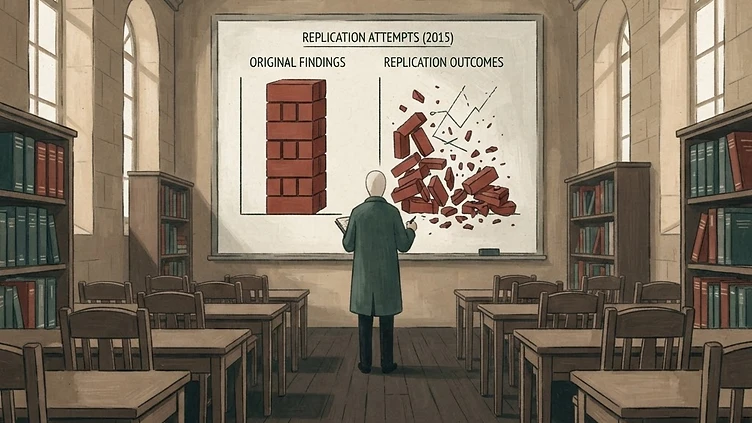
I have often wondered about the difference between trusting a finding and finding it to be true. When a newspaper headline catches my eye with something like the formula for happiness or a simple habit to strengthen memory, I believe it at first, then I grow suspicious, and finally, I forget it. Yet, science promises us something far beyond these three stages: replicability. If an experiment succeeded once, it should yield the same result when repeated under identical conditions, right? A large-scale study conducted in 2015 shook this simple but vital assumption, showing that even the most brilliant findings in psychology failed to shed the same light a second time. In this essay, I will attempt to understand where this tremor originated, why it grew, and how the scientific community managed to ignore it for so long. ## The Magic Threshold: The Trap of p<0.05 At the turn of the twentieth century, a statistician proposed a practical threshold for determining whether a result was merely a coincidence: if the probability of a finding appearing by chance was less than one in twenty, it was worth noting. It was a simple, useful, and temporary rule; it was like a key used to open a door, not the door itself. But over time, this key became the door itself. Researchers were no longer trying to understand nature, but to fall below that magic threshold, because in the academic world, the only thing required for a finding to be deemed significant was to obtain that small number. Consider this: the fate of an experiment lasting months in a laboratory hinges on a digit in the third decimal place. Who is to say that such a sharp boundary is as sharp as nature itself? The crucial point here is this: when a researcher slices and dices their data in different ways, tests different variables, or examines different subgroups, they sooner or later find a combination that falls below that threshold. Statisticians call this the garden of forking paths with a poetic touch; I prefer a simpler analogy: if you have enough dice, you will eventually roll the number you want. This is often not a malicious trick; the researcher believes in their hypothesis and tries to read the data the right way, but the effort itself distorts the result. When the threshold ceases to be a tool for scientific discovery and becomes the target itself, the reality of what is discovered is cast in shadow. ## The Cold Shower of 2015: The Large Replication Study At this point, in 2015, a large community of researchers rolled up their sleeves and retested one hundred published studies in psychology, staying as faithful as possible to the original methods. The goal was simple: would these findings yield the same effect as they did the first time? The result was a cold shower that shook the field. A significant portion of the studies failed to produce the effects observed in the first instance; for those that did, the effect was generally much smaller. Some findings that had once become famous enough to enter textbooks quietly dissolved during the second attempt. This was not merely the failure of a few weak studies; it was a question mark hanging over the entire field. What bothered me most was how this result was received. Some researchers immediately went on the defensive, claiming that replication studies cannot fully capture original conditions, that different samples can lead to different results, and that cultural contexts have changed. There is, of course, some validity to these objections; science is not static, nor is it entirely independent of context. But this explanation does not clarify why the initial effects found were systematically larger, more striking, and more publishable. If the issue were merely a difference in context, we would expect results to be sometimes larger and sometimes smaller; instead, the pattern pointed in the same direction: the first finding was always brighter, the second always dimmer. This was a deviation too consistent to be explained by chance, and it told us that something was broken—not in the finding itself, but in the process of selecting the finding. ## Publish or Perish: The Price of the Incentive System So, where does this selection process take place? The answer lies outside the laboratory, in the very logic of an academic career. A researcher's ability to keep their job, advance to the next position, and secure funding often depends on a single criterion: the number of publications and their impact. An ordinary result, an honest paper stating that the expected effect was not found, is greeted with no excitement by any journal; such studies remain in drawers, unread and uncited. Yet, a headline stating that behavior X makes people thirty percent more honest catches the interest of both journals and newspapers. The system inadvertently pushes researchers to produce striking and positive results because that is the price of survival. Consider the position of a young academic: they have a three-year dataset, they have not found the exact effect they expected, but they must publish at this stage of their career. What do they do? Perhaps they examine the data from slightly different angles, perhaps they separate subgroups, or perhaps they highlight the most promising result. This person is not malicious; this is the only rational option the system offers them. Negative results, failed attempts, and unrecorded replications accumulate in a kind of invisible archive; some call this the drawer problem. Ultimately, what remains in the literature is not reality itself, but the most striking, positive, and publishable slice of reality. This is why the crisis went unnoticed for so long; because each individual study appeared to follow the rules, but the sum of the whole produced an illusion. The real question underlying all of this is not whether bad researchers or bad incentives are to blame; both are two sides of the same coin. In a system where those producing honest, ordinary results and those manipulating data to produce striking results do not receive the same rewards, only the latter type of behavior survives over time. This is a process similar to natural selection; it is not the most valid ideas that survive, but the most marketable ones. The 2015 replication study thrust the consequences of this selective pressure into our faces and left the scientific community with an uncomfortable question: if even our most famous findings have been shaped by this pressure, how solid is the knowledge we trust? I do not want to end this essay on a pessimistic note, because the crisis also gave birth to an awakening. Pre-registration systems, open data sharing, and the increasing value placed on replication studies show me that science has the capacity to recognize and correct its own mistakes. Perhaps the power of science lies not in never being wrong, but in admitting its errors and restructuring its methods. The cold shower of 2015 was painful but necessary, for a discipline looking honestly into its own mirror, however painful it may be, is the only way to make that discipline more reliable.
İlgili Denemeler
Can the Human Brain Detect Magnetic Fields?
Geophysicist Joseph Kirschvink's experiment at Caltech indicates that the human brain responds to magnetic fields, raising questions about a potential sixth sense.
Jan Hendrik Schön: The Physicist Who Fooled Science
The scandal of Jan Hendrik Schön's fabricated data at Bell Labs highlights the critical vulnerabilities in the scientific peer-review system.
Barry Marshall Drank Bacteria to Prove Stomach Ulcer Theory
Barry Marshall made medical history by consuming harmful bacteria to prove that stomach ulcers are caused by an infection rather than stress alone.
Tartışma (0)
Henüz yorum yok. İlk yorumu siz yapın.
Join the Newsletter
New essays, once a week, delivered to your inbox.