Rat Park Experiment: Is Addiction Chemical or Social?
When a psychologist moved rats from cramped cages to an idyllic paradise, the secret of addiction was turned on its head.
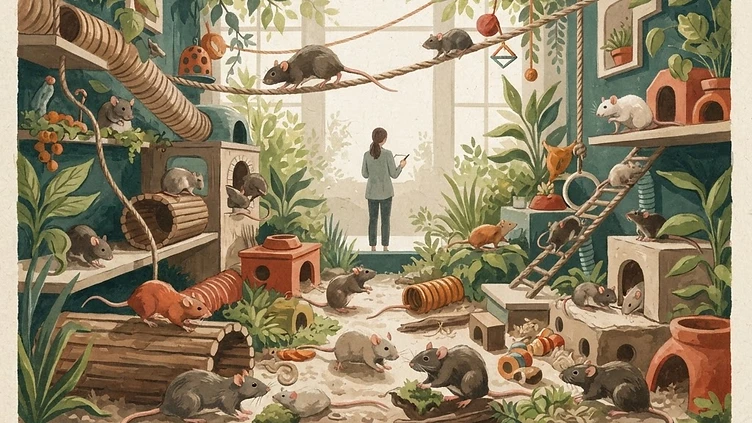
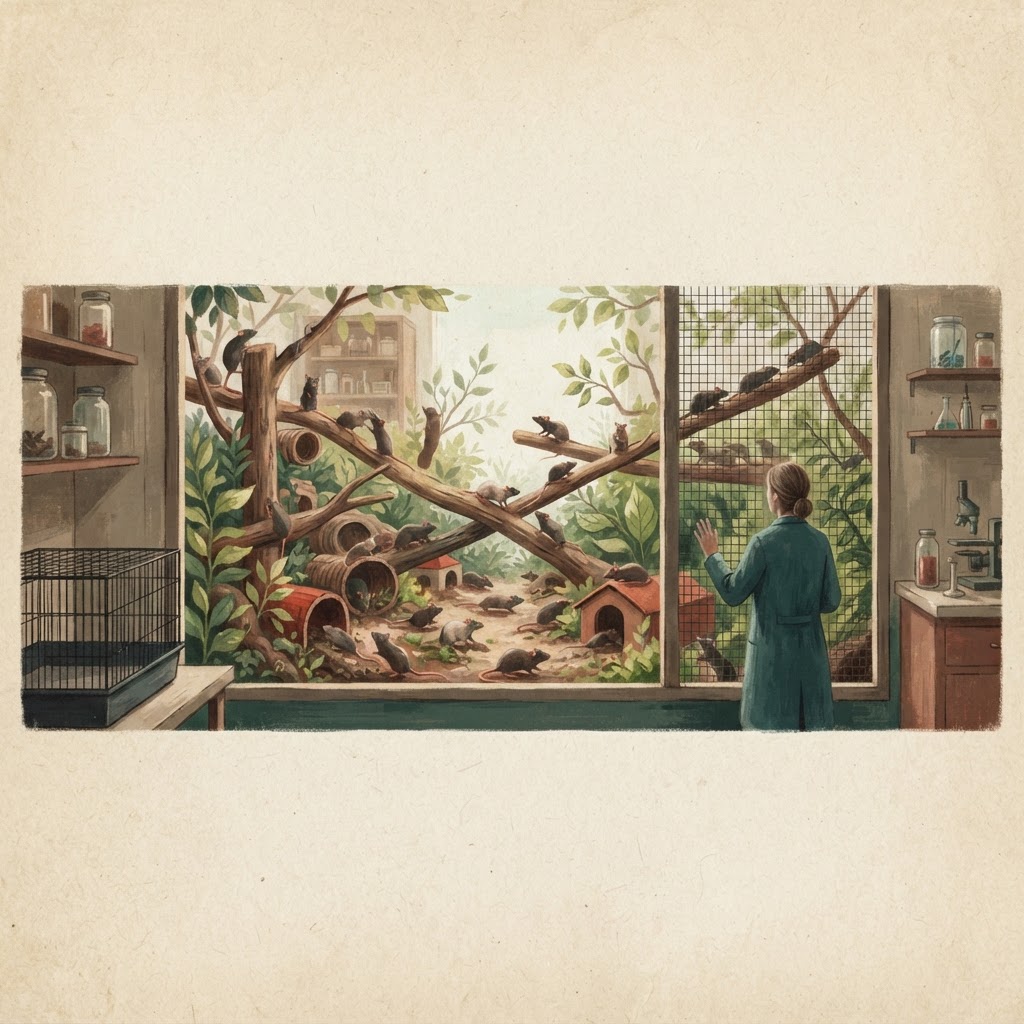
When we speak of addiction, our minds immediately turn to chemistry: dopamine receptors in the brain, morphine binding to synapses, and a molecular war that erodes willpower. Yet, there remains an unsettling question outside of this picture. Is the substance itself what binds a human or a rat, or is it the void in which the creature exists? A peculiar experiment conducted years ago by Canadian psychologist Bruce Alexander trapped this question within laboratory walls and steered the answer in an entirely unexpected direction. ## Is the Caged Rat a Prisoner of Chemistry? In the mid-twentieth century, the standard scene for addiction research was quite simple: one rat, one cage, one choice. The animal spent its days within four walls, with neither a partner, a game, nor a corner to explore. Two bottles were placed before it, one plain water and the other laced with narcotics, and the rat eventually turned to the latter. Scientists drew a clear conclusion from this: the substance was a trap in itself, locking a door that could not be reopened once it entered the brain. The problem with this scene lay in the experimental design, yet no one questioned it for a long time. The caged rat was left with nothing to expect from life; no social contact, no physical movement, no stimulus to spark curiosity. In such a void, the drugged water became the only way to pierce the boredom. Still, the formula derived from this simple scene, substance equals enslavement, permeated popular culture, legal systems, and our daily conversations. We began to view the addict not as a victim, but as a weak will caught in a chemical trap, because that was what the laboratory told us. ## The Construction of Rat Park and the Surprising Result Bruce Alexander struggled to believe this picture and, in the 1970s, set up a very different scene: Rat Park. This was a spacious area suited to the natural tendencies of rats rather than an ordinary cage; it featured surfaces for climbing, corners for hiding, mates for breeding, and peers for interaction. The rats encountered not boredom here, but a community, a playground, and almost a way of life. Alexander placed the same morphine-laced water in this free environment, and the expectation was the same as in previous experiments: the substance would win again. It did not. The rats in Rat Park rarely touched the drugged water, some never touched it at all, and those who did never displayed the passionate addiction seen in earlier experiments. It was as if the substance lost its allure when the environment was rich; as if the brain did not require a chemical escape as much in the middle of a full life. A valid objection might arise here: rats are not humans, and human addiction is woven from much more complex social and biological layers. True, but Alexander's experiment did not claim to offer a definitive theory for humans; it merely showed that addiction is not solely a chemical necessity and that the environment can be just as decisive as the substance. This small but radical difference was strong enough to shift the direction of the entire debate. One must also consider this: if addiction were merely a chemical destiny of the brain, the rats in Rat Park should have fallen to it at the same rate, because the morphine molecule had not changed; only the environment had. This simple observation cast a serious doubt on the idea that addiction begins and ends in the brain. Perhaps the substance was something that filled the void, not the void itself. ## The Legacy of the Experiment for Modern Addiction Policies The legacy of Rat Park has extended far beyond laboratory walls. If addiction is merely a chemical trap, then treatment must also be purely chemical: medication, detox, or intervention to balance brain chemistry. Yet, the experiment shows that this formula is incomplete; removing an addict from a substance may not suffice, because if the life they return to remains as empty as the old cage, a new escape will be found sooner or later. The fact that some treatment approaches today make more room for community-based programs, the pursuit of work and meaning, and social bonding is actually an echo of the lesson whispered to us by these small rats. To make this tangible, one need only look at city life. It is no coincidence that addiction rates are higher among people living alone in large cities with weakened social circles and repetitive, meaningless days compared to those with strong communities. The substance acts not as a cause here, but as a symptom; the real issue is isolation, the real issue is the absence of a Rat Park. This perspective opens the door to a policy that questions the individual's environment rather than blaming the addict, which could be both a more humane and more effective approach. Still, presenting Rat Park as a miracle formula would be unfair. The experiment demonstrated the importance of environment but did not prove that chemistry is entirely ineffective; some substances carry a certain potential for addiction even in the richest of environments. What is sought here is not a single explanation, but a balance: a perspective that acknowledges that the environment and social bonds are just as decisive as brain chemistry without ignoring it. In the end, this question remains: should we attribute addiction to a person's weak will or the void that surrounds them? The rats released from their cages in Rat Park taught us to ask a more honest question rather than giving us a definitive answer. Perhaps the true antidote to addiction has never been just a drug, but a community, a purpose, and a life to return to.
İlgili Denemeler
Can the Human Brain Detect Magnetic Fields?
Geophysicist Joseph Kirschvink's experiment at Caltech indicates that the human brain responds to magnetic fields, raising questions about a potential sixth sense.
Jan Hendrik Schön: The Physicist Who Fooled Science
The scandal of Jan Hendrik Schön's fabricated data at Bell Labs highlights the critical vulnerabilities in the scientific peer-review system.
Barry Marshall Drank Bacteria to Prove Stomach Ulcer Theory
Barry Marshall made medical history by consuming harmful bacteria to prove that stomach ulcers are caused by an infection rather than stress alone.
Tartışma (0)
Henüz yorum yok. İlk yorumu siz yapın.
Join the Newsletter
New essays, once a week, delivered to your inbox.