Phantom Limb Pain: Ramachandran's Mirror Box
Suffering from a missing limb is one of the most curious pieces of evidence in the history of science regarding how the brain constructs the body.
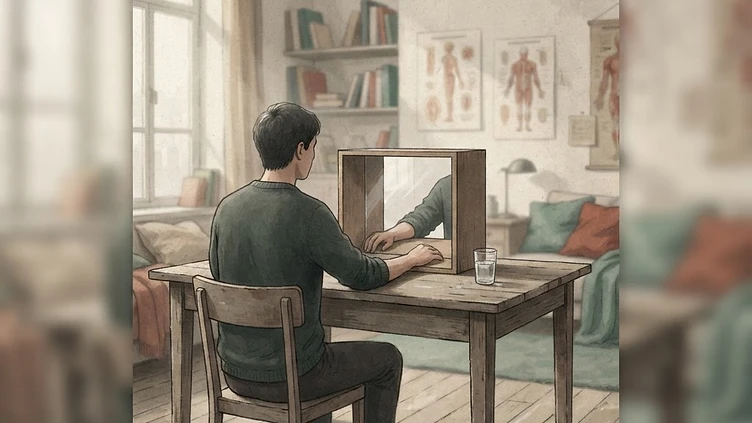
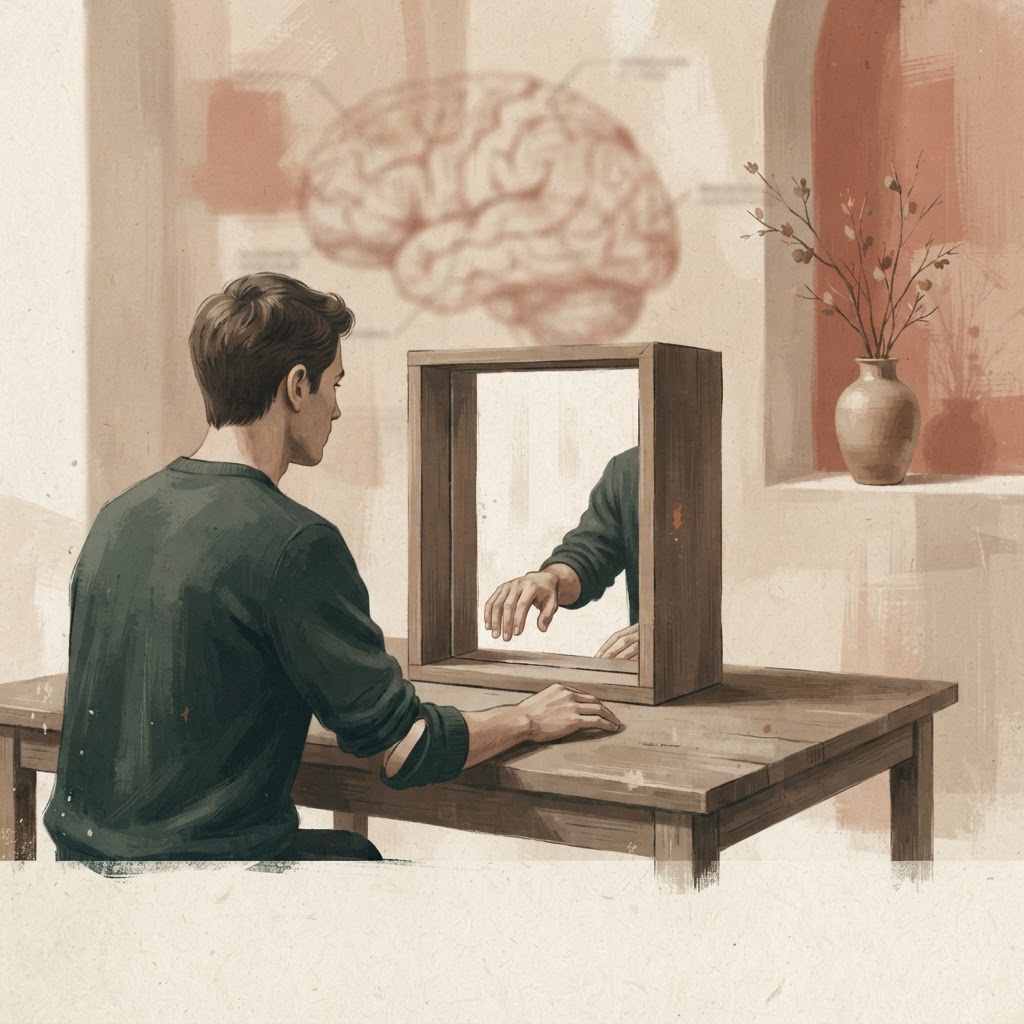
Imagine a person whose right arm has been amputated at the elbow, yet at night, they still feel a pin-prick sensation in the palm of that missing limb. How can a hand that is no longer there suffer pain? At first glance, this question seems absurd, as we generally assume that pain is tied to tissue, a nerve, or a wound. However, phantom limb pain shatters this assumption: even if the body vanishes, the map the brain has created of that body may remain in place. The mirror box experiment, which has become synonymous with Ramachandran's name, acts like a bridge built over this strange crack, demonstrating how an inexpensive mirror can soothe a pain that medicine has struggled to resolve for years. I wish to cross that bridge step by step in this text, for the story told is not merely an interesting clinical note but one of the clearest pieces of evidence we have regarding how the brain truly constructs the body. ## The Crack in the Body Map In the surface layers of our brain, there is a representation network corresponding to every body part; signals that move the hand and signals that twitch the lip reside in separate locations on this map. The interesting aspect of this map is that it functions not by the organ in the external world, but by the organ’s representation within the brain. When an arm is amputated, the tissue disappears, but the region in the brain dedicated to that arm is not immediately erased; it continues to send signals, wait, and even misinterpret. You might think the patient knows the arm is gone but does not feel it; the reality is stranger because the brain tells them the arm is still there, and sometimes, that it is writhing in agony. The critical question here is: is pain a product of the body or the brain? The answer contradicts our intuition: pain is always produced in the brain; the external wound may be a trigger for that production, but not a necessary condition. Some may object, arguing that if there is no tissue, how can a nerve ending send a pain signal? Yet that is exactly the issue; it is not the end of a severed nerve, but the old map in the brain that is activated. After amputation, the brain tries to fill the vacant region with signals from neighboring areas, leading to strange cross-connections, such as feeling tingling in a phantom hand when the face is touched. In this reorganization process, the brain sometimes recalls old motor commands, tells the hand to move, but no feedback arrives; the arm does not twitch because the arm is not there. This gap between the command and the result is experienced by many patients as a chronic sensation of cramping, and sometimes as unbearable pain. The body is not physically there, but the brain believes it is, and even that it is locked; this belief is no less painful than an actual wound. ## The Lie in the Mirror The solution Ramachandran discovered is not a complex drug or surgery; on the contrary, it has an almost childlike simplicity: placing a vertical mirror inside a box and having the patient place their intact hand in front of the mirror, with the side containing the phantom limb behind it. When the patient looks into the mirror, they see the reflection of their intact hand, and their brain mistakes this for the missing hand itself. When they open and close the intact hand, the reflection in the mirror also opens and closes; the brain accepts this visual information as real and is convinced that the phantom hand, which it had assumed was frozen and locked for years, has suddenly moved. This simple visual trick bridges the painful gap between the brain's motor command and the feedback it expects. Consequently, the patient feels not that their arm is cramped, but that it is opening freely; the pain withdraws precisely with this new perception. What is surprising here is how ready the brain is to be deceived. That our body could be redefined just because our eyes see something seemed a bit exaggerated to me when I first heard it; after all, pain should be a deep, biological, immutable reality, as we expect. But the accounts of Ramachandran's patients reverse this expectation: if visual evidence is sufficiently convincing, the brain can rapidly cancel its previous judgment. This shows that pain is not a fixed data point perceived from the outside, but an interpretation that the brain constantly updates. The mirror here is not performing magic; it is merely making visible something the brain is already inclined to do: the tendency to reconstruct the body at every moment. ## From Virtual Reality to Neuroprosthetics The principle revealed by the mirror box is simple but comprehensive: body perception is not a fixed reality, but a simulation that the brain constantly updates. Once this principle was understood, extending the same logic with more powerful tools was an inevitable step. Virtual reality goggles can now show the patient's lost limb as a three-dimensional, moving, and even interacting simulation, rather than just a static reflection. The patient is no longer looking at a fixed reflection, but at a digital hand that reacts to their own movements in real-time; this makes the brain’s persuasion process both more flexible and more permanent. Moreover, this technology is not limited to phantom pain; it is used with similar logic in rehabilitation after paralysis or for stroke patients, because the issue is actually always the same: providing the brain with convincing evidence that the body is still functional. Brain-machine interfaces go one step further in this story; now it is not just a visual illusion, but a matter of reading neural signals directly and transferring them to a prosthetic limb. The old hand map that is still active in the patient's brain can now be used to move a real robotic hand; the brain sends its command, the prosthesis executes it, and in some systems, even the sense of touch is fed back and transmitted to the brain. At this point, the connection I have drawn between the mirror box and neuroprosthetics has always made sense to me: both rely on the same fundamental truth—the body is not just muscle and bone, but a narrative the brain constructs regarding that muscle and bone. As technology advances, our capacity to rewrite this narrative increases; perhaps one day phantom pain will be relegated to history, but this will happen not through the discovery of a drug, but through tools that allow the brain to rebuild its own story. The reason I find Ramachandran's mirror box so striking is perhaps the depth that is inversely proportional to its low cost and simplicity. A patient sitting in front of a mirror is actually witnessing the silent, ongoing negotiation their own brain is having regarding the body; as we watch, we begin to question how fixed or constructed our own bodies actually are. Perhaps the real lesson is this: the place where we experience pain is not always the place where the wound is, but the place where the brain narrates that wound. And every time we can change that narrative, we redefine our relationship with our own body.
İlgili Denemeler
Can the Human Brain Detect Magnetic Fields?
Geophysicist Joseph Kirschvink's experiment at Caltech indicates that the human brain responds to magnetic fields, raising questions about a potential sixth sense.
Jan Hendrik Schön: The Physicist Who Fooled Science
The scandal of Jan Hendrik Schön's fabricated data at Bell Labs highlights the critical vulnerabilities in the scientific peer-review system.
Barry Marshall Drank Bacteria to Prove Stomach Ulcer Theory
Barry Marshall made medical history by consuming harmful bacteria to prove that stomach ulcers are caused by an infection rather than stress alone.
Tartışma (0)
Henüz yorum yok. İlk yorumu siz yapın.
Join the Newsletter
New essays, once a week, delivered to your inbox.