Project Pigeon: How Pigeons Guided WWII Missiles
During World War II, the U.S. military seriously attempted to transform the most common city bird into the most precise guidance system.
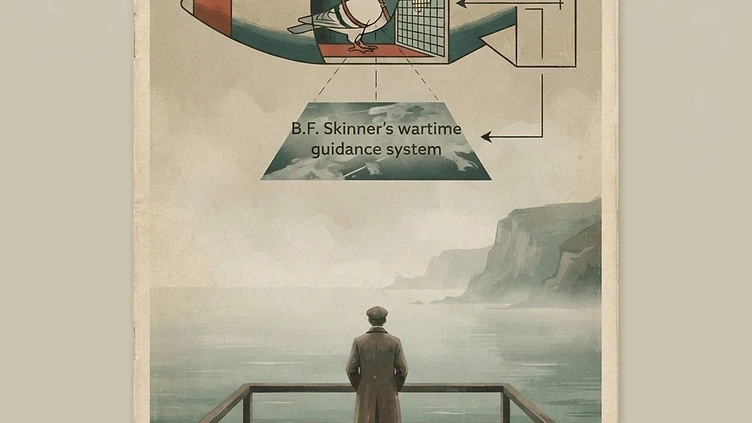
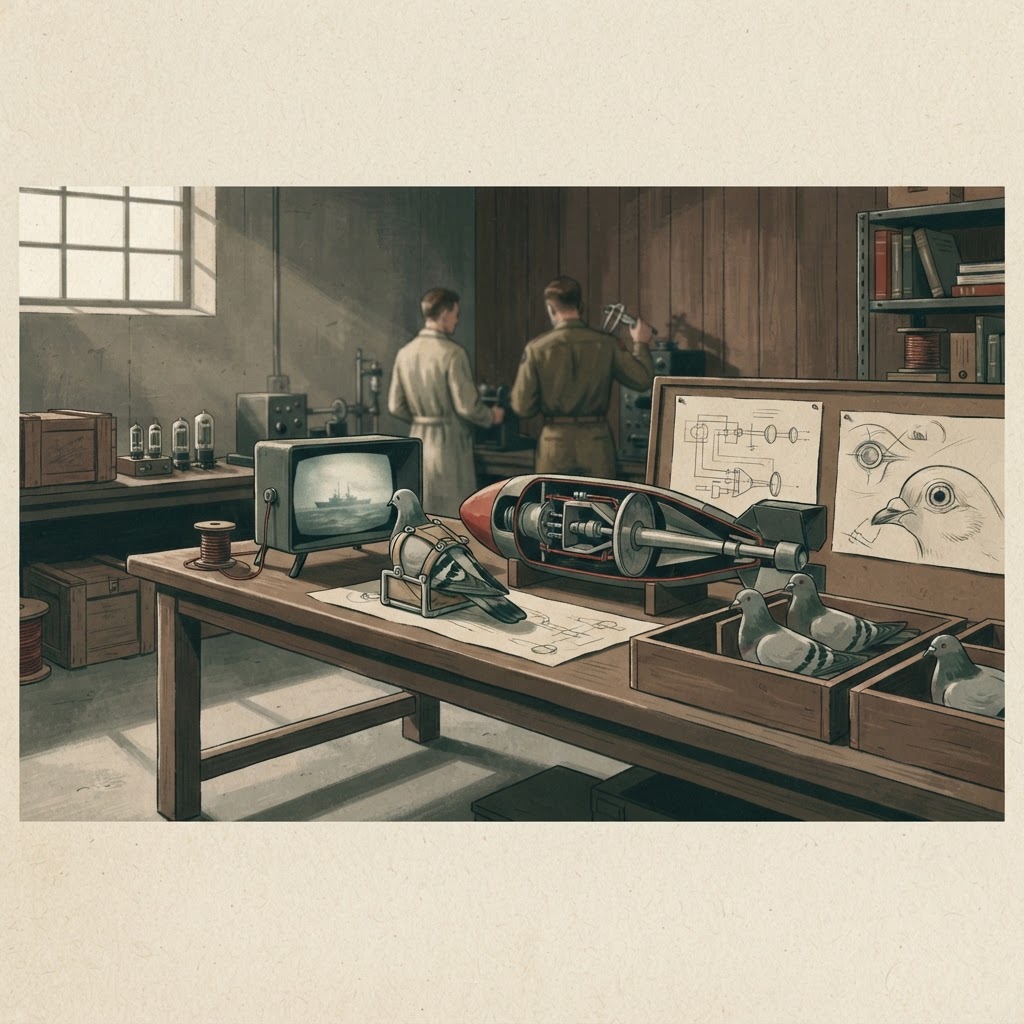
If I told you that in the middle of World War II, the American military attempted to rely on the instincts of a bird rather than technology, it might sound like a premise from a science fiction novel, yet it describes exactly what happened. B.F. Skinner, a young psychology professor at Harvard, imagined turning the common pecking behavior of pigeons into a mechanism precise enough to determine a bomb's trajectory. The question was simple: how stubbornly could a pigeon continue to peck at a target appearing on a screen, and would that persistence be enough to guide a missile to its mark? Project Pigeon, established to find the answer, became a strange and somewhat poignant experiment that showcased both the desperation of the era and the potential reach of behavioral science. ## A Guidance System Powered by a Beak Skinner worked in the field of operant conditioning, a learning model based on reinforcing or extinguishing a behavior based on its outcome. The choice of pigeon was not random: their keen eyesight, ability to react quickly to simple visual stimuli, and, most importantly, their ease of training with food rewards made them ideal. Skinner conditioned the birds to peck at a target image projected on a screen in front of a lens system housed in the nose of a bomb. When the bird centered the target, it received food; if it veered off, the pecking motion shifted the bomb's control surfaces to correct the course. Thus, without even realizing it, the pigeon became a living component of a feedback loop. The tests yielded surprisingly good results. Pigeons could peck at photographed targets for hours without wavering, and the margin of error could be further reduced by having multiple birds watch the same screen and make a collective decision. What was interesting here was that Skinner did not present this as a miracle or proof of intelligence; on the contrary, he wanted to demonstrate that behavior was mechanical, learnable, and predictable. A pigeon's brain could not perform calculations as complex as a radar, but with the right conditioning, a simple chain of reactions locked onto a single task could provide a level of visual tracking that the electronic systems of the time could not achieve. This revealed the core of the issue: it was not about intelligence, but reliable repetition. ## Not a Matter of Science, But of Reputation So, why was a technically functioning system shelved? This is where the strange part begins. When the project was presented to the military's defense committee, the numbers and test results were satisfactory; the problem was not the data, but the setting itself. The committee members could not bring themselves to take seriously the image of a pigeon trapped in a box inside a bomb, waiting for a seed. In a period where the war was waged with the highest expectations of technology, trusting the fate of victory to feathers and beaks weighed heavier than laboratory reports: it was a matter of reputation. One might counter that the committee was perhaps right, as it was difficult to predict how a living creature would behave under the stress of war; a pigeon could tire, panic, or lose its focus at an unexpected moment. But Skinner's response was equally strong: the electronic sensors of the era were just as fragile, if not more unpredictable, when faced with vibration, temperature, and humidity changes. It was not a genuine comparison of reliability, but a matter of perception. It was easy to accept an engineering flaw, but admitting a failure caused by a pigeon would have tarnished the military's sense of seriousness. The project was officially halted, and while it was briefly discussed in different contexts in later years, it never found serious support; even this detail proves that the primary obstacle was image-related, not technical doubt. ## The Forgotten Ancestor of Modern Guidance Systems The pigeons of Project Pigeon were relegated to the dusty corners of history, but the logic behind the project did not vanish so easily. In its essence, the system Skinner created was a primitive mimicry of what underlies every guided munition today: constant observation, instantaneous error calculation, and adjusting the course according to that error. The pigeon's beak was later replaced by electro-optical sensors, laser seekers, and infrared cameras, but the logic of the loop remained the same: see the target, measure the deviation, correct the path, and repeat. There is something here that we should pause and consider: why was a problem attempted to be solved with a bird eventually solved with circuit boards, yet the underlying idea remains so familiar? Because Skinner's true contribution was not the biological material, but the feedback loop itself. While engineers at the time were still largely working with direct, pre-calculated trajectories, Skinner envisioned the bomb having a continuous conversation with its target; this was an early rehearsal of the control and feedback theory that would mature in the post-war years. Moreover, it would be incomplete to look for this legacy only in military technology. The true mark Skinner left on behavioral science was the very cycle of reward and correction that underlies learning and even machine learning; this simple mechanism he built with a pigeon's beak can be read as an early dialect of the language that automation and control systems would speak in the following decades. Project Pigeon may have folded as a failed weapon, but the idea itself became a silent milestone on the path toward the development of electronic control. Today, if you asked an engineer at a missile factory, they would likely know nothing about Skinner's pigeons, and that is the most striking part of the story: some ideas survive by carrying their logic into other bodies and other materials, even after their original vessel is dismissed as ridiculous. The real legacy of Project Pigeon was not the bird, but the idea that a machine could maintain a continuous dialogue with its target, and that idea continued to live in other circuits long after the bird in the box was forgotten. Perhaps that is why the history of technology is so interesting: the smartest solutions sometimes emerge from the wreckage of the most absurd-looking experiments.
İlgili Denemeler
Can the Human Brain Detect Magnetic Fields?
Geophysicist Joseph Kirschvink's experiment at Caltech indicates that the human brain responds to magnetic fields, raising questions about a potential sixth sense.
Jan Hendrik Schön: The Physicist Who Fooled Science
The scandal of Jan Hendrik Schön's fabricated data at Bell Labs highlights the critical vulnerabilities in the scientific peer-review system.
Barry Marshall Drank Bacteria to Prove Stomach Ulcer Theory
Barry Marshall made medical history by consuming harmful bacteria to prove that stomach ulcers are caused by an infection rather than stress alone.
Tartışma (0)
Henüz yorum yok. İlk yorumu siz yapın.
Join the Newsletter
New essays, once a week, delivered to your inbox.