The Pitch Drop Experiment: The World's Slowest Science
Pitch placed in a funnel in Australia has been dripping for over a century, continuing science's most patient experiment.
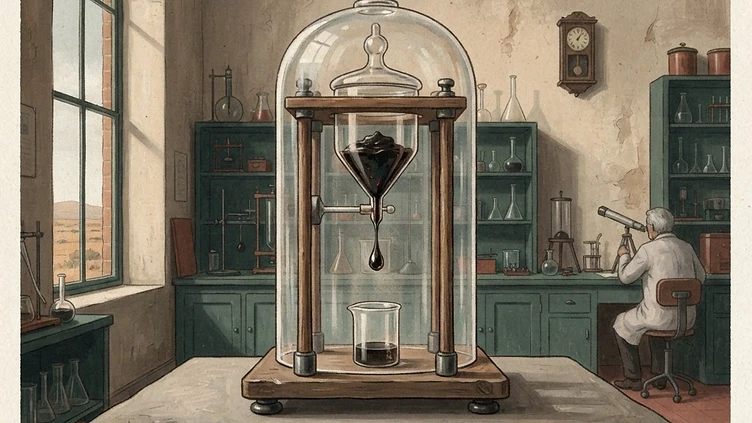
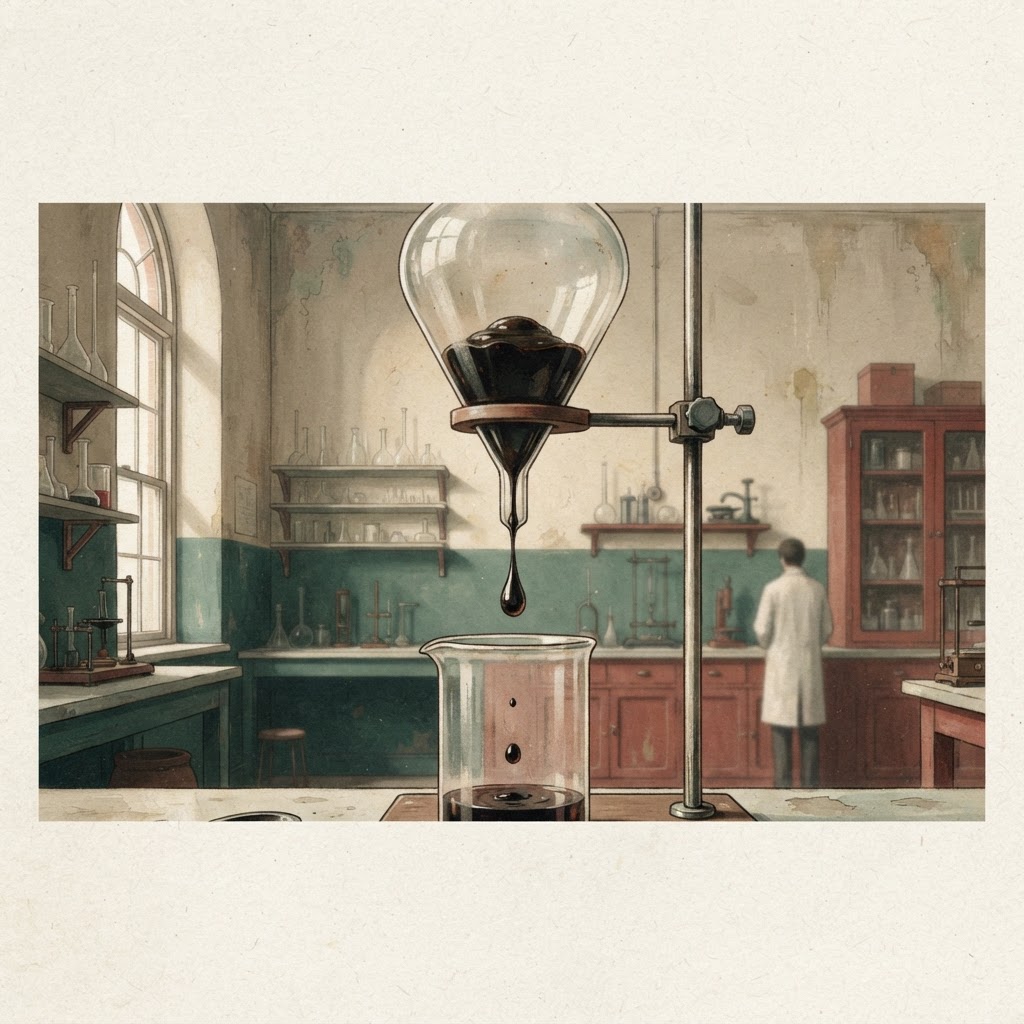
Imagine an experiment where the initiator passes away without seeing the result, and the successor shares the same fate. Science generally demands speed, data, and clear answers before moving to the next paper. Yet, in a corner of Australia, locked in a glass cabinet, the same question has been answered drop by drop since 1927: is pitch truly solid, or are we measuring time incorrectly? The question sounds simple, but the answer easily exceeds a human lifespan. This is why the Pitch Drop Experiment stands as one of the most patient, peculiar, and educational narratives in the history of science; with every drop, it questions both the nature of matter and our perception of it. ## A Liquid That Looks Solid Pitch shatters when handled and breaks when struck by a hammer; in every way, it reminds us of a solid object. In 1927, Thomas Parnell, a physics lecturer at the University of Queensland, wanted to demonstrate exactly this misconception to his students. He heated a piece of pitch, poured it into a funnel, waited three years for it to harden, and then cut the bottom of the funnel. The goal was simple: to reveal the difference between what our eyes see and what matter actually does. Because, when examined at the molecular level, pitch is nothing more than a liquid that never loses its fluidity, moving only at a speed we cannot perceive. The striking point here is how viscosity plays tricks on human perception. To understand whether a substance flows, we need time, not just our eyes; but our time is measured in seconds, or at most years, while pitch thinks in terms of decades. At this point, we must ask: if a substance appears to us as if it is not moving at all, how can we so easily decide that it is motionless? Consider glaciers; they look stationary while resting on a mountainside, yet they travel for kilometers over years. Pitch does exactly this, only our patience is not enough to observe it. The Pitch Drop Experiment stands there, under the same funnel for years, like a mirror forcing our impatience upon us. ## The Drop No One Could See The strangest, and perhaps most human, part of the experiment is that the drops never fall exactly when expected. Physicist John Mainstone, who oversaw the experiment for years, spent the better part of his career watching this funnel, yet strangely, he never once captured the precise moment a drop fell. Once he left the room to get a cup of tea, another time he went on a short vacation, and the drop silently broke away and fell. It was as if the experiment preferred not to be observed; it is the moment where continuous observation, the very thing science relies on most, is most lacking. This situation shows us that scientific observation is not just about discipline, but also a bit of luck. Of course, someone might say, keep the camera on all the time, problem solved, and eventually, this was done; a continuously running camera began monitoring the experiment twenty-four hours a day. But even this solution does not eliminate the core question, because it is not just a technical shortcoming. It is the fact that science can surprise us even when we are most prepared. If an event awaited with patience for years happens exactly during that one second when our attention drifts, perhaps nature is reminding us that we are not always in control. ## Science's Patience Beyond Human Lifespan Another dimension of the Pitch Drop Experiment is that it cannot fit into the lifespan of a single scientist. Parnell started the experiment but did not see the first drop fall; Mainstone took over but departed this world without catching the moment he sought. Now the experiment continues in other hands, and most likely, the person watching it today will not see the final drop either. This is not something modern science is accustomed to; today's academic world teaches us to produce results quickly, publish papers as soon as possible, and acquire data to advance our careers. The Pitch Drop offers the exact opposite model: a patience passed down from generation to generation, which no one can claim as their own. Is this patience truly science, or just an object of curiosity? It is fair to ask this question, as the experiment has almost no practical utility; we can measure the viscosity of pitch with much faster methods today. But perhaps the value of the experiment lies right there, outside of practical utility. Science is not always a race toward the next discovery; sometimes, simply observing, waiting, and passing that wait on to the next generation is a scientific stance. Pitch Drop shows us that science does not have to be hasty, and that sometimes the most valuable knowledge is hidden in an observation accumulated with patience over years. Today, that funnel still stands there, its camera is still on, and the pitch inside is still silently descending. Perhaps one day someone will see the drop fall while looking at the screen, or perhaps they will miss it again. But that is not the point; the point is that this patience, which has lasted for a century, makes us rethink our own time, our own impatience, and our expectations of science. While looking at the Pitch Drop Experiment, the question we ask is no longer just how slowly pitch flows, but how quickly we judge. And perhaps the most precious thing science teaches us is that sometimes waiting for an answer tells us more than searching for it.
İlgili Denemeler
Can the Human Brain Detect Magnetic Fields?
Geophysicist Joseph Kirschvink's experiment at Caltech indicates that the human brain responds to magnetic fields, raising questions about a potential sixth sense.
Jan Hendrik Schön: The Physicist Who Fooled Science
The scandal of Jan Hendrik Schön's fabricated data at Bell Labs highlights the critical vulnerabilities in the scientific peer-review system.
Barry Marshall Drank Bacteria to Prove Stomach Ulcer Theory
Barry Marshall made medical history by consuming harmful bacteria to prove that stomach ulcers are caused by an infection rather than stress alone.
Tartışma (0)
Henüz yorum yok. İlk yorumu siz yapın.
Join the Newsletter
New essays, once a week, delivered to your inbox.