Phineas Gage: The Miracle That Changed Neuroscience
How a railroad worker who survived an 1848 accident became the most famous case in the history of neuroscience.
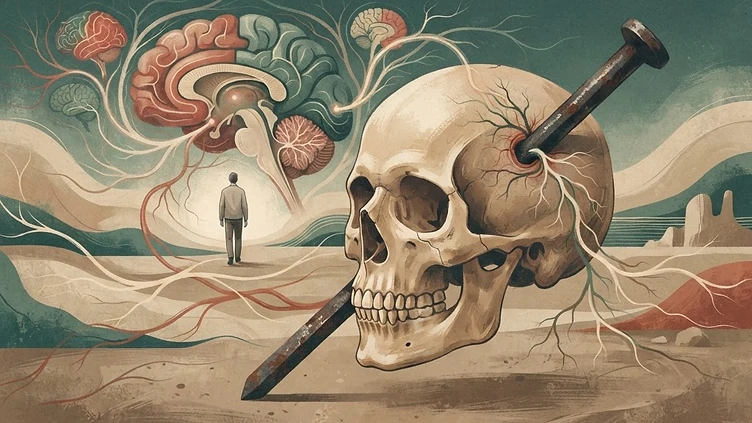
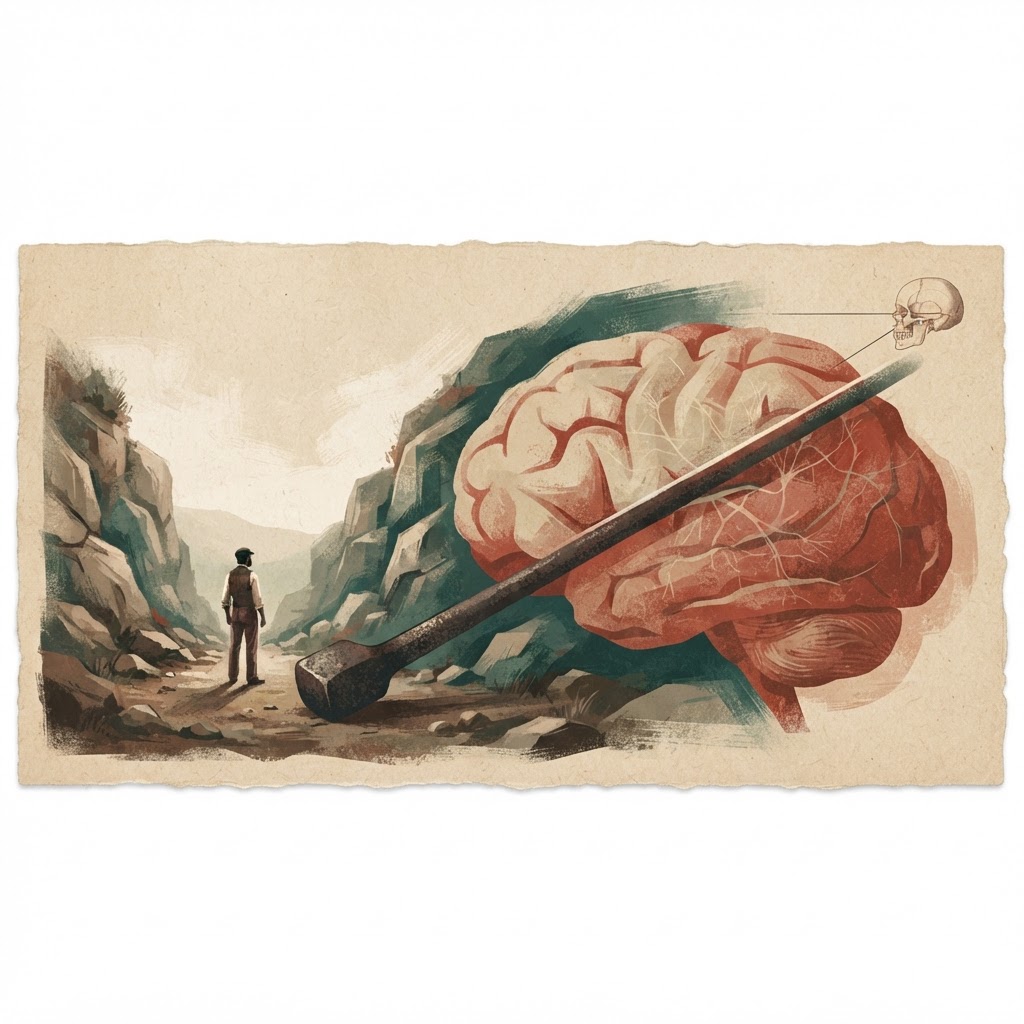
Imagine an iron rod entering a person's skull, just below the eye, and exiting through the top. Now, imagine this same person standing up minutes later, walking to a carriage, and explaining to their doctor what happened. When I first read this scene, I found it hard to believe; it felt as if the boundaries between a myth and a real medical case were blurring. Yet, what happened to Phineas Gage was a well-documented event in the mid-nineteenth century, and it remains one of the most cited stories in neuroscience today. What makes his story so intriguing is not just his survival, but how it shook our way of thinking about what the brain is and where personality originates. ## The Accident: What Happened in Vermont in 1848? The incident occurred in 1848 during a railroad construction project in Vermont. Gage was an experienced and capable foreman who worked with a long iron rod used to pack blasting powder into rock crevices. That day, a moment of inattention or a stroke of bad luck caused the powder to explode unexpectedly. The force of the blast launched the rod; it entered Gage's face, exited through the top of his skull, arched through the air, and landed several meters away. Everyone present at that moment assumed this man would be dead within minutes. But that did not happen. Gage did not lose consciousness and even began to talk shortly after. The records of Dr. John Martyn Harlow, who treated him, clearly show the astonishment this event caused in medical history. Physicians of the era found it difficult to believe that a person could survive such massive brain damage, let alone retain the ability to think and speak. In the medical understanding of that era, the brain was largely thought of as a single, undivided organ; the case of Gage became one of the first serious signs to shatter this assumption. Harlow's long-term monitoring of his patient and his meticulous note-taking paved the way for this case to move beyond a mere curiosity and become a scientific reference. ## Myth or Reality: How Was the Personality Change Exaggerated? Over time, Gage's story gained a second, more intriguing layer than the accident itself: the narrative of personality change. It was said that Gage, once a responsible and reliable foreman, had transformed into an aggressive, uncontrolled, and unreliable individual after the accident. This version was repeated so often that it infiltrated neuroscience textbooks, popular science articles, and even casual conversations. The idea that damage to the frontal lobe of the brain could make a person almost unrecognizable was alluring because it sounded both dramatic and instructive. But was it really so? Looking back at the original medical records, the picture appears much more measured. While Harlow's notes acknowledge a change in Gage's behavior, he does not describe it as the wild or permanent destruction seen in exaggerated narratives. Moreover, Gage's life after the accident does not align with the image of a completely dysfunctional person; it is known that he later worked as a stagecoach driver in Chile and maintained a steady work life for years. This simple fact alone weakens the claim that his personality had completely disintegrated. We must then ask where this exaggeration came from; the answer likely lies in science occasionally preferring the dramatic over the accurate when constructing its own narratives. As each generation retells Gage's story, it has projected its own era's assumptions about the brain onto it, layering a coat of myth over the actual case. ## Legacy to Modern Neuroscience: Why Is Gage Still Important Today? Even when stripped of its exaggerations, the Gage case opened the door to a fundamental transformation in neuroscience. Until the mid-nineteenth century, the brain was viewed by most thinkers as a homogeneous whole; the idea that functions like thinking, emotion, and decision-making might be distributed across different regions of the brain was not yet widely accepted. The damage to Gage's frontal lobe and the subsequent shift in his behavior provided one of the first tangible pieces of evidence for the idea that specific regions of the brain might be linked to specific functions. This turned an abstract philosophical debate into a concrete case; we were suddenly forced to consider that what we call personality could have a correspondence in physical tissue. Today, Gage's skull remains an object of study; thanks to modern imaging techniques, researchers can recalculate exactly which regions of the brain the iron rod passed through and discuss which neural networks might have been affected. These re-examinations transform Gage from a victim who lived over a century and a half ago into a current research subject. His name is still invoked in studies on the relationship between the frontal lobe and decision-making, impulse control, and social behavior, because the Gage example offers both a historical and conceptual starting point for discussing the link between brain damage and personality. The fact that a single case remains alive for so long shows that it is not just an interesting anecdote, but a reference point that science keeps returning to while telling its own history. The reason we hold onto Gage's story for so long, I suspect, lies in the unsettling question it asks us about ourselves. Is what we call our personality really so dependent on a few square centimeters of tissue inside our skulls? Gage's experience does not close this question with a definitive answer; on the contrary, it serves as a reminder of the brain's complexity, the unpredictability of damage, and the fact that the human mind can be both surprisingly resilient and disturbingly fragile. Perhaps this is why his story lives on not as an accident report, but as part of the human endeavor to understand itself; each new study, while looking back at that old skull, is actually asking the questions of today.
İlgili Denemeler
Can the Human Brain Detect Magnetic Fields?
Geophysicist Joseph Kirschvink's experiment at Caltech indicates that the human brain responds to magnetic fields, raising questions about a potential sixth sense.
Jan Hendrik Schön: The Physicist Who Fooled Science
The scandal of Jan Hendrik Schön's fabricated data at Bell Labs highlights the critical vulnerabilities in the scientific peer-review system.
Barry Marshall Drank Bacteria to Prove Stomach Ulcer Theory
Barry Marshall made medical history by consuming harmful bacteria to prove that stomach ulcers are caused by an infection rather than stress alone.
Tartışma (0)
Henüz yorum yok. İlk yorumu siz yapın.
Join the Newsletter
New essays, once a week, delivered to your inbox.