Peto's Paradox: Why Do Whales Get Less Cancer Than Humans?
The fact that massive creatures with trillions of cells develop cancer far less frequently than humans with significantly fewer cells is one of evolutionary biology's most startling enigmas.
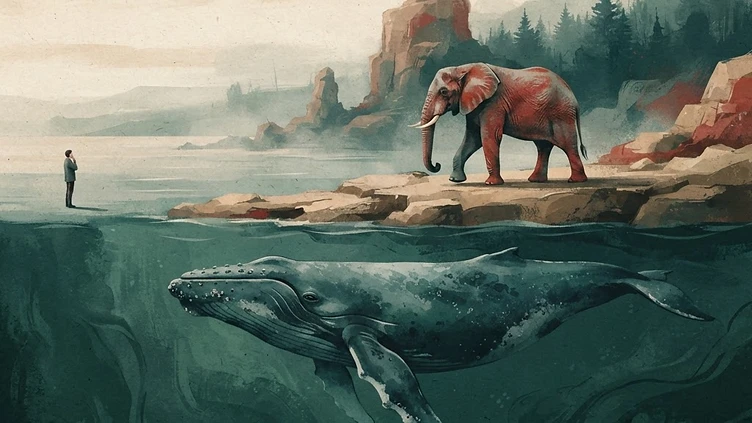
When you consider the massive body of a whale, have you ever wondered if any of the trillions of cells teeming within it might one day go rogue, forget the rules of division, and begin multiplying uncontrollably? Logic presents us with a simple equation: as the number of cells increases, the risk that one of those cells will become cancerous also rises. While the human body consists of thirty-seven trillion cells, a blue whale harbors vastly more; furthermore, as lifespans extend, the probability of mutation accumulation multiplies. Yet, the real world pays no heed to this elegant mathematics. Elephants, whales, and other large mammals face less cancer than their smaller-bodied relatives; this curious contradiction has become a puzzle known by the name of epidemiologist Richard Peto, a question that has haunted biologists for decades. ## The Unexpected Disconnect Between Cell Count and Cancer Risk We know that cancer is essentially a numbers game. Every cell division requires the replication of genetic material, and this copying process is not flawless; occasionally, a letter is misspelled, a sequence is distorted, or a gene is silenced or overstimulated. Most of these errors are harmless; the cell repairs them or sacrifices itself. But among millions or billions of divisions, some errors survive and accumulate. Theoretically, a creature that is both multi-cellular and long-lived, like an elephant or a whale, should provide much more opportunity for this accumulation of errors than the human body. Even a small mouse should be considered advantageous due to its short lifespan according to this logic, but a massive whale, with both its size and its lifespan spanning seventy to eighty years, should be an ideal laboratory for cancer. However, data suggests the exact opposite. The cancer mortality rate among elephants is significantly lower than that of humans; a similar trend is observed in whales. Peto, who first noticed this situation in the 1970s, revealed through his observations that cell count does not have a linear relationship with cancer risk, and this disconnect evolved into a paradox that bears his name. What is interesting here is that the paradox is not just an exception, but operates almost like a universal rule; when cross-species comparisons are made, the expected positive correlation between body size and cancer incidence is not found; on the contrary, there is often no correlation at all or even a slight inverse relationship. How can this be possible? We might think we are asking the wrong question; perhaps cell count is not the only variable determining cancer risk, and factors such as metabolic rate, immune system differences, or lifestyle come into play. This objection is partially true, but it does not offer a sufficient explanation on its own. For within the same species, for instance, in humans, a slight positive correlation is observed between height and cancer risk; taller individuals are statistically slightly more prone to cancer. This indicates that cell count is indeed a factor, but that this factor is somehow balanced across species transitions. Thus, evolution must have invented another mechanism that comes into play in large-bodied species; the answer to the question lies not in the number of cells, but in how those cells are protected. ## The Elephant's Secret Weapon: Extra Tumor Suppressor Genes This is where the answer scientists have sought for years comes in: elephants possess far more genetic mechanisms to clean up damaged cells than ordinary mammals. Specifically, studies on the tumor suppressor gene known as p53, described as the guardian angel of the genome, have shown that this gene is not just a single copy in the elephant's genome, but is repeated in dozens of copies. While human cells make do with only a pair of p53 genes, elephant cells carry dozens of additional copies of this gene. These extra copies mean more alarm buttons that can be activated when a damaged cell is detected; if they are damaged.hey detect a problem, they trigger cell death.hey are detected.he cell is detected as damaged, the alarm is raised.he cell is damaged beyond repair, these genes rapidly direct it toward apoptosis, or programmed cell death. The beauty of this mechanism is that it reminds us that the only way to prevent cancer is not necessarily to avoid creating mutations altogether. On the contrary, although elephants have more cells and therefore statistically more mutations than humans, they have developed a system that ruthlessly weeds out cells carrying these mutations. When a cell begins the path toward cancer, the elephant body does not wait, it does not argue, it does not give it a second chance; it instantly deactivates that cell. This is a form of evolutionary safety measure, balancing the risk brought by having a large body with a solution forced by the same large body. Whales also possess similar, though not identical, mechanisms; some research suggests that genes related to DNA repair in the whale genome are also duplicated or regulated in different ways. At this point, one might raise an objection: if extra tumor suppressor gene copies are so effective, why haven't all mammals adopted this strategy? The answer lies in the fact that evolution never chooses the best solution, but rather the one that is sufficient under the circumstances. For a small-bodied and short-lived animal, the cancer risk is already low because it has both fewer cells and does not live long enough for cancer to develop. Therefore, there is no evolutionary pressure for these species to develop an extra defense mechanism. However, for a creature that is both large and long-lived, like an elephant or a whale, cancer is a serious threat capable of causing death before reaching reproductive age; therefore, evolution has applied a ruthlessly selective pressure to build additional layers of protection in these species. An elephant ancestor with extra p53 copies must have lived longer and left more offspring than its peers without this copy; over time, this trait spread throughout the entire population. ## The Hope the Paradox Brings to Human Medicine Peto's Paradox does not remain merely a zoological curiosity; it also opens a new window for oncology research. If elephant cells can destroy themselves so quickly and effectively when damaged, understanding the molecular pathways behind this mechanism could reveal ways to trigger a similar response in human cells. Some research groups are attempting to decipher how this gene works so effectively by comparing the response of cells carrying the elephant p53 gene to DNA damage with that of human cells. The goal is to one day develop drugs that mimic this mechanism; in other words, teaching human cells to behave as if they had extra p53 copies. The allure of this idea lies in the notion of not just treating cancer, but preventing it from the start. Most of today's cancer treatments come into play only after the disease has already emerged; chemotherapy, radiotherapy, or targeted drugs are all used in the stage after a tumor has formed. Yet, the strategy of elephants intervenes before a tumor forms, the moment a cell begins to go rogue. If such an early warning and early destruction system could be strengthened in human cells, it might be possible to stop cancer at its root. This is, of course, not an easy engineering problem; adding extra gene copies to the human genome could lead to unexpected side effects, as the p53 gene is also related to the aging process, and disrupting this balance could create other problems. Nevertheless, the most valuable thing this paradox teaches us is perhaps the fact that evolution has been experimenting with ways to fight cancer for millions of years. Human medicine generally tries to invent solutions from scratch, whereas nature has solved, tested, and preserved what works in different species in different ways. Elephants and whales can be thought of as natural archives carrying the summary of experiments that would take years in a laboratory within their own genomes. What scientists need to do is read this archive correctly and translate it into a form suitable for human biology. This process may not be fast, but even the paradox itself reminds us that cancer is not an inevitable fate and can be a preventable disease, even on a large scale. This entire story actually shows that size is not a problem in itself, but an opportunity to accumulate solutions. While a whale's trillions of cells might first appear to the human mind as a pile of risk, evolution has turned this pile into a line of defense. Peto's Paradox reminds us that cancer is not a simple numbers game and that living creatures have been producing solutions appropriate to their own scales for millions of years. Perhaps the real question is not why we get cancer, but how nature can suppress this disease so skillfully even in bodies much larger than our own. Pursuing this question pushes scientists to look both at the genomes of elephants and into the deepest corners of the human cell; and this perspective could one day fundamentally change the way we understand cancer.
İlgili Denemeler
Can the Human Brain Detect Magnetic Fields?
Geophysicist Joseph Kirschvink's experiment at Caltech indicates that the human brain responds to magnetic fields, raising questions about a potential sixth sense.
Jan Hendrik Schön: The Physicist Who Fooled Science
The scandal of Jan Hendrik Schön's fabricated data at Bell Labs highlights the critical vulnerabilities in the scientific peer-review system.
Barry Marshall Drank Bacteria to Prove Stomach Ulcer Theory
Barry Marshall made medical history by consuming harmful bacteria to prove that stomach ulcers are caused by an infection rather than stress alone.
Tartışma (0)
Henüz yorum yok. İlk yorumu siz yapın.
Join the Newsletter
New essays, once a week, delivered to your inbox.