Paolo Macchiarini: The Truth Behind the Trachea Scandal
While a surgeon celebrated as the star of the Karolinska Institute claimed to achieve the impossible, how many patients lives did he actually put at risk?
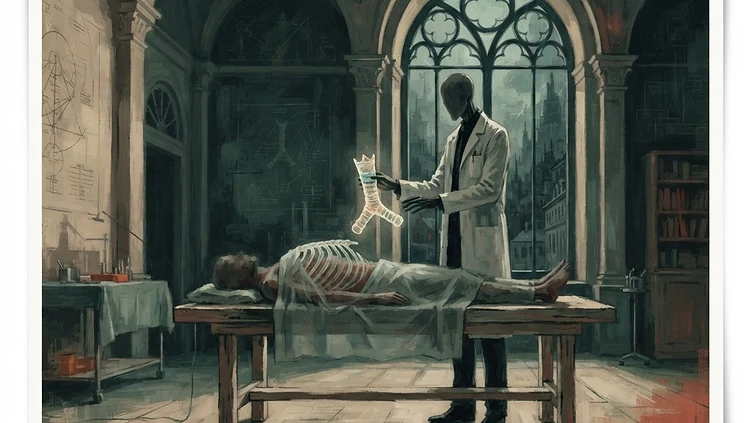
In the history of science, some stories fill us with both wonder and dread. The story of Paolo Macchiarini carries exactly this duality: on one side, a surgeon shining with the promise of a cure for a fatal disease; on the other, a silent destruction lurking behind that promise. The question seems simple, yet its answer is anything but: how many lives can a person truly endanger while claiming to have achieved the impossible? The case of Macchiarini proves painfully that this question is not merely a theoretical exercise and that even the most trusted institutions of science can fall into this trap. ## A Career Built on the Promise of a Miracle Imagine a patient facing death due to a tracheal illness, offered a brand-new windpipe made from a plastic scaffold coated with their own cells. It sounds like science fiction, does it not? This was precisely the idea Macchiarini proposed: coating a synthetic frame with the patient stem cells to overcome the harsh realities of donor organ waiting lists. This idea was not only bold but also promised great hope for the future of regenerative medicine. Who could be expected not to be excited by someone who seemed to have solved a problem that the medical community had struggled with for years? Yet, what is interesting here is not the idea itself, but how it was presented. Macchiarini was not just a scientist; he was an impressive storyteller. In press conferences, interviews, and lecture halls, he introduced this technology as the medicine of the future. The media easily embraced this narrative because the story was perfect: desperate patients, a courageous surgeon, and a solution pushing the boundaries of science. However, there was a fundamental question that should have been asked but rarely was: had this technology been tested sufficiently in the human body? As the magnitude of the excitement replaced scientific caution, asking questions began to appear almost like an attitude that spoiled the celebration. ## The Silence of the Karolinska Institute A institution prestige can sometimes be its greatest weakness. The Karolinska Institute, a globally respected medical institution and a pillar of the Nobel Prizes, faced a dilemma. To question the achievements of a surgeon working at such an institution meant questioning the institution own reputation. So, what happened when early warning signs emerged? Concerns from colleagues, inconsistencies in patient outcomes, and suspicious data in published papers all came up at some point, but the institution chose silence rather than taking these signals seriously. This silence did not stem from deliberate malice, but rather from an institutional reflex: closing eyes to avoid tarnishing its own shining star. One might object here that every new technology faces doubts and every revolutionary idea encounters resistance, so ignoring early criticism is not always a sign of bad intent. This objection is partially true, as the history of science is full of ideas that were rejected before being validated. But in Macchiarini case, the issue was not encountering standard scientific skepticism; the issue was that reports of concrete patient harm were repeatedly brought to the table, and the institution chose to cover them up rather than investigate. When forced to choose between protecting an institution reputation and seeking the truth, Karolinska chose the path that stood in direct opposition to the skepticism that must be at the core of science. This shows us that institutional trust can sometimes be the enemy of truth. ## The Cost to Patients and the Crisis of Scientific Trust The heaviest part of this story is, of course, the patients who entrusted their lives to this experimental method on the operating table. For them, options were already limited; perhaps that is why agreeing to an experimental treatment was a logical consequence of desperation. However, the fact that most of these patients did not survive the operation is not just an individual tragedy but also an indicator of how the scientific system can crack. The mechanism we call peer review is theoretically science way of self-correction; it is expected to prevent the spread of incorrect or premature results. But in Macchiarini case, this mechanism was repeatedly deactivated because those who questioned were sometimes silenced, sometimes ignored, or sometimes simply no one wanted to listen. At this point, we must ask: why is peer review so easily broken? The answer perhaps lies in the human side of science. Scientists are also human beings sensitive to hierarchy, fame, and institutional interests; criticizing a colleague, especially when that colleague is the star of a powerful institution, is not an easy task. Macchiarini case reveals the chasm between accountability as an abstract principle and its application in real life. The cost to patients was heavy, but this cost also held a mirror to the scientific community: the reflection we see is a system far more fragile than we would like to admit. Today, as we look back on this story, perhaps the most striking thing is that malice alone is not a sufficient explanation at any stage. Macchiarini own ambition, the institutional reflexes of Karolinska, the media enthusiastic narrative, and the desperation of the patients; all these were woven together to make this catastrophe possible. Perhaps the greatest danger in science is not evil, but carelessness combined with good intentions. Macchiarini story reminds us that behind every brilliant promise, there must always stand a mundane, patient skepticism; because what we call a miracle can sometimes be nothing more than an unquestioned error.

İlgili Denemeler
Can the Human Brain Detect Magnetic Fields?
Geophysicist Joseph Kirschvink's experiment at Caltech indicates that the human brain responds to magnetic fields, raising questions about a potential sixth sense.
Jan Hendrik Schön: The Physicist Who Fooled Science
The scandal of Jan Hendrik Schön's fabricated data at Bell Labs highlights the critical vulnerabilities in the scientific peer-review system.
Barry Marshall Drank Bacteria to Prove Stomach Ulcer Theory
Barry Marshall made medical history by consuming harmful bacteria to prove that stomach ulcers are caused by an infection rather than stress alone.
Tartışma (0)
Henüz yorum yok. İlk yorumu siz yapın.
Join the Newsletter
New essays, once a week, delivered to your inbox.