Overview Effect: How Seeing Earth From Space Changes Humans
Most astronauts who travel to space claim they are not the same people upon their return; what is the source of this profound transformation?
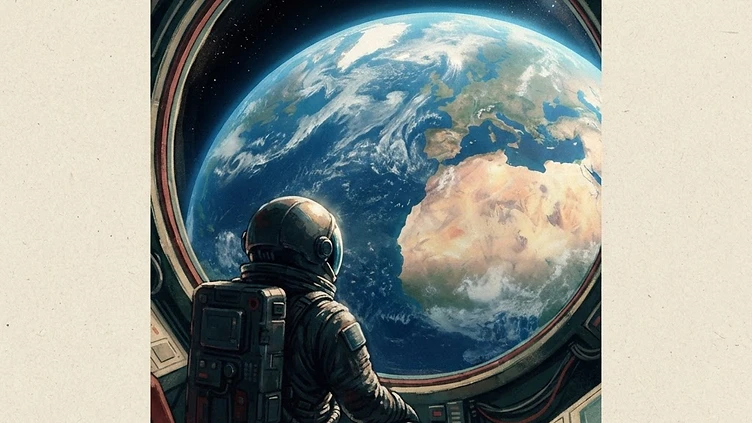
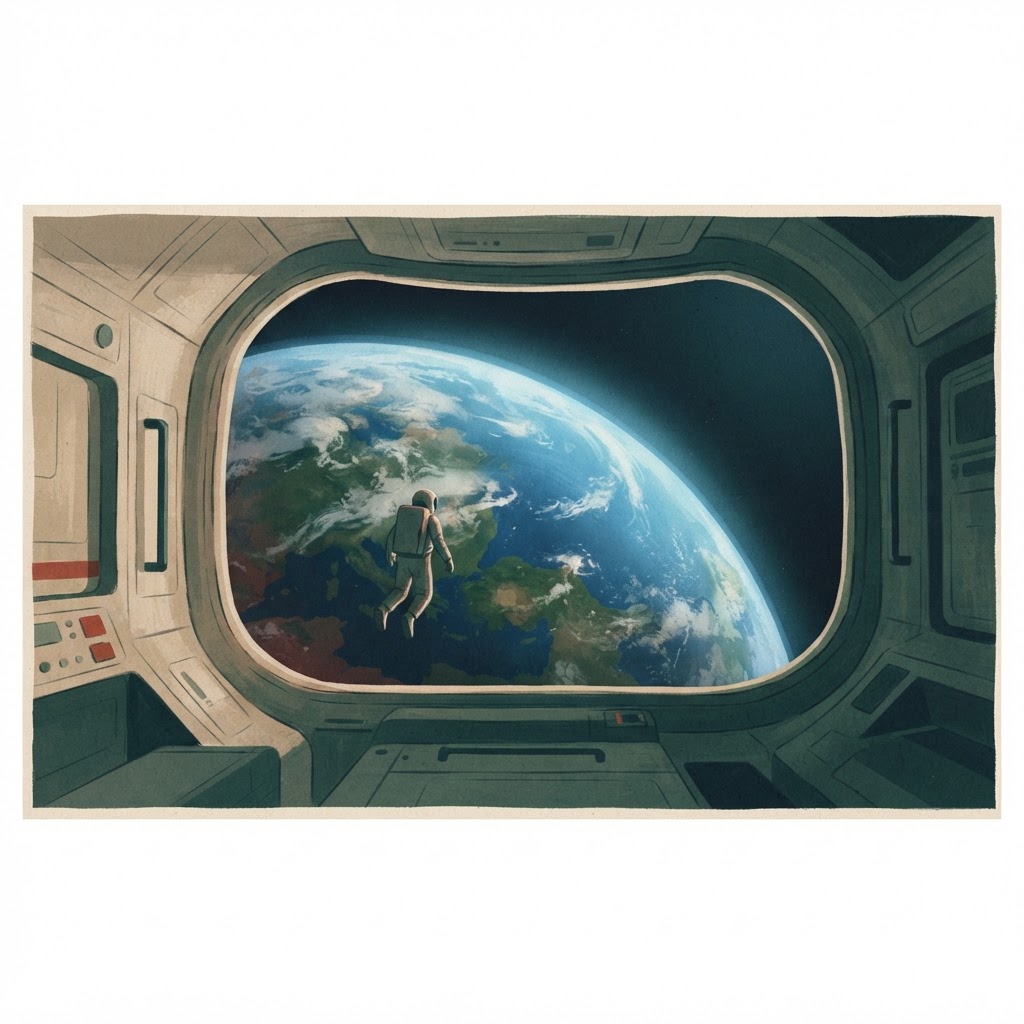
None of us can truly know what a human encounters when they travel to space, for the number of those who have ventured there is small, and what they recount upon returning often pushes the limits of language. Astronauts report that as they watch Earth through the window, something breaks within them; it is as if concepts they held until that moment—identity, ego, and belonging—suddenly lose their meaning, replaced by a larger, more daunting sense of wholeness. This shift displays a pattern so common and recurring that it has been given a name: the overview effect. How is it possible for a mere few seconds of observation to change a person so fundamentally? Seeking the answer requires looking into personal experience, the functioning of the brain, a philosophical question, and an increasingly growing commercial sector. ## The Mental Fracture Named by Frank White When Frank White coined this term to describe the shared impression astronauts shared upon their return, he was not inventing a new emotion but giving voice to an experience that already existed without a name. What caught his attention was that astronauts from different cultures, faiths, and missions described the same phenomenon in strange ways. One likened the sky to a thin blue membrane, another noticed that borders exist on maps but not in reality, and a third realized how small a detail their own life truly was. In this similarity, White pursued something much deeper than ordinary excitement: proof that the way a person defines themselves can change radically alongside the expansion of their perspective. The striking element here is that this transformation moves beyond a temporary euphoria into a permanent shift in identity. Most returning astronauts admit they cannot look at their old lives with the same eyes; career goals, political affiliations, and even feelings of nationalism lose their former weight. One might argue this is merely fatigue or the emotional intensity of the mission, but the accounts collected by White do not align with such an explanation; the effect persists years after the mission, with some astronauts defining it as the turning point of their lives. It is clear this is not a transient mood but a permanent shift in perception itself; the moment humans see Earth as a whole, they instantly recognize their own fragmentation. ## The Measurable Traces of Awe The inevitable question arises: can such a subjective, personal account be studied scientifically, or are we left with beautiful but unprovable stories? This is where research on the emotion of awe comes in. Awe is an emotional state long studied by psychologists, one that pulls a person outside their own self, typically triggered by encountering something large-scale and unexpected. It is a repeatedly observed pattern that this emotion makes one feel smaller, the world larger, slows the perception of time, and fosters a sense of connection with the community. When we interpret the overview effect through this lens, what the astronauts describe ceases to be a strange mystical experience and becomes a familiar mechanism of the human mind activated by an extreme trigger. This is precisely why NASA takes this subject seriously: if awe truly leads to a detectable change in the brain, the overview effect is not just an interesting anecdote but a window into how the human mind operates under extreme conditions. When dealing with practical matters like the psychological resilience of astronauts on long-term missions, crew harmony, and motivation for returning to duty, understanding how this emotion works is not just philosophical curiosity but a matter of mission safety. Thus, there is a strange intersection here where poetic narrative and laboratory questions meet; one does not invalidate the other, but rather strengthens it. ## A Commercialized Transformation Yet, this deep, almost sacred experience is no longer the monopoly of professional astronauts. With companies like Blue Origin and Virgin Galactic sending ordinary passengers to space for a few minutes, the overview effect has suddenly turned into a purchasable product. This situation is both hopeful and unsettling: if this experience truly changes people, would it not be good for the world if more people had access to it? Increased sensitivity toward global warming, less obsession with borders, and a stronger sense of shared destiny might only be possible through the proliferation of such an experience. Still, an unsettling question remains: it is unclear whether a one-minute view carries the same weight as what an astronaut living in orbit for months experiences. Perhaps the issue lies not in the duration but in the preparation, the unexpected nature, and the intertwining of life with irreversible risk; in a tourist flight, most of these elements are missing. Moreover, the moment the experience is tied to a ticket, the risk emerges of it becoming a privilege accessible only to those with economic power. This creates an ironic picture: an experience expected to unite humanity with a sense of wholeness is ultimately distributed through inequality. Amidst this entire debate, one cannot help but ask: perhaps the overview effect teaches us something not about space, but about perspective. Perhaps it is not the distance, the altitude, or the location that changes us, but the opportunity to look at one’s own life and boundaries from the outside. If so, as unsettling as the commercialization of this experience may be, the underlying need remains the same: the human desire to remember one’s own smallness and realize how temporary and constructed one's attachments are. Whether it is possible to seek this perspective without going to space, or if one truly needs to look out that window, remains a question perhaps too human to ever be answered.
İlgili Denemeler
Can the Human Brain Detect Magnetic Fields?
Geophysicist Joseph Kirschvink's experiment at Caltech indicates that the human brain responds to magnetic fields, raising questions about a potential sixth sense.
Jan Hendrik Schön: The Physicist Who Fooled Science
The scandal of Jan Hendrik Schön's fabricated data at Bell Labs highlights the critical vulnerabilities in the scientific peer-review system.
Barry Marshall Drank Bacteria to Prove Stomach Ulcer Theory
Barry Marshall made medical history by consuming harmful bacteria to prove that stomach ulcers are caused by an infection rather than stress alone.
Tartışma (0)
Henüz yorum yok. İlk yorumu siz yapın.
Join the Newsletter
New essays, once a week, delivered to your inbox.