Oumuamua: Alien Craft or Natural Space Rock?
Discovered in 2017, this peculiar celestial object has split the scientific community for years with its movement, which challenges the laws of physics.
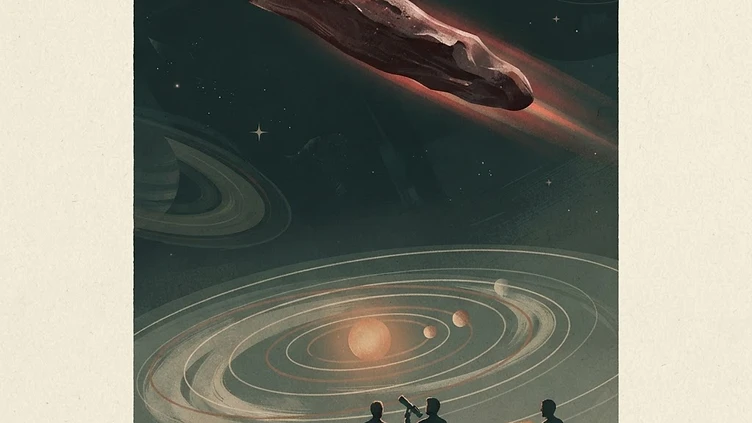
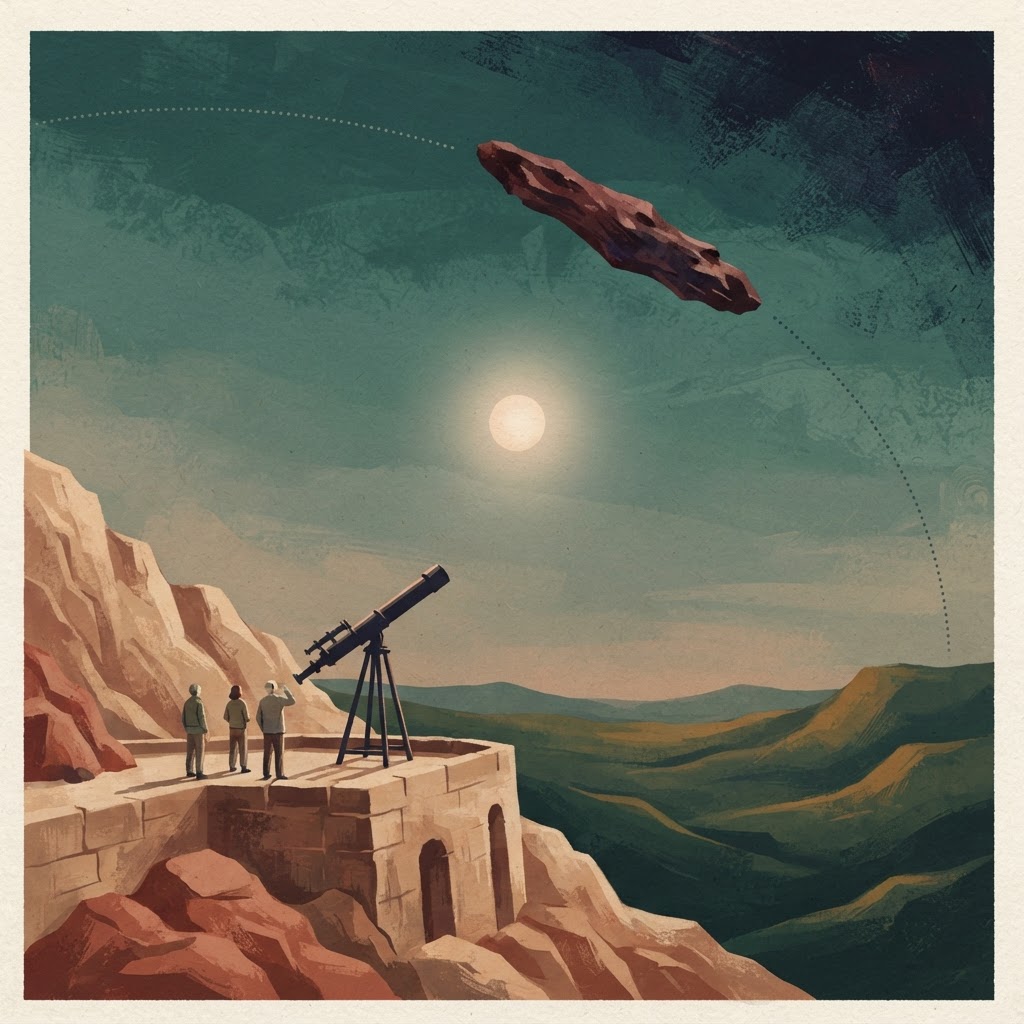
In October 2017, while the Pan-STARRS telescope in Hawaii was scanning the sky, it encountered a point of light of a kind never seen before. Initially assumed to be an ordinary comet or asteroid, its movement, the way its brightness varied, and the path it followed defied every catalog available to astronomers. Realizing it had arrived from outside our solar system, from interstellar space, it was named Oumuamua, meaning scout or messenger in Hawaiian. In the years since, this piece of rock, if it is indeed just a rock, has remained one of the most debated topics in the scientific community. How, then, can a celestial object make physicists so uneasy and raise so many questions? ## The Extraordinary Object Captured by Telescopes When astronomers cannot directly observe the shape of an object, they look at how its brightness changes over time. Because Oumuamua’s light dimmed and brightened at regular intervals as it rotated, scientists deduced that it possessed an extremely long and thin structure; its length was more than ten times its width, almost like a cigar or a pen. This ratio did not match any asteroid or comet observed in our solar system; it did not seem plausible to physicists that natural processes could produce such extreme geometry. Its rotation was also irregular, as if it were tumbling through space uncontrollably, which opened up further questions about its origin. Moreover, as the object approached the sun, it did not show a tail or a cloud of gas, as expected; there was no familiar glowing trail left behind by a classic comet as its ice warms and evaporates. At first glance, this made it resemble an asteroid, but asteroids were not expected to take on such an extreme shape. In short, Oumuamua behaved like neither a full comet nor a full asteroid; it was a difficult-to-define intermediate form between the two categories. For astronomers, this uncertainty was the first sign that made the object both fascinating and unsettling. ## Acceleration That Cannot Be Explained by Gravity As Oumuamua began to move away from the sun, researchers continued to track its trajectory for months and noticed something unexpected: the object was accelerating slightly more than what could be predicted by the sun’s gravity alone. This kind of extra acceleration is a known phenomenon in comets because vapor erupting from the surface creates a small rocket effect that pushes the object. But here things became complicated because neither a gas cloud nor a dust trail was seen around Oumuamua; spectroscopic measurements found no traces of the expected type of outflow. Thus, the question of what mechanism was pushing the object remained unanswered. Scientists proposed several natural explanations to fill this gap; for example, it was debated that there might be an incredibly thin but effective layer of hydrogen ice on the surface of the object, and that this ice could silently evaporate due to sunlight, pushing the object. This idea seemed plausible because it could provide thrust without leaving observable gas or dust. Still, even this explanation did not carry absolute certainty, because how such a pure layer of hydrogen ice could remain intact throughout an interstellar journey was a separate riddle. Every answer brought with it a new question, and this turned Oumuamua into an unsolved equation rather than an ordinary space rock. ## A Harvard Professor’s Claim and the Limits of Science Into this void, astrophysicist Avi Loeb from Harvard University proposed a different possibility: what if this object is not a natural but an artificial structure? According to Loeb, Oumuamua’s movement, being both extremely thin and showing an unexpected sensitivity to sunlight, allowed for a comparison to a solar sail; a very thin, very light structure could be pushed by the pressure of sunlight to accelerate beyond what natural gravity calculations predicted. With this proposal, Loeb suggested that the object might be a craft or a remnant sent by another civilization; it was a bold idea, but not entirely baseless, as it could at least mathematically explain the observed anomaly. This claim triggered the expected reaction in the scientific community: most astronomers reminded everyone that a natural scenario is always a more reasonable starting point to explain the same data. The old principle known as Occam's razor suggested that the simplest explanation should be preferred, and the assumption of an alien craft was a far greater claim than an ordinary mechanism like hydrogen ice. Critics emphasized that jumping to such a far-fetched conclusion without direct images or samples could damage scientific discipline and that caution should not be sacrificed to gain popular interest. But there was also some validity on Loeb’s side; in the history of science, some radical ideas were ridiculed when first proposed, only to be confirmed years later. The true value of this debate was perhaps not about who was right, but that it reignited the question of how science should behave in the face of the unknown. On one side is caution: not jumping to the most extraordinary explanation without evidence is the cornerstone of the scientific method. On the other side is courage: trying to force unusual data into conventional boxes can sometimes block the way to a real discovery. Both coexisted in the case of Oumuamua; while some scientists clung cautiously to natural explanations, others preferred to keep the possibilities wide open. This tension is, in fact, as old as science itself. Oumuamua has now left our solar system, moving away into the darkness in such a way that it can never be examined up close again. Perhaps this is why everything said about it is based not on definitive proof, but on interpretations built upon the incomplete data at our disposal. But it is precisely this incompleteness that makes it so impressive; because it shows us that the universe sometimes leaves behind only questions without providing all the answers. Perhaps Oumuamua was just an oddly shaped piece of rock, or perhaps it was a trace of something we will never know. Standing in that gap between the two is perhaps the most honest state of science.
İlgili Denemeler
Can the Human Brain Detect Magnetic Fields?
Geophysicist Joseph Kirschvink's experiment at Caltech indicates that the human brain responds to magnetic fields, raising questions about a potential sixth sense.
Jan Hendrik Schön: The Physicist Who Fooled Science
The scandal of Jan Hendrik Schön's fabricated data at Bell Labs highlights the critical vulnerabilities in the scientific peer-review system.
Barry Marshall Drank Bacteria to Prove Stomach Ulcer Theory
Barry Marshall made medical history by consuming harmful bacteria to prove that stomach ulcers are caused by an infection rather than stress alone.
Tartışma (0)
Henüz yorum yok. İlk yorumu siz yapın.
Join the Newsletter
New essays, once a week, delivered to your inbox.