Mycorrhizal Networks: The Forest's Underground Web
How do trees talk to each other and share nutrients beneath the soil through fungi?
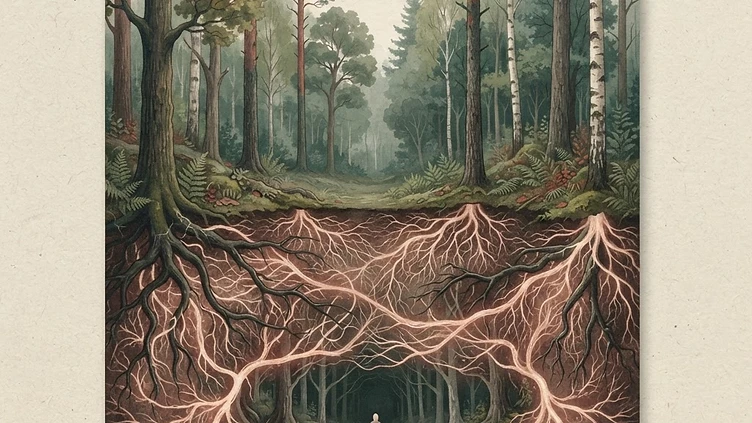
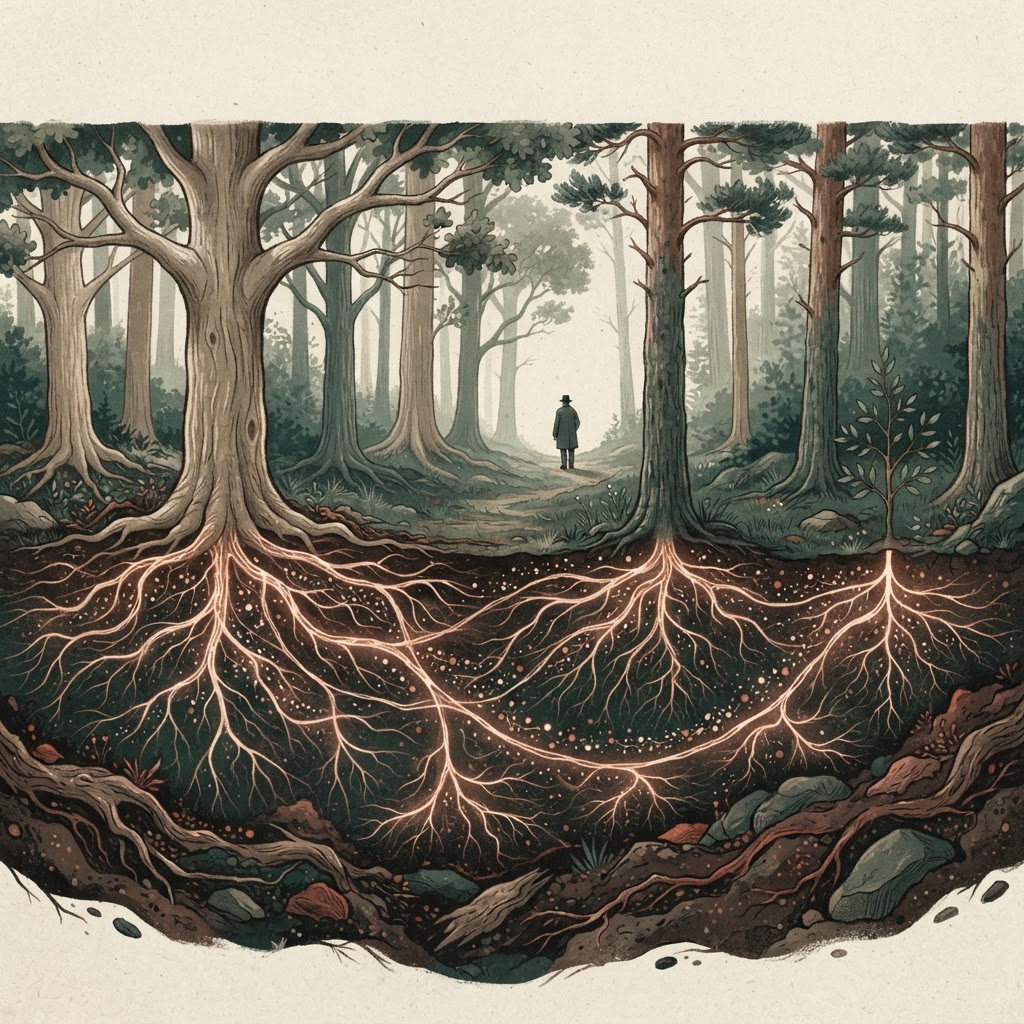
When walking through a forest, we often believe what we see: that trees are independent entities competing for sunlight, quietly fighting beneath the soil with their roots. Each engages in its own struggle for survival; the strongest capture the most light, while the weakest wither in the shade. However, findings uncovered by biologists in recent years have fundamentally shaken this picture. A few centimeters beneath the soil, in a world invisible to the eye, trees communicate, share nutrients, and even assist one another. When I first heard this, it sounded like a fairy tale; then I realized the true fairy tale was the old narrative that nature consisted solely of competition. ## A Network Built Among Hyphae Mycorrhizal fungi consist of thin filaments, almost impossible to notice, living on the blurry boundary between root and soil. These filaments are called hyphae, and in a handful of soil, they can stretch for miles. Scientists have shown that these hyphae are not limited to the roots of a single tree but form a massive network connecting the roots of many trees in the forest. In other words, when you enter a forest, it would not be wrong to say you are not seeing individual trunks, but parts of a single organism intertwined beneath the ground. This network functions like a kind of subterranean internet, as some researchers suggest; each tree is a node connected to this grid, and every hypha is a cable transmitting the information between them. What is carried across this network? Not only water and minerals, but carbon compounds and even danger signals can travel from one tree to another through these hyphae. It has been observed that when one tree suffers an insect attack, neighboring trees begin to produce defensive chemicals. Translated into human language, this could be thought of as a form of screaming; one perceives the danger, and the information flows from root tips to fungal hyphae, and from there to other roots. We must stop and ask here: what does a tree gain by warning its neighbor of impending danger? The answer may lie in this: the forest acts as a system that invests in the resilience of the whole rather than the survival of a single tree. ## The Mother Tree's Table The most striking aspect of this underground network is the role played by the old, large trees in the forest. Researchers sometimes call these mother trees because they act as resource hubs, not just for their own growth, but for the survival of the young saplings around them. Consider a small sapling with limited access to sunlight that has remained in the shade; the energy it can produce through photosynthesis is very limited. It is at this point that the fungal network connected to the old tree's roots intervenes, transferring excess carbon compounds to the small sapling. This is somewhat like the story of a child growing at a mother's table; the sapling cannot yet set its own table, but it feeds from the family's meal. This finding fundamentally changes how we understand the forest. Instead of seeing each tree as an independent individual standing on its own, we must now think of them as parts of an interdependent community. When a tree is cut down, not only does a trunk disappear, but the future of the saplings it fed and was connected to is also jeopardized. This requires us to rethink forestry policies, and even the logic of tree planting in urban parks; perhaps instead of planting trees individually, it is necessary to establish a texture where roots can reach one another. There is, of course, an objection that comes to mind: if every tree is so interdependent, why do some trees still grow faster than others and overshadow them? The answer, I believe, lies in the fact that cooperation does not entirely eliminate competition, but it does cease to be the only explanation. ## Cooperation Replacing Competition The language we have used for centuries to describe nature relies on the image of a battlefield where the strong survive. This image. has deeply shaped both scientific thought and our intuitions about daily life; in the workplace, the market, and even our relationships, we have believed that the only way to survive is to leave the competition behind. But the picture presented by mycorrhizal networks opens a serious crack in this one-dimensional narrative. If the oldest, strongest trees share their energy with weak saplings, it means that in nature, sometimes the price of being strong involves keeping those around you standing as well. This does not mean competition has vanished; there is still a race for sunlight, and roots still compete for water. But beneath this race, a hidden network of solidarity balances it out. We must also ask this: is cooperation done solely out of kindness, or is there a calculation of interest for the trees as well? As biologists point out, a forest remaining resilient as a whole may provide more benefits than a single tree being strong alone; a connected forest is more resistant to drought, disease, and storms than a solitary trunk. Thus, cooperation can also be read as a long-term survival strategy rather than a romantic sacrifice. This tells me something about humans as well; perhaps the forms of solidarity we see in our societies also arise not from pure kindness, but from the intuition that the collapse of the whole will take everyone down with it. What the forest teaches may be that kindness and interest are not always opposites. Putting all these findings side by side, I can no longer look at a forest as I once did. Knowing that an invisible conversation is taking place beneath every standing trunk, and that nutrients, warnings, and even a form of memory are flowing deep in the soil, changes the mental map I have constructed of nature. Perhaps the real issue is not just that nature gives us lessons in survival, but that it reminds us how connected we are, even in places where we seem separate. This silent telegraph line built beneath the soil whispers to us that the solitary trunks we see above are not lonely at all; perhaps the answers to the questions we ask about human communities are also coming from the most unexpected place, the silence of a fungal network.
İlgili Denemeler
Can the Human Brain Detect Magnetic Fields?
Geophysicist Joseph Kirschvink's experiment at Caltech indicates that the human brain responds to magnetic fields, raising questions about a potential sixth sense.
Jan Hendrik Schön: The Physicist Who Fooled Science
The scandal of Jan Hendrik Schön's fabricated data at Bell Labs highlights the critical vulnerabilities in the scientific peer-review system.
Barry Marshall Drank Bacteria to Prove Stomach Ulcer Theory
Barry Marshall made medical history by consuming harmful bacteria to prove that stomach ulcers are caused by an infection rather than stress alone.
Tartışma (0)
Henüz yorum yok. İlk yorumu siz yapın.
Join the Newsletter
New essays, once a week, delivered to your inbox.