Operation Sea-Spray: The US Secret Biological Test
In 1950, an American port was turned into a test site for a cloud of live bacteria without the public having any idea.

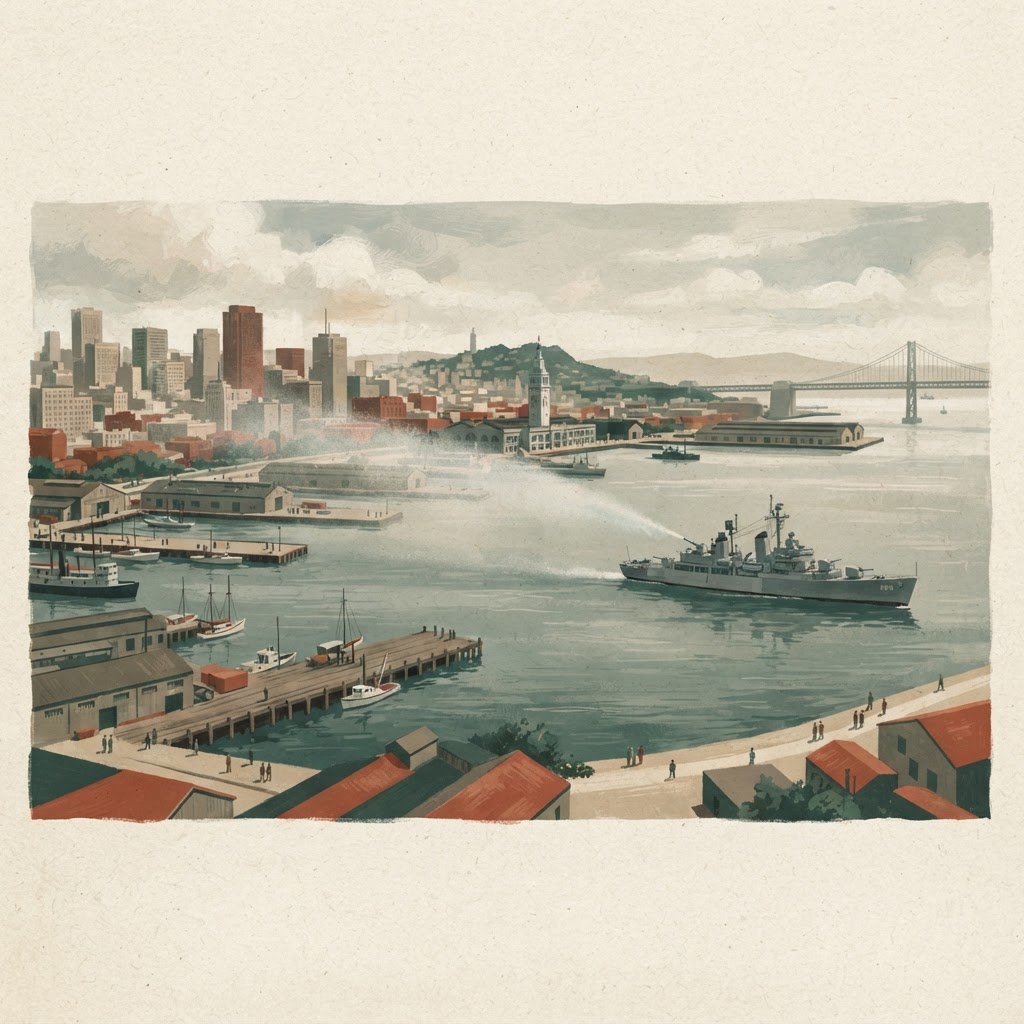
On a morning over San Francisco Bay, the sky is slightly hazy and the sea is calm. Port workers, families out for morning walks, and children on their way to school have no idea that the air they breathe that day is not ordinary. A fine mist from the deck of a ship spreads over the city, unnoticed because it was never meant to be noticed. This scene is not science fiction; it is the cold reality of Operation Sea-Spray, conducted by the US military in 1950. What does it mean for a nation to make its own citizens, within its own borders, a part of an experiment without their consent? While seeking the answer to this question, one must also question when science ceases to be research and turns into a violation. ## Releasing a Bacteria Thought to be Harmless In the shadow of the Cold War, the American military wanted to measure the potential effects of biological weapons on cities. The question asked was simple yet chilling: If an enemy state were to release a biological agent into an American port, how much would it spread, how many people would it affect, and through which corridors would it infiltrate? To find the answer, a live test scene was preferred over theoretical models. San Francisco was seen as an ideal laboratory due to its geography, the structure of its port, and its population density. The bacteria Serratia marcescens was chosen because, based on the knowledge of that era, it was believed to be harmless to human health; furthermore, its reddish color made it easy to visually track how it dispersed in the air. One must pause here and ask: Does the belief that a bacterium is harmless make it legitimate to test it on humans? The logic of the military was that conducting an experiment with a substance considered harmless would not create an ethical problem. However, this logic itself completely sidelined the concept of consent. Thousands of people, without knowing what substance they were exposed to, became subjects of an experiment that was part of the air they breathed one morning. The cloud sprayed from the deck of the ship reached the city's streets, homes, and lungs, and no one chose to be a part of this process. Scientific curiosity used the public's ignorance as a tool; this reveals the ethical void of the experiment rather than its scientific value. ## The Truth Covered Up for Two Decades Documents and reports that emerged after the experiment was conducted remained on the dusty shelves of military archives for years. The public continued their lives without knowing that the air they breathed was once part of an experiment. This silence was not just the protection of a state secret; it was also proof of how scientific responsibility can turn into a power game. The truth came to light in the mid-1970s during Senate investigations into intelligence activities. The time that passed until then was a period where almost an entire generation remained deprived of this information. So, what does this long silence reveal? It is easy to think that science is transparent within itself, but in state-led research, transparency often melts away under the guise of national security. There is an interesting contradiction here: the military's goal was to protect the public, but this protection was based on completely disregarding the public's right to know. Documents revealed during the Senate investigations exposed not only Sea-Spray but also other similar experiments; this showed that it was not an isolated error but part of a systematic approach. This twenty-year silence has gone down in history as proof of how inadequate scientific institutions can be in self-regulation. ## The Origins of Today's Biosecurity Debates What makes Sea-Spray a modern issue, rather than just a past scandal, is that it forms the origin of an ongoing debate. Today, gain-of-function research, which involves making pathogens more infectious or dangerous, creates a similar tension in the scientific community. Is making a virus more potent in a laboratory done to prepare for future pandemics, or do these studies themselves become a new source of risk? There is a striking similarity between the question asked by Sea-Spray and the question asked by today's biosecurity laboratories: When does an experiment conducted in the name of security become a security threat itself? The issue of consent in public health interventions also draws from this historical root. At what point does a vaccination campaign, a substance added to a water source, or a disease tracking program require an individual's informed consent? Sea-Spray shows that the answer to this question is not always clear. When states claim to act for the good of society, there is always the danger of individual consent remaining in the shadows. Although bioethics committees, research approval processes, and international oversight mechanisms have been established today, none of these are an absolute guarantee. The legacy of Sea-Spray stands as a warning, reminding us why these mechanisms exist; because once trust is broken, it can take years to rebuild it. The air breathed in the streets of San Francisco that morning has gained a different meaning in the more than seventy years that have passed. Now, this event is not just a record of a military experiment, but a concrete example of how easily that thin line between science and power can be crossed. In every new biosecurity debate, in every piece of news about gain-of-function research, the ghost of Sea-Spray returns in some way; because the question it asks remains unanswered: Can science use human life as a tool in the name of protecting human life? The answer to this question is not a clear yes or no, but at least not forgetting the question itself might be the first step to ensuring the silence experienced in the past does not repeat itself.
İlgili Denemeler
Can the Human Brain Detect Magnetic Fields?
Geophysicist Joseph Kirschvink's experiment at Caltech indicates that the human brain responds to magnetic fields, raising questions about a potential sixth sense.
Jan Hendrik Schön: The Physicist Who Fooled Science
The scandal of Jan Hendrik Schön's fabricated data at Bell Labs highlights the critical vulnerabilities in the scientific peer-review system.
Barry Marshall Drank Bacteria to Prove Stomach Ulcer Theory
Barry Marshall made medical history by consuming harmful bacteria to prove that stomach ulcers are caused by an infection rather than stress alone.
Tartışma (0)
Henüz yorum yok. İlk yorumu siz yapın.
Join the Newsletter
New essays, once a week, delivered to your inbox.