Operation Popeye: The US Secret Cloud Weaponization Project
Could an army really weaponize the weather to bury the enemy's supply routes in mud?

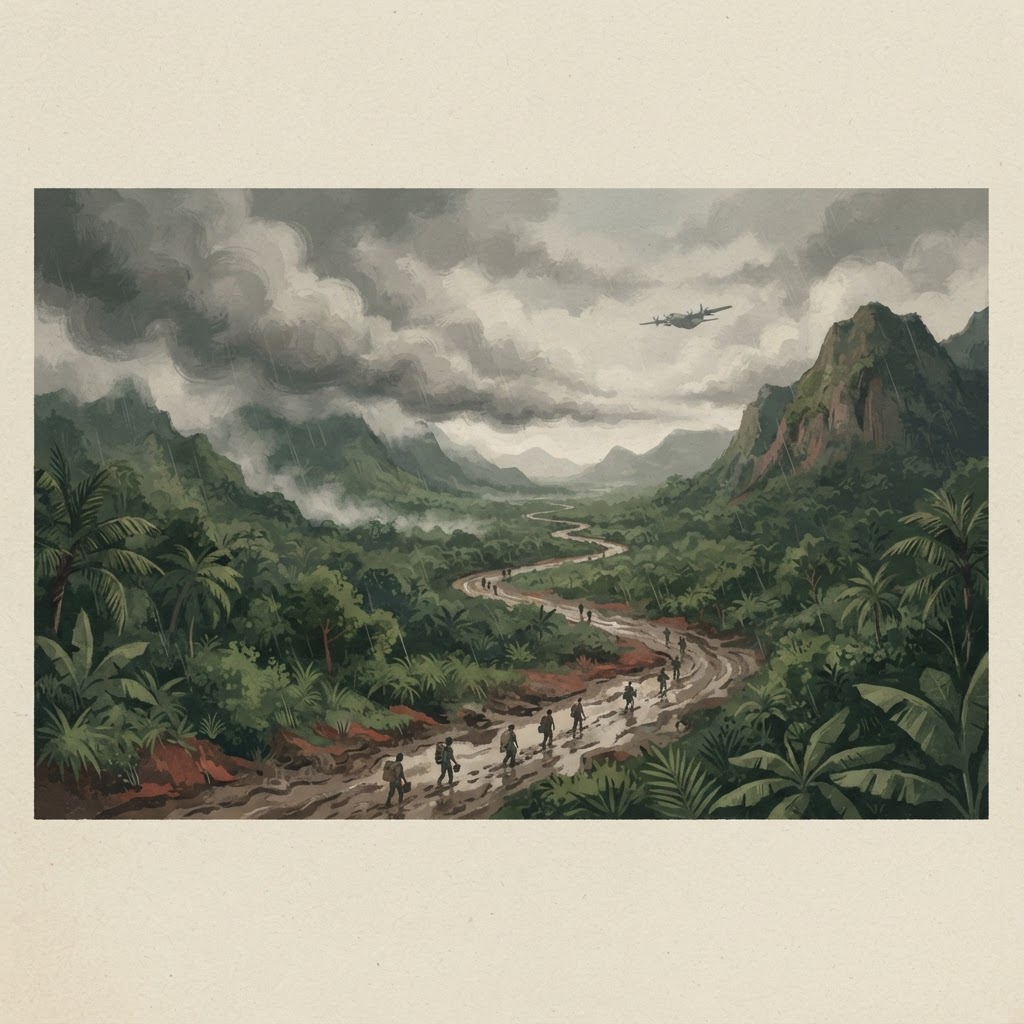
It might seem strange to think that the U.S. military had a deal with the sky. Yet, one of the quietest chapters in military history tells the story of exactly such an agreement. Can a nation manipulate clouds to turn an enemy's path into a quagmire? While the question sounds like science fiction, it became a genuine military doctrine during the Vietnam War. Known as Operation Popeye, this project turned the sky into a front line and clouds into ammunition. When we trace the roots of today's debates on climate engineering, we encounter the traces of this old and covert operation. ## A War Rained Down with Silver Iodide Between 1967 and 1972, U.S. Air Force planes seeded clouds over Laos with silver iodide. The goal was simple but audacious: to drench the Ho Chi Minh Trail—the critical route used by North Vietnamese forces to transport troops and supplies to the south—with rain far exceeding seasonal norms. Trucks buried in mud, washed-out roads, and stalled convoys; this was a way to slow the enemy without firing a single shot. For military planners, this was a means of altering the physical geography of war, turning nature into a weapon depot. We must stop and consider: we know what a bomb does, but who can control what a cloud does? When silver iodide crystals are released into clouds, they create nuclei around which water droplets condense, triggering rain. The theory was clean on paper, but in practice, weather systems know no borders. Rain dumped on one region could drive neighboring areas to drought or unexpectedly flood civilian farmland. Thus, the U.S. military was not just playing with the enemy's path, but with the balance of an entire ecosystem; whether they were aware of this is another question. ## The Pentagon's Denial and Disclosure By 1971, details of the operation leaked to the press. The news created a wave of shock in Washington, as it presented a story that was bizarre both militarily and ethically. The Pentagon's initial reaction was exactly as expected: denial. Spokespeople claimed such a program did not exist and that reports were based on misinformation. However, the denial was short-lived, as pressure from the press and the public brought the issue to the Senate floor. The Senate investigation revealed a dimension of war history that had never before been so openly discussed: it was understood that weather conditions were being secretly and systematically used as a weapons system. This revelation shook the familiar categories regarding the tools of war. Tanks, planes, mines; we could understand these. But turning a cloud into a weapon redefined the war's relationship with nature. Moreover, this was as disturbing as the secrecy itself, because the military's reflex to deny actually showed they were conscious of their actions. Would one persist in hiding something if they truly believed they were innocent? ## From ENMOD to Modern Geoengineering The political echoes of the scandal turned into an international convention in 1977. ENMOD, which prohibits the use of environmental modification techniques for military or hostile purposes, is the direct legacy of Operation Popeye. What is interesting here is that international law is trying to ban an intention, not a technology. Cloud seeding itself was not banned; it is still practiced in many parts of the world to combat drought for agricultural purposes. What was banned was the use of this technique as a tool of conflict. The convention attempted to draw a line on weaponizing nature, but it simultaneously revealed how flexible that line is. Today, when we look at climate engineering discussions, we see the same tension returning in a different guise. Proposals such as spraying particles into the atmosphere to reflect sunlight, fertilizing oceans, or brightening clouds are now on the table in the name of finding solutions to the climate crisis. The difference is this: in Vietnam, the goal was to weaken the enemy; today, the goal is to cool the planet. But the question remains the same, as a step taken by one country could turn into a storm on the shore of another. Who will decide, and who will be held responsible? Even if technology is presented as a well-intentioned solution, the question of who holds control is not very different from the secrecy issue in Operation Popeye. Climate engineering advocates might say that this is now a field conducted with transparency, scientific rigor, and international cooperation; but the promise of transparency is a promise that has been made and broken before. The story of Operation Popeye is actually more about human intention than the technology itself. Silver iodide is a harmless chemical compound; cloud seeding is a neutral technique on its own. The real issue is what the power holding this tool uses it for. While those rain clouds in Vietnam formed the invisible front of the war, today's geoengineering projects are progressing with similar invisibility, because we cannot see or understand an intervention in the sky as easily as an explosion on the ground. Perhaps this is why history keeps whispering the same question: is our desire to control nature always stronger than our desire to protect it?
İlgili Denemeler
Can the Human Brain Detect Magnetic Fields?
Geophysicist Joseph Kirschvink's experiment at Caltech indicates that the human brain responds to magnetic fields, raising questions about a potential sixth sense.
Jan Hendrik Schön: The Physicist Who Fooled Science
The scandal of Jan Hendrik Schön's fabricated data at Bell Labs highlights the critical vulnerabilities in the scientific peer-review system.
Barry Marshall Drank Bacteria to Prove Stomach Ulcer Theory
Barry Marshall made medical history by consuming harmful bacteria to prove that stomach ulcers are caused by an infection rather than stress alone.
Tartışma (0)
Henüz yorum yok. İlk yorumu siz yapın.
Join the Newsletter
New essays, once a week, delivered to your inbox.