Operation Acoustic Kitty: The CIA's Spy Cat Project
How did this secret, multi-million dollar project end with a cat being struck by a taxi?
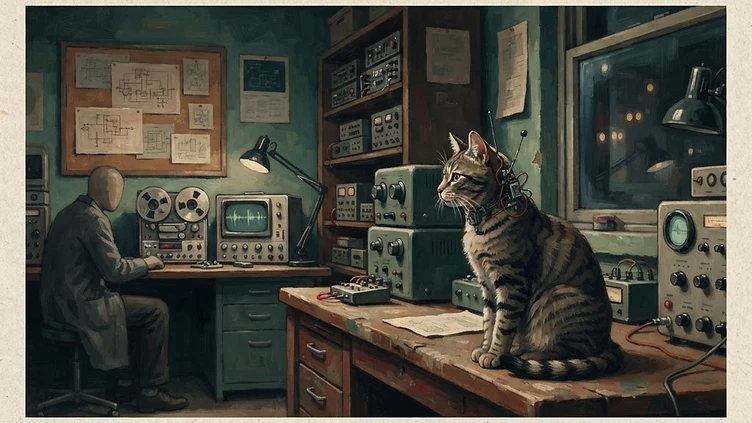
The most peculiar moments in human history are often born from the most serious intentions. The world of intelligence, operating in the shadow of the Cold War, sometimes approached illogical ideas with such gravity that these ventures, which seem ridiculous to us today, turned into projects supported by massive budgets. The CIA's attempt to turn a cat into a live listening device, Acoustic Kitty, is one of the most striking examples of this absurdity. Although the idea of turning an animal into a tool for capturing the secret conversations of an enemy sounds like science fiction, it was a real operation that lasted for years and cost millions of dollars. So why would an intelligence agency take an idea so contrary to the logic of nature so seriously? The answer lies in the mentality of the era and how paranoia collided with technological ambition. ## The Paranoid Imagination of the Cold War During the Cold War years, intelligence agencies found ways to stay one step ahead of the enemy by trying every possible solution. The race for information, much like the nuclear arms race, opened a field of limitless competition; whoever could listen faster and watch more covertly would gain the upper hand before a war even began. In this atmosphere, technology was no longer just improving the possible; it was bringing the impossible to the table. A cat's ability to wander through streets, gardens, and embassy courtyards unnoticed began to be seen as a strategic opportunity in intelligence circles. Nobody would look at a cat with suspicion, whereas a human agent could lose their cover with the slightest movement. This logic reflected a broader trend of the period: the dream of redesigning nature for intelligence purposes. Similar experiments with pigeons and even other animal species were all products of this paranoid imagination. Was it really reasonable to pour so many resources into such an ambiguous idea? Perhaps the answer should be sought not in logic itself, but in the fear of losing. The true driving force of the Cold War was the belief that the opponent might be one step ahead; this fear was enough to legitimize even the most absurd projects. While turning a cat into a spy was not realistic, the attempt itself carried a kind of deterrent message against the rival. ## Implanting a Microphone into a Cat Although the idea looked attractive on paper, turning it into reality was another matter entirely. Turning a cat into a listening device was not just about attaching a microphone; electronic components had to be implanted in the animal's body, a power source had to be carried, and the signal had to be transmitted. The entire system was expected to function without disrupting the cat's natural behavior; yet a cat is not a machine that can be guided by human will, but a living being that acts on its own instincts. As engineers tried to program a living organism like a tool, they came face to face with the logic of biology itself. The problem that arose at this point was not just a technical challenge; it was a deeper contradiction. When a cat felt hunger, was drawn to a sound that caught its attention, or simply wanted to run away, it could render even the most advanced electronic system placed upon it meaningless. As the intelligence agency tried to control the animal's behavior, it had actually entered into a struggle with nature itself; and nature often continues on its own path without accounting for human plans. Attempts to guide the cat in the desired direction eventually collided with the animal's own will; because a cat could not be programmed to act like a loyal agent. The question to be asked here is: can science fully instrumentalize a living being? The story of Acoustic Kitty provides the answer to this question in a bitter way. It does not matter how far technology has advanced; the instincts of an organism will always resist a pre-planned scenario. This resistance was less about an engineering flaw and more about biological reality itself; the human mind cannot fully domesticate the chaotic nature of life. Perhaps the CIA engineers learned their biggest lesson here: no matter how perfectly you design a system, the moment you put a living will inside it, that system is no longer entirely under your control. ## Millions of Dollars Ending Under a Taxi The end of the project came as a symbol of this very lack of control. Years of work, large budgets, and complex engineering efforts came to an unexpectedly meaningless end when the cat deployed into the field was struck by a taxi. This ending ironically refuted the entire premise of the project in a single sentence: no matter how advanced the technology, the rules of the street always win. Before the cat could even begin its mission, it encountered the most ordinary danger of the human world—the wheels of a vehicle—and everything ended instantly. This striking conclusion can be read as a warning that reminds us of the limits of scientific ambition. Whenever intelligence agencies believe they can reshape nature with technology, they are actually facing a variable they cannot control; this variable is sometimes an animal's instinct, and sometimes the chaotic flow of the city. The story of Acoustic Kitty is not just a tale of failure, but also an allegory that shows how fragile the human mind's confidence in nature is. Millions of dollars were not lost due to the death of a cat, but to that silent resistance that nature shows against human plans. Although the story of Acoustic Kitty is an anecdote told with a strange smile today, it carries a deep lesson that reminds us of the limits of the human mind and that nature is always one step ahead. Born in the most secret corridors of the intelligence world, this idea shows how unlimited confidence in the power of technology dissolves when faced with the simple instincts of a living being. Perhaps we are still falling into a similar trap in different fields today, acting with the belief that we can fully control nature, animals, and even human behavior. But history shows us time and again that even the most advanced plans can end in an ordinary moment on the street, quite unexpectedly.

İlgili Denemeler
Can the Human Brain Detect Magnetic Fields?
Geophysicist Joseph Kirschvink's experiment at Caltech indicates that the human brain responds to magnetic fields, raising questions about a potential sixth sense.
Jan Hendrik Schön: The Physicist Who Fooled Science
The scandal of Jan Hendrik Schön's fabricated data at Bell Labs highlights the critical vulnerabilities in the scientific peer-review system.
Barry Marshall Drank Bacteria to Prove Stomach Ulcer Theory
Barry Marshall made medical history by consuming harmful bacteria to prove that stomach ulcers are caused by an infection rather than stress alone.
Tartışma (0)
Henüz yorum yok. İlk yorumu siz yapın.
Join the Newsletter
New essays, once a week, delivered to your inbox.