Did Neutrinos Break the Speed of Light?
When a measurement from CERN shook Einstein's century-old theory, the source of the error turned out to be as trivial as a loose cable.

Imagine for a moment: how would you feel if the most unshakable rule of the universe, the principle that nothing can travel faster than light, suddenly became open to debate? In September 2011, physicists around the world found themselves grappling with exactly that question. When the OPERA experiment team at CERN announced a measurement suggesting that mysterious particles called neutrinos were moving faster than light, it was not merely a laboratory note; it was a claim that threatened to crack the foundation of Einstein's special theory of relativity. In this essay, I want to reflect on the excitement of those days, the patient search that followed, and the frustrating yet instructive truth that eventually emerged.
The Measurement That Shook the World
The OPERA experiment aimed to send neutrinos produced by a particle accelerator at CERN to the Gran Sasso underground laboratory in Italy, measuring the distance covered and the time elapsed. Neutrinos are strange entities that interact with matter almost not at all, which is why physicists refer to them as ghost particles; capturing them is an art in itself. When the team measured this journey of approximately seven hundred and thirty kilometers, they noticed that the neutrinos arrived about sixty nanoseconds earlier than light should have. It might sound like a small difference, but in physics, this was an anomaly of immense proportions because the speed of light is accepted as the limit, the ceiling, that governs the workings of the universe.
When the news broke, a shockwave spread through the scientific community almost instantly. Newspapers were filled with headlines asking if Einstein was wrong, while physicists spent hours in conference halls discussing the results; some met the news with cautious curiosity, while others met it with open skepticism. What was interesting here was that the OPERA team itself was not entirely convinced of its results, so when they published the data, they offered not a definitive claim but an invitation: they were effectively saying, come, let us test this together. Because in the history of science, great claims usually require great evidence, and no matter how surprising a single measurement may be, it is not enough to topple a century-old theory. Nevertheless, this waiting period created a sense in everyone that the most fundamental assumption of modern physics was swinging on a fragile thread.
The Story of a Loose Cable
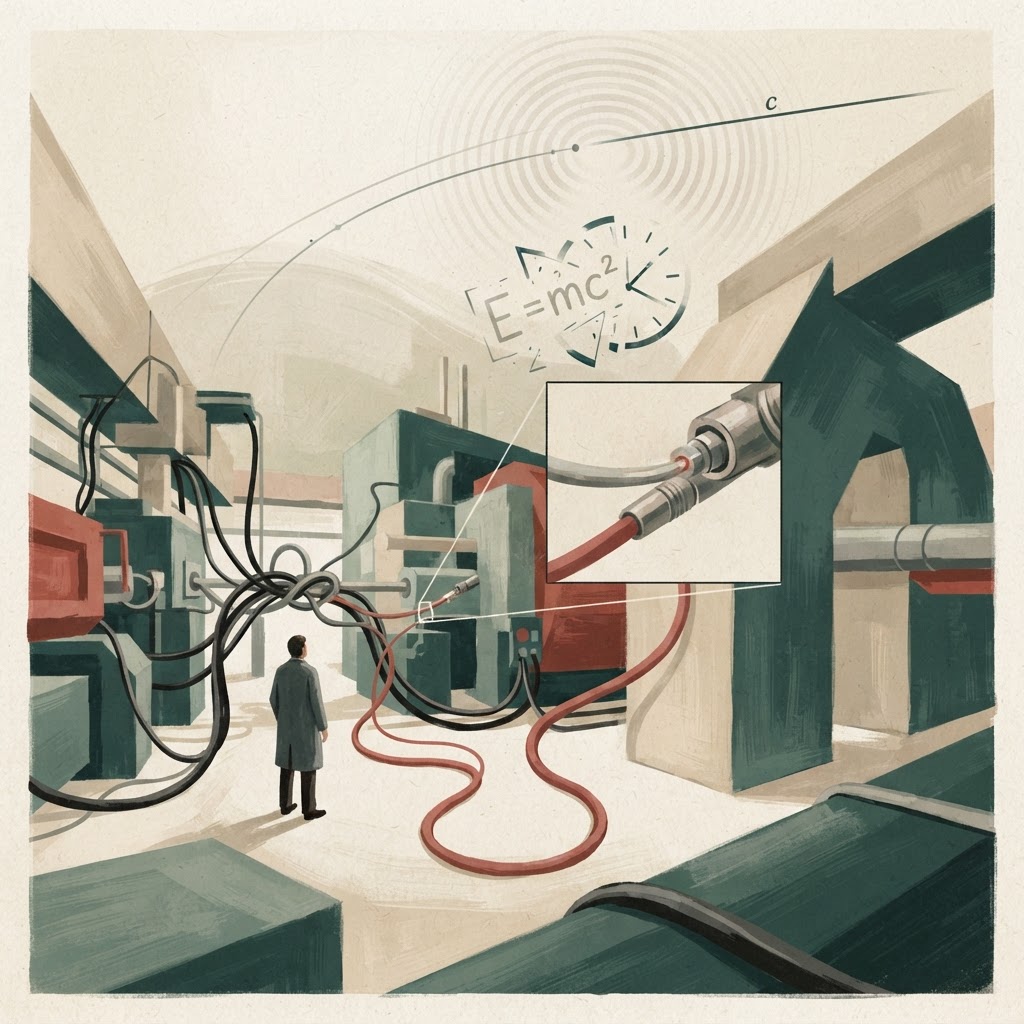
The following months were a period of exhausting introspection for the OPERA team. Every step of the measurement, every sensor, and every timing system was scrutinized repeatedly, as debugging one's own errors before announcing such a revolutionary result to the world is the most crucial part of scientific responsibility. At the heart of the experiment was a GPS-based time synchronization system; this system was vital for equating the exact time of particle production at CERN with the moment of detection at Gran Sasso. So, what kind of margin of error could there be in such a precise setup? The answer to the question was not as dramatic as one might expect.
After months of meticulous checking, the team discovered that a fiber optic cable connecting the GPS receiver to the laboratory's computer system was not securely fastened. This tiny mechanical flaw caused a systematic delay in the timing signal, which made the neutrinos appear faster than they actually were. Consider this for a moment: an anomaly that questioned the most fundamental law of the universe was caused by an overlooked connection in a corner of the lab, perhaps one that a technician had nudged and failed to seat properly. One cannot help but ask: is it a coincidence that most of the complex scientific crises are born from the most ordinary, most human causes, or is it a reality inherent to the nature of science? I believe the latter is a more accurate reading, because every large system is ultimately built from small parts, and when one of those parts loosens, the entire structure can be shaken.
Confessing the Error Is the Triumph of Science
The most valuable thing the OPERA team did was perhaps not the measurement itself, but that when they found their error, they shared it with the public without hiding it or feeling shame. Retracting one's own findings is not a gesture to be underestimated for a scientist; on the contrary, it takes great courage to end the most talked-about moment of one's career by saying, I was wrong. Many people think of science as a mechanism that produces flawless, perfect results, but the truth is quite the opposite: science is a discipline that learns to first accept and then correct its errors. For this reason, the OPERA example tells us more than just a story of a technical malfunction; it shows us the lifeblood of the scientific method.
Perhaps it is necessary to include a counter-argument here; some read this incident as a blow to the credibility of science, fueling skepticism by saying, look, even the most prestigious institutions can be wrong. But in my opinion, this reading is turning the issue on its head. It is not that an institution makes a mistake that is important, but that the mechanism to notice and correct that mistake functions; just like a pilot who misreads weather conditions and then immediately changes course, what matters is not the initial mistake, but how fast and honestly the corrective reflex works. When the OPERA team retracted its claim, it did not lose credibility in the eyes of the scientific community; on the contrary, through this transparency, it became living proof of how robustly the scientific method functions.
Looking back today, the aspect of this story that strikes me the most is that a major physical crisis was resolved by such a small, human detail. Science is often remembered for moments of heroism and great discoveries, but the OPERA experiment shows us that sometimes the greatest victory lies in an action as humble as plugging in a cable tightly. Einstein's theory proved to be robust, and neutrinos did not travel faster than light, but the lesson that emerged from this process is more permanent than the theory itself: the path to reaching the truth does not come from a claim of perfection, but from the willingness to seek, find, and openly accept error. Perhaps the greatest power of science lies exactly here, in seeing the possibility of being wrong not as a threat, but as a tool.
İlgili Denemeler
Can the Human Brain Detect Magnetic Fields?
Geophysicist Joseph Kirschvink's experiment at Caltech indicates that the human brain responds to magnetic fields, raising questions about a potential sixth sense.
Jan Hendrik Schön: The Physicist Who Fooled Science
The scandal of Jan Hendrik Schön's fabricated data at Bell Labs highlights the critical vulnerabilities in the scientific peer-review system.
Barry Marshall Drank Bacteria to Prove Stomach Ulcer Theory
Barry Marshall made medical history by consuming harmful bacteria to prove that stomach ulcers are caused by an infection rather than stress alone.
Tartışma (0)
Henüz yorum yok. İlk yorumu siz yapın.
Join the Newsletter
New essays, once a week, delivered to your inbox.