The First Strike in History: Deir el-Medina Workers
The laborers who built the Pharaoh's tombs launched history's first known strike when their grain rations were delayed.
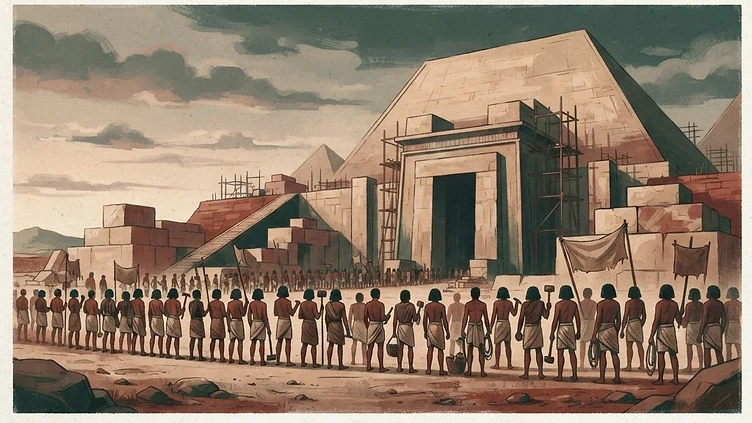
Imagine a man working deep inside a tomb, in a corridor where light barely reaches. With a hammer in his hand, stone before him, and a simple calculation in his mind: where is this month's grain? This man, carving the Pharaoh's journey to eternity into stone, is actually occupied with a very earthly concern. Immortality may be under construction, but no stone falls into place until the one building it is fed. This simple tension whispers a truth that does not seem strange to us today but was anything but ordinary thousands of years ago: labor is a concept that brought with it the inherent right to demand its due. ## The Pharaoh's Secret Village When we think of Egyptian history, the same scene always comes to mind: thousands of slaves, the cracking of whips, crowds of people pulling massive stones. This image is an easy cliche gifted to us by cinema, but the reality is much more intriguing. The craftsmen living in the village called Deir el-Medina were not slaves; they were salaried employees of the state. Painters, stonemasons, carpenters, scribes; each was a person with a specific expertise, registered, and even attached to a payroll in the modern sense. This raises a question: the moment a society invents the idea of working for wages, what is it that it actually invents? The answer, though it may seem simple, carries a deep meaning. A wage implies a contract, and a contract means acknowledging that both sides have obligations. Even while serving the divine power of the pharaoh, the workers of Deir el-Medina knew that their labor had a value. For them, labor was not a sacrifice melting away in the service of the sacred, but an exchange that was calculated, recorded, and expected. This consciousness was an attempt to establish a balance between the individual and the system they worked for, long before modern labor law. Perhaps this is why Deir el-Medina waits to be read not just as a worker's village, but as one of the first silent testimonies to the dignity of labor. ## The Hammers Stopped When the Grain Did Not Arrive During the reign of Ramses III, something went wrong. A disruption in the functioning of the state, a shortage in the warehouses, or a simple administrative oversight; whatever the reason, the grain rations due to the workers did not arrive on time. This delay, which might seem trivial to us today, was a matter of survival for the worker of that era, because grain was not just a means of payment, but also bread, beer, and life itself. So what did these people do? They did not wait patiently and suffer in silence. They put down their tools, abandoned the workplace, and marched in a group. Here, we must stop and ask ourselves: why does this behavior feel so familiar to us? Because despite the thousands of years that have passed, that thin thread between labor and its reward has never changed. The workers marched to the temples near the tombs and tried to make their voices heard by the authorities. This was not a riot, nor was it an outburst of anger; it was more of an orderly, even disciplined stance of people waiting for their rights to be upheld. Some might argue that this cannot be counted as a strike, but rather a form of complaint. But is there really another name for stopping work until a demand is met, a move that was even repeated more than once? This was a form of resistance in the very sense we understand today; our vocabulary just hadn't developed enough to name this concept yet. ## A Lesson Speaking from Where the Papyrus Fell Silent What brings this event to us is not a stone monument or a magnificent temple relief, but a fragile piece of papyrus. This record, which starts like a bureaucratic note, is actually a confession hidden in the collective memory of a society, reaching us today by chance. The fact that the state recorded its own fault is an interesting detail in itself, because those in power usually prefer to hide their own failures. Here, the opposite happens: both the delay and the workers' reaction were recorded.delay and the reaction of the workers are noted exactly as they occurred. This shows us that sometimes the most honest testimony of history is hidden in a small detail that the authorities could not afford to ignore. But does this papyrus tell us only about an ancient event, or does it whisper something about our own era? I believe the latter is a more accurate reading. The idea that the demand for labor, fair wages, and timely payment is a right is not an invention of modern unions; it is an intuition that has existed since the moment humans began working together. No matter how limitless the power of the pharaoh seemed, the patience of the hands building his tomb was limited. This shows that even the most powerful regimes find a form of resistance waiting for them when they ignore the basic needs of labor. Perhaps this is why this papyrus delivers the loudest lesson from where it fell silent. Today, anyone who gets angry at a paycheck delay in a workplace is, even without knowing it, carrying the legacy of those craftsmen in Deir el-Medina. Times have changed, the tools have changed, and even the ways of making demands have shifted to completely different channels; but there is one thing that has not changed in its essence: humanity has never given up on demanding the reward for its labor. The immortality of the pharaohs may be carved in stone, but the rights of those who built it are etched into history just as permanently. Perhaps what is truly immortal is not the tombs, but this simple yet powerful demand itself: ask for your due, raise your voice, put down your tool. History shows us how ancient a reflex this is; today, whether we are aware of it or not, we are still continuing this legacy.
İlgili Denemeler
The Mechanical Turk: History's Chess-Playing Mystery
The chess-playing automaton known as the Mechanical Turk deceived figures like Napoleon and Benjamin Franklin, masking a hidden human operator as a machine.
Bournville: The Utopian Town Built by Chocolate
The streets, gardens, and teetotal order of Bournville reveal how the Quaker faith imprinted a distinct form of morality upon the foundations of industry.
Levi's: The Story of Riveted Jeans Born from Gold Rush
In 1873, a tailor's discovery of a riveted solution for torn pockets redirected the true fortune of the gold rush toward the enduring garment industry.
Tartışma (0)
Henüz yorum yok. İlk yorumu siz yapın.
Join the Newsletter
New essays, once a week, delivered to your inbox.