Banksy's Shredded Art: Value in Object or Narrative?
When a painting destroyed itself, the art market was forced to reconsider what it was actually purchasing.
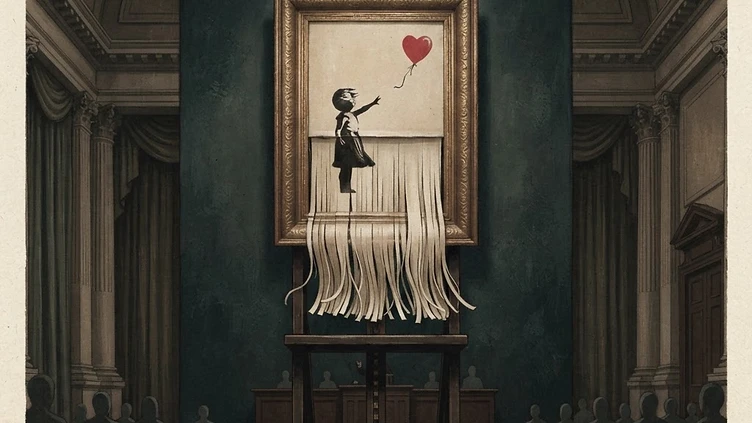
When we ask what determines the value of an artwork, the answer often seems simple: brushwork, color balance, composition, or the signature at the bottom. However, a five-second event at a London auction house on an October evening in 2018 showed how inadequate that simple answer truly is. At the very moment the gavel fell and the sale was finalized, the canvas itself sprang into action, shredding into pieces before the eyes of the audience. After that night, the art market was left grappling with a question it had always asked but never answered so clearly: was what they bought an object, or was it the story woven around that object? ## The Seconds When the Hammer Fell The moment of sale is usually a threshold in the auction world; a definitive point where ownership passes from one hand to another, and the work officially belongs to its new owner. The mechanism Banksy had pre-installed in the frame triggered at this exact threshold, and the painting transformed into long strips of paper before the room. The surprise was not merely the existence of the mechanism; what was truly striking was that the artist had choreographed the timing so precisely that the work destroyed itself not before it was sold, but the very moment it was. Thus, what was eliminated was not a painting, but a moment of ownership. In art history, works are generally thought of as frozen pieces of time; an image captured in the final second the artist lifted the brush. Here, the opposite occurred: the work ceased to be a frozen moment and became an event itself. Those sitting in the room were not looking at a painting that evening; they were witnessing a performance, and the material of that performance was the canvas itself. Confronted with such a thing, one cannot help but wonder: does a work become more of a work by destroying itself? Because those five seconds provided something that paint or line could never offer; it gave the viewer an unforgettable moment. ## The Fragment is More Precious Than the Whole At this point, the first objection that comes to mind is: all right, it is an impressive scene, but ultimately there is a damaged, incomplete object left; the value of this object must have plummeted. The market, however, said the exact opposite. When that piece, now turned into strips, went back to sale years later, it found a buyer at a price many times higher than its original state. The logic here was reversed; the work was not ruined, but enriched, because what it carried was no longer just paint, but the memory of an event. This paradox merely surfaced a tendency the art market has carried for a very long time. A tragic event in a painter's life, the theft and recovery of a work, or a painting being brought to light due to forgery allegations—all these influence price, because the buyer is often purchasing the narrative along with the object. What Banksy did was to put this implicit truth on stage in an exaggerated but honest way. The shredded paper strips were essentially telling the market: it is not the canvas that makes me valuable, but the story of what happened to me. One stops here and thinks; then is the true value of every work we see in a museum not the weight of the color on the wall, but the weight of that story passed from ear to ear? ## When the Idea of Ownership is Shaken Perhaps the most unsettling aspect of the event was that the person who destroyed the work was not a thief or a vandal, but the artist himself. Someone who has hidden his identity for years, works on the streets, and has always been critical of the gallery system, was reminding the buyer while destroying his own creation: this work can remain mine at any moment, even if you buy it. It seems that what we call ownership is not as simple as a signature and an invoice; if the artist wishes, he can intervene even in the fate of a sold work. This brought the silent power balance between the collector and the artist back to the agenda. Normally, the buyer pays, the work is hung on their wall, and the artist no longer has a say; the work lives its own life. By breaking this silent agreement, Banksy showed that he still held the invisible string attached to the work. Some read this as a sign of arrogance or even control, while others saw it as a reminder that an artist's responsibility toward their work does not end with a sales contract. Both may be right, but the truly interesting part is this: the discussion itself added another layer to the value of the work. In the end, what we are left with is not just a painting that has turned into paper strips; it is a scene where the art world interrogated its own rules with its own hands. When a canvas destroyed itself, it asked us not what we bought, but why we bought it. Perhaps what we are really looking for when we chase after an artwork is not a surface to hang on a wall, but a story to tell; and Banksy knew very well that all he had to do to show this was to shred the beauty he created right before our eyes.
İlgili Denemeler
Ralph Lauren: From Bronx to American Aristocracy
The true story of Ralph Lauren reveals how a non-existent aristocratic past was successfully transformed into a global fashion empire.
Ecce Homo: How a Failed Restoration Became a Hit
A century-old fresco in a small Spanish town was transformed into an entirely different work during an amateur restoration, ultimately changing the town's fate.
Anish Kapoor and Vantablack: Art's Color Monopoly
Anish Kapoor's monopoly over Vantablack reignited debates on artistic ownership, authenticity, and whether colors can be confined to a single creator's signature.
Tartışma (0)
Henüz yorum yok. İlk yorumu siz yapın.
Join the Newsletter
New essays, once a week, delivered to your inbox.