Ecce Homo: How a Failed Restoration Became a Hit
How an elderly woman, while attempting to restore a fresco, created something entirely different and put a forgotten Spanish village on the world map.
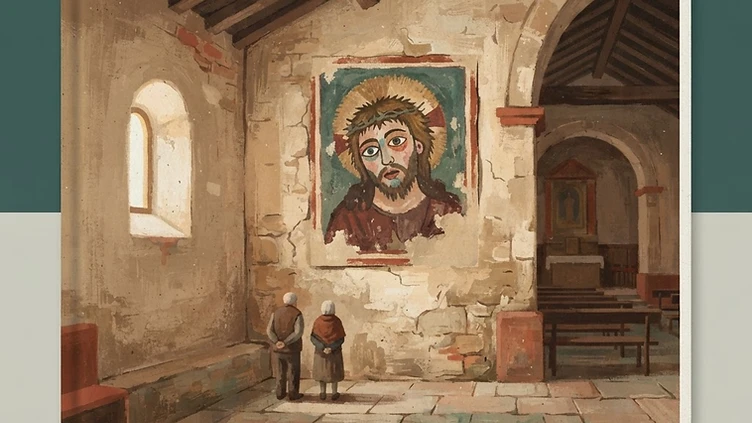
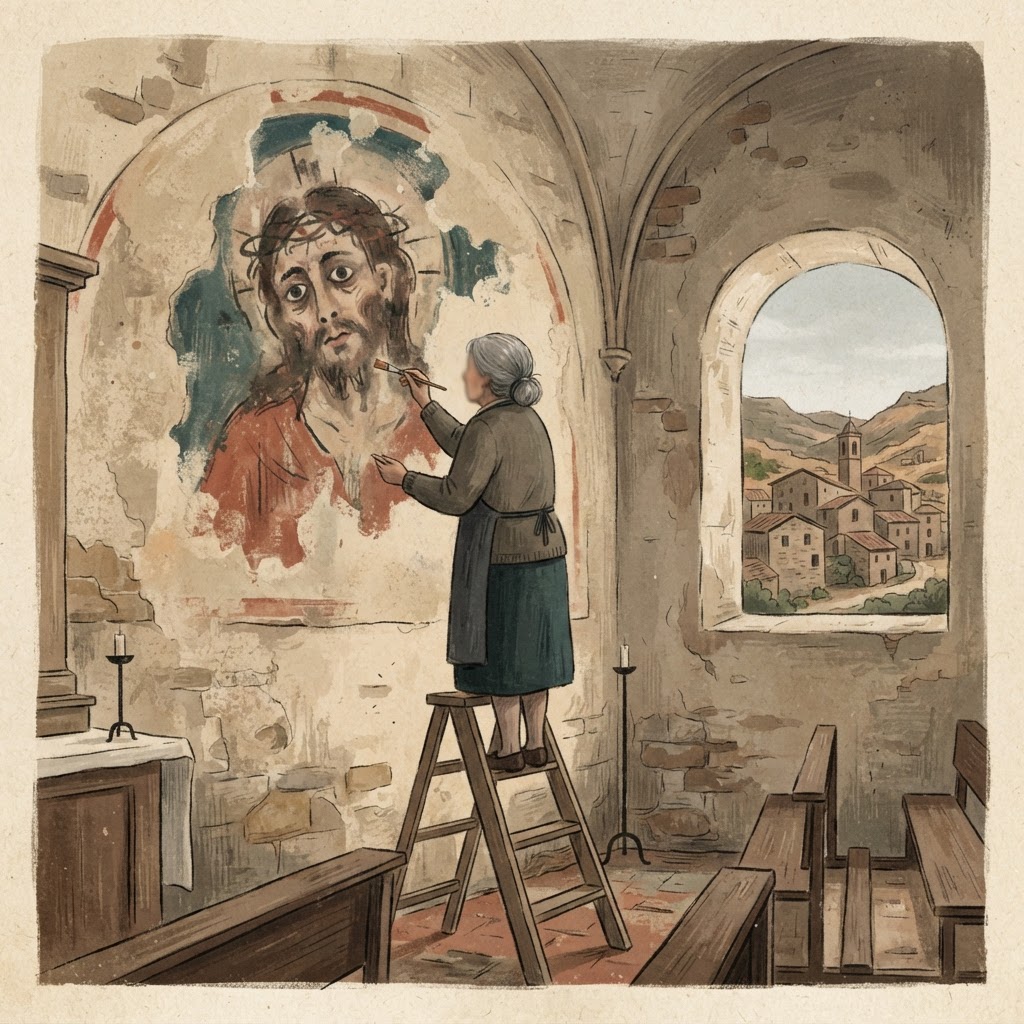
The town of Borja in northern Spain remained a quiet spot on the map for many years, holding no special place in anyone's memory beyond its narrow streets, stone houses, and a century-old fresco fading into the dim wall of a church. That fresco was an Ecce Homo, a scene of Christ with his head bowed under a crown of thorns, slowly vanishing under the dampness of time. No one remained indifferent to this silent dissolution, yet no one dared to intervene, until an elderly woman, moved by her devotion to the church, picked up a brush. Her intention was to save it; what emerged was something that challenged the limits of preservation, perhaps even redefining what it means to save something. ## The Chasm Between Intention and Skill The story of Cecilia Giménez is essentially a story of a mistake made with love. Her training was not in art restoration, but in respect for art; she picked up the brush because she did not want to see a face she had known since childhood, resting in the corner of the church for years, fade away. One must pause here to ask: can good intentions truly compensate for a lack of technical knowledge? Giménez’s hands were perhaps trying to protect the thing she loved most, but protection sometimes requires not touching at all. Restoring a work is different from remembering a face; the distance between the two grew with every stroke of the brush. The result was clear: Elías García Martínez’s century-old depiction of Christ had become unrecognizable, the features of the face blurred, and the eyes transformed into a childish doodle. It is easy to slide into a harsh judgment here, to say that an ignorant hand wasted a heritage. But I believe this judgment is exactly the problem, because blaming the gap between intention and skill solely on one woman’s deficiency misses the bigger picture: the failure of institutions, the church, and the municipality to consider calling in an expert. Giménez is not someone to be blamed alone; she was filling a vacuum in a system. Perhaps that is why the story turned from a scandal into an irony. ## The Value Gained by Flaws When the photos hit the internet, no one could have predicted this would turn into a tourism miracle. The first reaction was mocking; people dubbed the new face Ecce Mono, or Behold the Monkey, and made fun of it in thousands of social media posts. But when mockery turned into interest, something changed: the number of people visiting Borja reached levels never seen in the days when people came to see the original fresco. The question to be asked here is this: was it really art that drew people, or the peculiarity of what happened to the art? I do not think it was either exactly; what drew people was that a mistake was displayed so nakedly, so humanly. The town quickly turned this demand into an opportunity. Admission to the church became fee-based, and the image of the face was printed on mugs, t-shirts, and wine bottles, as local shopkeepers met with a level of activity they had not seen for years. One could object, saying this is a disrespect to the seriousness of art. But is it disrespect, or is it the breaking of the state of art that so rarely mingles with daily life? The cultural value of a work is not always measured by the mastery approved by experts; sometimes the degree to which an image makes people laugh or brings them together is also a measure of value, perhaps even a more honest one. At this point, what the town gained was not just an economic revival. Borja transformed from a name no one knew into a location mentioned in the world press; the local people, who were initially ashamed of the event, gradually began to take pride in it. The fact that a flaw turned into such a quick sense of belonging tells me something about how human communities construct identity: sometimes what makes a place special is not its perfection, but its own unique, unrepeatable oddity. ## Rewriting Authenticity The art world debated this event for a long time because the question was about what constitutes authenticity.issue was no longer just the fate of a fresco; it was the question of what authenticity is. Does the value of a work lie in the originality of the hand that created it, or in the meaning subsequently loaded onto that work? García Martínez’s original Christ might have been technically flawless, but it did not change anyone’s life; the face Giménez accidentally created changed the fate of a town. It is difficult to ignore this contradiction. Perhaps authenticity is not something frozen in the past as we assume, but an agreement that each generation reproduces with its own perspective. I often ask myself: if the value of a work is measured by the interest it arouses, then what is the word original protecting? Museums and restoration boards naturally defend the untouched state because their job is to pass on the past as it is. But the Borja example shows that sometimes a community can form a stronger bond with the past precisely in its ruined state. This does not completely invalidate restoration ethics, but it adds a question mark to it: are we protecting the work, or our story about the work? Most of those who go to Borja today are not going to look at art history, but at an accident from a woman’s hand. This reminds us that the value of a work is measured not by its certificate of origin, but by the meaning people add to it. Perhaps the most sincere form of art is that which is unplanned, flawed, or even a bit ridiculous; because that form carries the trembling of a human hand more than the cold perfection of a master. The story of the ruined Christ is not actually a story of a fresco, but a story of transformation. A brushstroke made by a woman with respect but without knowledge brought a forgotten town into the eyes of the world, opened a new debate in the art world about origin and value, and forced a re-examination of the concept of authenticity. Perhaps the real lesson is this: a flaw is not always a lack; sometimes it is the flaw itself that allows something to be seen. That strange face on the wall of Borja whispers to us that it is not perfection, but attention, interest, and shared meaning that determine true value; perhaps that is why we still go there and look at that face, precisely because it is ruined.
İlgili Denemeler
Ralph Lauren: From Bronx to American Aristocracy
The true story of Ralph Lauren reveals how a non-existent aristocratic past was successfully transformed into a global fashion empire.
Anish Kapoor and Vantablack: Art's Color Monopoly
Anish Kapoor's monopoly over Vantablack reignited debates on artistic ownership, authenticity, and whether colors can be confined to a single creator's signature.
Why Was the Guernica Tapestry Covered at the UN?
This essay explores the untold story behind the blue curtain that covered Picasso's Guernica tapestry during the Iraq war speech at the UN in 2003.
Tartışma (0)
Henüz yorum yok. İlk yorumu siz yapın.
Join the Newsletter
New essays, once a week, delivered to your inbox.