Why Was the Guernica Tapestry Covered at the UN?
While a war speech was being delivered at the United Nations, why was one of the most powerful symbols of peace kept hidden from sight?
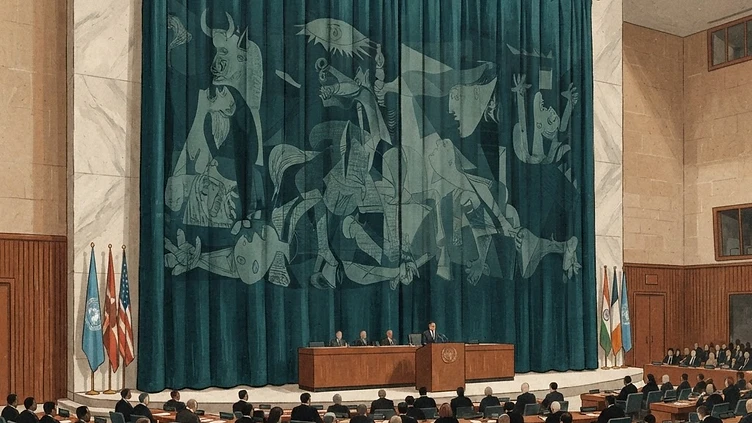
For years, a woven replica of Picasso's Guernica hung in the narrow corridor leading to the UN Security Council, where journalists waited for diplomats. It depicted the most brutal face of war, with shattered bodies, a screaming horse, and a mother clutching her lifeless child, standing at the very threshold of the hall where the world's most significant decisions on peace and war were made. In February 2003, as Colin Powell presented his claims regarding Iraq to the global public, this tapestry was suddenly covered with a blue curtain. The question seems simple, yet the answer is anything but: why is a work of art made invisible when it conflicts with the spoken word? And more importantly, does this attempt at invisibility actually work, or does it, conversely, make the work even more visible?
A Tapestry's Journey at the UN
Donated by Nelson Rockefeller in 1985, this tapestry was no ordinary gift. It was a woven version of Picasso's 1937 painting depicting the destruction of Guernica, a town in the Spanish Civil War, following a Nazi bombing. For over half a century, this copy served as the most striking proof that art and diplomacy could coexist under the same roof. Ambassadors, advisors, and journalists passing by daily walked beneath this silent scream as they entered the hall to determine the fate of nations; the tapestry felt like a constant reminder hovering over every human decision. This was not an accidental placement but a conscious choice, signaling that modern diplomacy aimed to hold its own conscience accountable by keeping the power of art close to the center of politics.
However, this proximity also harbored tension. The longer a piece hangs at the threshold of power, the more meaning it accumulates; visitors stop noticing it, grow accustomed to it, and eventually almost forget it. Perhaps the Guernica tapestry had sunken into such a silence, becoming a part of the daily routine. Yet, the moment it suddenly became a problem showed that it had never truly been forgotten. We hide things only because we remember them; what is rendered invisible is precisely what is most feared to be seen.
The Moment the Curtain Fell
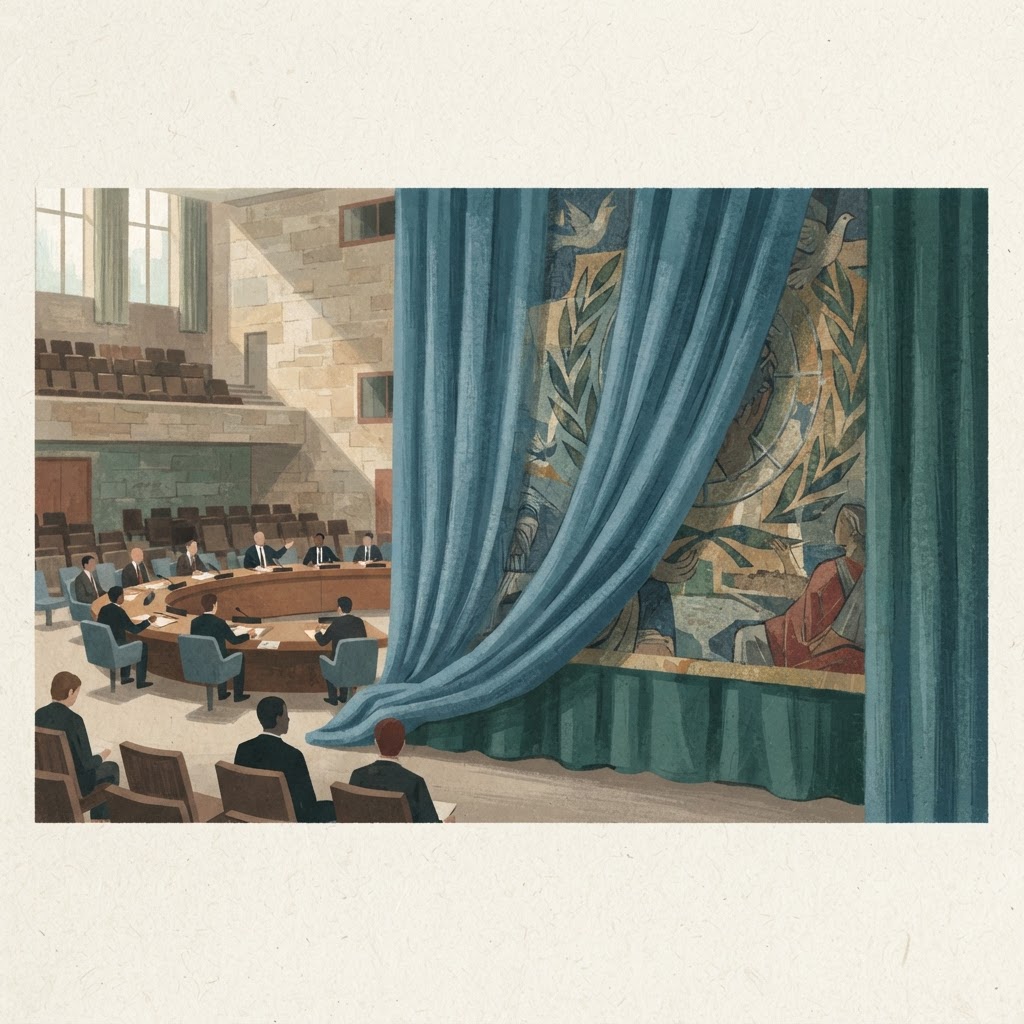
On that morning in February 2003, when Powell was to present his claims regarding weapons of mass destruction in Iraq, UN officials ordered a blue curtain drawn over the tapestry. The official explanation was that a simpler background was desired for the cameras, emphasizing color harmony for press photos; it was presented as a technical, aesthetic, or even mundane production decision. But taking this explanation seriously means missing the true significance of the event. To have a work depicting the most brutal consequences of war behind a war speech was a contradiction too profound to be justified by any camera angle. Had the shattered bodies, the screaming horse, and the burning house been visible behind Powell as he spoke, every word uttered would have been viewed alongside its own antithesis.
Here lies the core issue: the language of power cannot stand in the same frame as an image that contradicts it. When a speaker asserts the necessity of war while a work crying out the devastation of war hangs behind them, the viewer inevitably evaluates the two against each other, weakening the power of the words. Technical excuses are deployed in such moments to hide this fragility; they speak of lighting, color, or background simplicity, while the unspoken truth is that an image cannot exist simultaneously with a contradicting word. The falling of the curtain was, in effect, a confession; for what is hidden is often the doubter's own uncertainty.
A valid objection might be raised: perhaps it really was a technical concern, and we are overdramatizing a routine production choice. But this objection misses the point: if it were merely technical, why was a curtain needed on that specific day when the same tapestry had hung there for years? Timing is often the most reliable witness to intent.
The Unsilenceable Echo of the Scream
The blue curtain may have hindered the tapestry's visibility for a moment, but it could never silence its story; instead, the attempt to cover it was debated in the global press for days, becoming the subject of columns, and people wondered more about why it was hidden than about Guernica itself. Attempting to hide a work sometimes leads to more discourse than not hiding it at all, as the human mind always searches for a greater truth behind what is concealed. Even while standing behind the curtain, perhaps the Guernica tapestry found its most visible moment.
This validates an old but evergreen idea about the power of art: the impact of an image can be greater than the power of the hand attempting to control it. Powell's speech may have succeeded in swaying the global public in a certain direction that day, but years later, it is the story of the curtain behind him that is remembered. Hiding a work of art is not the same as destroying it; it merely adds a new chapter to its narrative. As a witness to both the Spanish Civil War and this UN moment, Guernica once again proved its permanence against the transience of political rhetoric.
What this story leaves us with is perhaps this simple but profound observation: the moment power tries to control an image, it reveals its own weakness. A blue curtain cannot truly hide anything; it only makes people more curious about what lies beneath. As the Guernica tapestry waited silently in that UN corridor, perhaps it spoke its most powerful word without saying a thing; for some screams are heard most clearly the moment they are silenced.
İlgili Denemeler
Ralph Lauren: From Bronx to American Aristocracy
The true story of Ralph Lauren reveals how a non-existent aristocratic past was successfully transformed into a global fashion empire.
Ecce Homo: How a Failed Restoration Became a Hit
A century-old fresco in a small Spanish town was transformed into an entirely different work during an amateur restoration, ultimately changing the town's fate.
Anish Kapoor and Vantablack: Art's Color Monopoly
Anish Kapoor's monopoly over Vantablack reignited debates on artistic ownership, authenticity, and whether colors can be confined to a single creator's signature.
Tartışma (0)
Henüz yorum yok. İlk yorumu siz yapın.
Join the Newsletter
New essays, once a week, delivered to your inbox.