Paleolithic Cave Art: Balancing Preservation and Truth
Paintings hidden in darkness for millennia faced the threat of extinction within decades due to human curiosity.
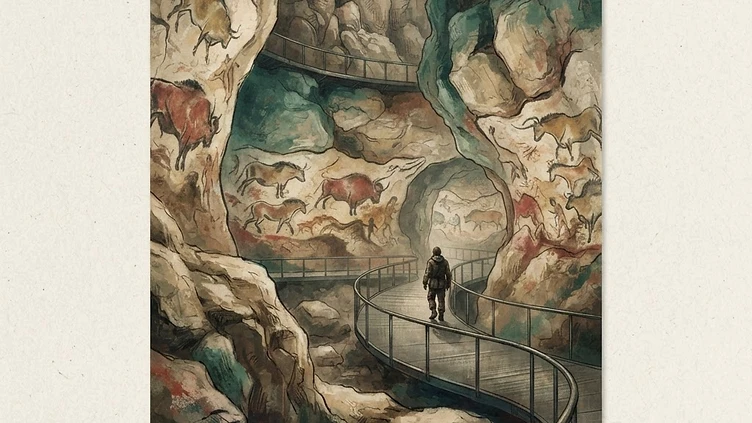
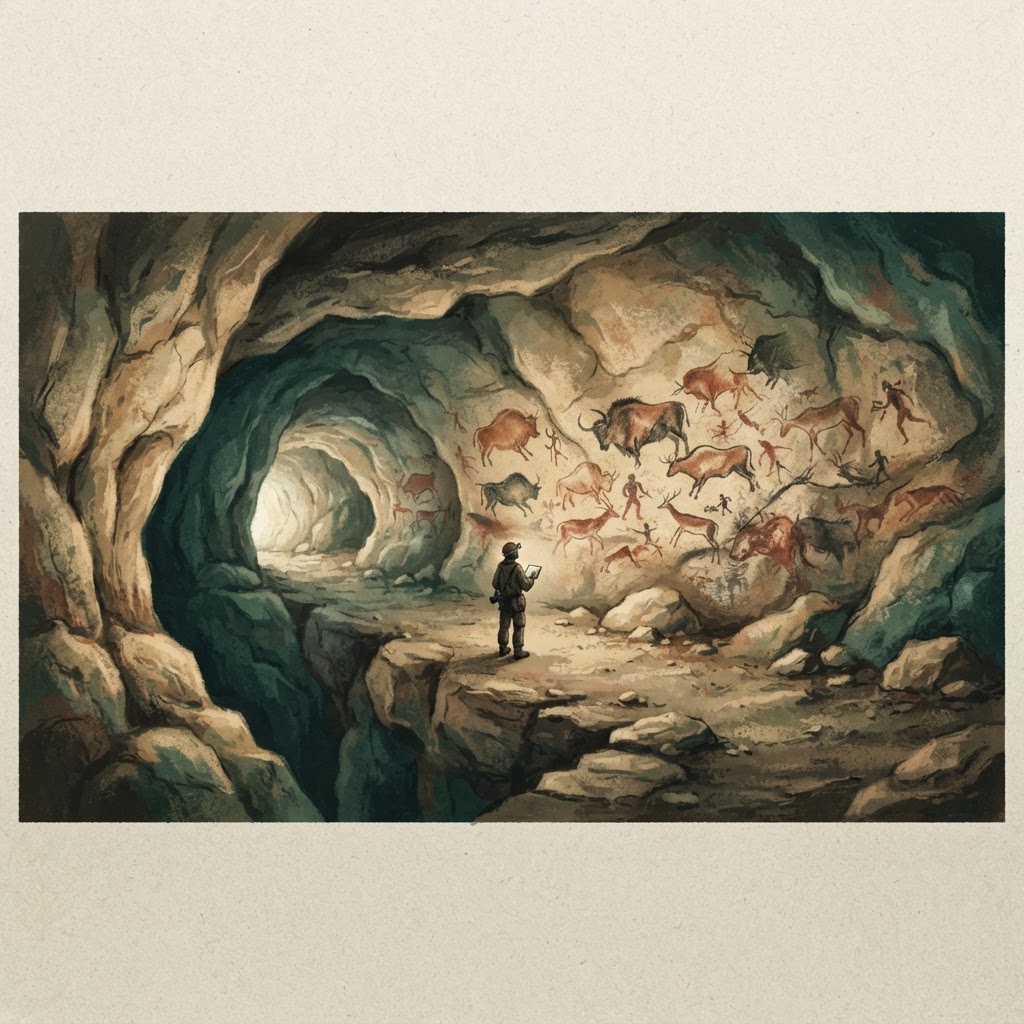
Humans sometimes destroy what they love; while this sentence may sound like a paradox, it is precisely what happened to a cave hidden within a cliff in southern France. Having slept for tens of thousands of years in the embrace of darkness, moisture, and stable air, these paintings were handed a death sentence the moment they encountered human curiosity. The core of this text addresses an ancient question: what makes a work of art real? Is it the stone, the pigment, the cave itself, or the excitement awakened in the eyes of the observer? Ironically, it is the creation of an exact replica to save these paintings that enables us to ask this question. ## A Miracle Emerging from Darkness The discovery of a cave often begins with an ordinary coincidence: noticing a crack, stumbling upon a fissure while tracking an animal, or a hiker peering curiously into an opening. A similar moment occurred in this French cave; the first beam of light to penetrate the darkness illuminated a world that no one had seen for millennia. The walls, decorated with red and charcoal-black lines of horses, bulls, and deer, looked as if time had stood still, because in truth, it had. The cave's enclosed structure, constant humidity, and unchanging temperature had kept the paintings sealed in a vessel, untouched by the seasons, rain, or sun. However, this preservation was a product of chance, not conscious protection. Just as the cave was opened by an accident, the balance within could be just as easily disrupted. That a stability lasting thousands of years could be threatened by human hands in just a few decades demonstrates how delicate the equilibrium of nature's self-preservation truly is. Darkness, silence, and humidity had, in a sense, imprisoned those paintings, but that imprisonment was precisely what kept them alive. Finding the cave was a miracle, but it took a human mistake to realize the fragility of that miracle. ## The Damage Caused by Awe When the first visitors entered the cave, no one spoke of danger; there was no visible destruction because the damage was invisible. The moisture and carbon dioxide carried by human breath began to slowly alter the cave's chemistry just by hanging in the air, without ever touching the walls. This was not vandalism; no one wanted to break or ruin anything. On the contrary, everyone who entered did so with a sense of wonder, perhaps to pay respect to the oldest art of humanity. But respect can sometimes cause harm, especially when it is expressed while ignoring the very nature of what is being respected. There is an objection that comes to mind: was a work of art made so that no one would see it? Certainly not, but the time elapsed between the moment of creation and today has, in a sense, transformed the work itself. When a Paleolithic artist wished for a successful hunt or performed a ritual, they could not have predicted that their work would become a destination for throngs of tourists tens of thousands of years later. Time does not just age a work; it compounds its fragility, as every passing century adds a condition that reduces the likelihood of the work's survival. That an act as natural as breathing can disrupt a millennial balance reminds us how thin a line human interaction with nature walks; even the most innocent actions, in the wrong context, can turn into the greatest destruction. When scientists realized this damage, it was not yet too late, but there were limits to the recovery. Closing the cave was perhaps the only solution, but it meant that people would never see that work again. It was here that the age-old conflict between conservation and access resurfaced: is it necessary to hide something from humanity to keep it alive, or is closing off something meant for humans a way of killing it? ## The Philosophy of the Copy The idea that emerged as a solution to this conflict was simple but bold: seal the original and build an exact replica nearby. This copy, where every line, every color tone, and every curve of the rock was meticulously reproduced, aimed to provide the visitor with the experience of the real cave without causing any harm to the original. But here, a question inevitably arises: is what we feel when looking at a copy the same as what we would feel when looking at the original? Or is the knowledge itself—the knowledge that 'this is a copy'—a hidden filter that changes the texture of the experience? There is no easy answer, but there is an aspect worth considering. Seeking the reality of a work only in the material that constitutes it may be too narrow a perspective. Because what affects us in a painting is not the chemical composition of the pigment, but the story that pigment tells us; it is the awe created by the fact that thousands of years ago, a hand, in the light of a candle, painted an animal so vividly. A copy can carry this story, because the story lives not in the matter, but in knowledge and memory. Yet, on the other hand, the shiver one gets from knowing that a hand actually touched that rock thousands of years ago cannot be reproduced in any copy; because that shiver comes not from the matter itself, but from its historical continuity. Perhaps what we call authenticity lives neither in the matter nor in the experience alone; it exists in the tension between the two, in that subtle space where knowledge shapes the experience. Someone looking at the copy views it with the knowledge that 'this is not real,' and this knowledge does not diminish their awe, but it changes its hue; it is no longer just awe, but a kind of gratitude—a gratitude for the effort humanity has made to save the original. Today, someone standing in front of that cave looking at the copy is actually looking at two things at once: the dream of a trace left by a hand tens of thousands of years ago, and the concrete evidence of the effort twentieth and twenty-first-century humans have exerted to ensure that trace is not lost. This dual perspective reminds us that art belongs not only to the past but also to the future; for to preserve a work is not to freeze it, but to make it transmittable to the next generation. It was our curiosity that caused our breath to close a cave, but in the decision to restrain that curiosity and build a copy, there lies something else unique to humans—perhaps a sense of responsibility born of regret. Art, in this way, shows both its fragility and its power to survive by telling us something about ourselves: even the oldest paintings can turn into a mirror for our newest questions.
İlgili Denemeler
Ralph Lauren: From Bronx to American Aristocracy
The true story of Ralph Lauren reveals how a non-existent aristocratic past was successfully transformed into a global fashion empire.
Ecce Homo: How a Failed Restoration Became a Hit
A century-old fresco in a small Spanish town was transformed into an entirely different work during an amateur restoration, ultimately changing the town's fate.
Anish Kapoor and Vantablack: Art's Color Monopoly
Anish Kapoor's monopoly over Vantablack reignited debates on artistic ownership, authenticity, and whether colors can be confined to a single creator's signature.
Tartışma (0)
Henüz yorum yok. İlk yorumu siz yapın.
Join the Newsletter
New essays, once a week, delivered to your inbox.