N-Rays: The Science World's Greatest Delusion
France's most esteemed physicist discovered a ray, hundreds of scientists confirmed it, and eventually, it turned out there was nothing there at all.

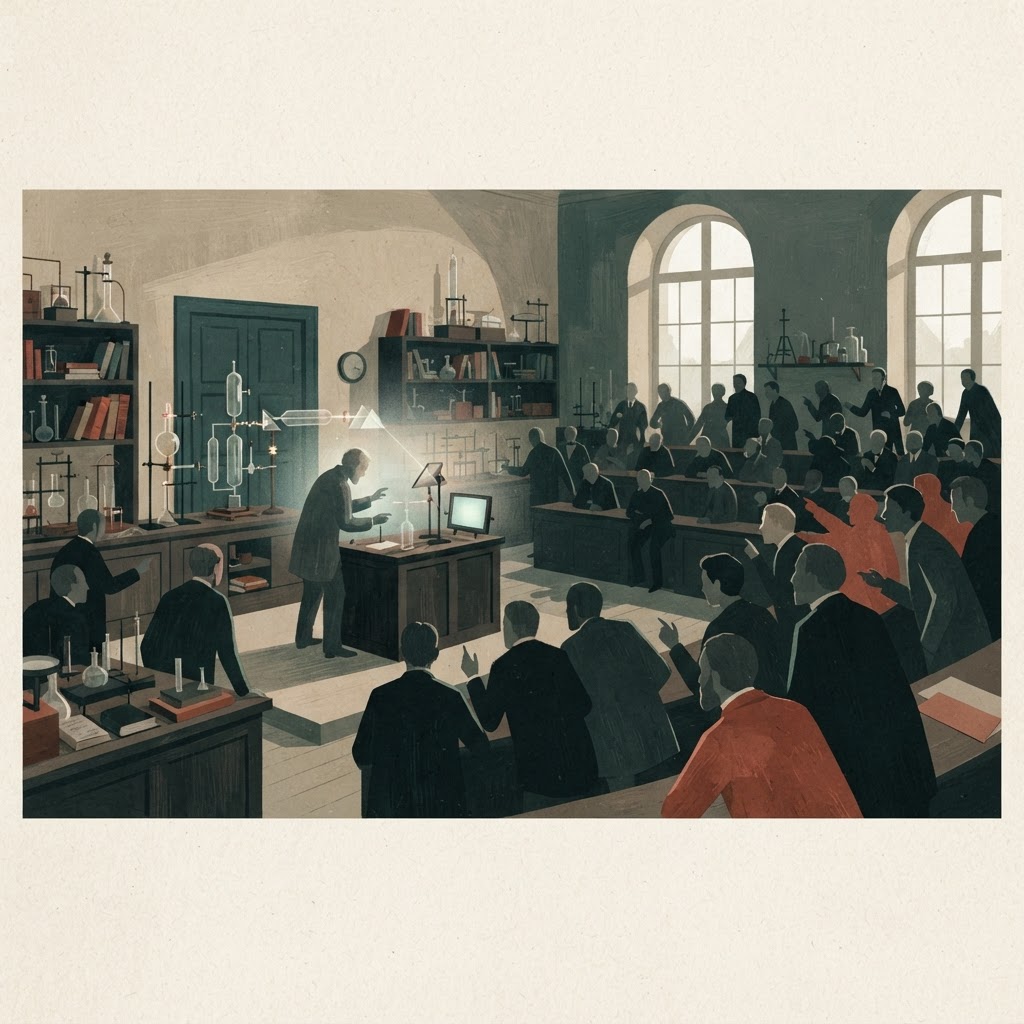
The most dangerous trait of the human eye is its ability to see what it wants to see. The history of science has proven this frailty countless times, but no case is as striking as the story of N-rays in France in 1903. At the time, one of the most respected figures in the physics world announced the discovery of an invisible ray. The most interesting part was that, without any definitive proof to refute it, hundreds of scientists across Europe claimed to see this ray as well. Today, when we read about this incident, we ask ourselves: How could such an educated, experienced group fail to notice that there was nothing there? The answer is closer than we think; the issue was not ignorance, but how belief guides the eye. ## The Discovery in Nancy René Blondlot was a respected physicist at the University of Nancy, eager to make a breakthrough similar to the discovery of X-rays. In 1903, while investigating whether X-rays could be polarized, he announced the detection of a previously unknown type of ray. He named them N-rays, inspired by the city where he worked. He claimed these rays increased the visibility of dimly lit objects, affected photographic plates, and even changed the brightness of electric sparks. The experimental setup was quite complex, relying on aluminum prisms, quartz lenses, and vague observations near the threshold of human perception. In other words, the measurement was not based on clear figures provided by an instrument, but on the observer's interpretation of what they saw in the dim light. We must stop here and ask: Why were Blondlot's experiments accepted so easily? Because the evidence was weak, but his reputation was strong. He was a member of the French Academy of Sciences and a renowned researcher in the field of X-rays, and the physics community of the time found the discovery of new types of rays normal; X-rays were very new, and radioactivity was still being debated. Science was constantly expanding its boundaries back then, so a renowned expert claiming to have found a new ray was far less surprising then than it would be today. Blondlot's word came before evidence; his reputation preceded his data. Perhaps the point was that no one was lying; everyone believed that following a respected name was a safe path. ## Everyone Saw the Same Light The most surprising part is not that Blondlot defended his claim, but that it was repeatedly confirmed in laboratories across Europe. Dozens of scientists in France, England, and Germany reported observing N-rays in their own experiments. Some suggested the rays passed through human muscles and the nervous system, while others claimed they were even effective on plants. A large number of articles on the subject were published, discussed at conferences, and N-rays rose to the top of the physics agenda. Such broad validation was enough to make the subject appear as an undisputed fact. Were these people lying? No, that was not the problem. The core issue was how perception works. When you try to distinguish a very faint difference in brightness in dim light, the brain engages expectations to fill in the void. If you are told you are about to see the effect of a ray, your eye becomes capable of seeing what is not actually there. This is not fraud, but proof of how dependent human perception is on authority and expectation. Blondlot's reputation shaped the observations of other scientists; as they repeated his method, they interpreted the same vague play of light with the same conviction. The strange part is that most of these validations were done not with bad intentions, but with a desire for rigor. If a scientist could not replicate the findings of a respected colleague, they would question their own experimental setup, not Blondlot's method. This small detail explains how the error survived for so long; the arrow of doubt was always turned in the wrong direction, toward the observer's own perceived incompetence. ## Robert Wood's Blind Experiment The N-ray debate continued for some time until the American physicist Robert Wood visited Blondlot's laboratory in Nancy. While observing the experiments, Wood did something remarkable: in the dark, without anyone noticing, he removed the aluminum prism that was supposed to be the source of the rays from the setup. Even with the prism missing, Blondlot's assistant continued to read measurements and describe the effects of the rays. In other words, with no physical source present, the observer still saw the same result. This showed that the only thing needed for the collapse of the theory was not a complex counter-experiment, but a simple intervention. This simple but lethal move revealed at once that N-rays were entirely an illusion of perception. When Wood published his findings, it caused a major tremor in the French scientific community; some researchers went on the defensive, while others quietly withdrew from the subject. Blondlot himself spent the remaining years of his career in the shadow of this incident, and his influence in the scientific world largely came to an end. What Wood did was actually very simple: he removed the variable and looked to see if the result changed. The most powerful weapon of science is sometimes not complex theories, but just such a plain question. The story of N-rays may seem like an old anecdote from the history of science today, but the issue remains relevant. Because we all find ourselves in the position of Blondlot's assistant in daily life; we look at what an expert, an authority, or a community says and accept it without questioning what our own eyes see. Perhaps the real lesson is not that N-rays did not exist, but that it took only the presence of hundreds of educated people to see them. The next time someone tries to show you something in the dark, it is worth asking: Is there really a light there, or are we just looking in the direction someone wants us to look?
İlgili Denemeler
Can the Human Brain Detect Magnetic Fields?
Geophysicist Joseph Kirschvink's experiment at Caltech indicates that the human brain responds to magnetic fields, raising questions about a potential sixth sense.
Jan Hendrik Schön: The Physicist Who Fooled Science
The scandal of Jan Hendrik Schön's fabricated data at Bell Labs highlights the critical vulnerabilities in the scientific peer-review system.
Barry Marshall Drank Bacteria to Prove Stomach Ulcer Theory
Barry Marshall made medical history by consuming harmful bacteria to prove that stomach ulcers are caused by an infection rather than stress alone.
Tartışma (0)
Henüz yorum yok. İlk yorumu siz yapın.
Join the Newsletter
New essays, once a week, delivered to your inbox.