The Mpemba Effect: Why Does Hot Water Freeze Fast?
A quirk noticed by a high school student in an ice cream mixture has kept physicists debating for sixty years without reaching a definitive answer.
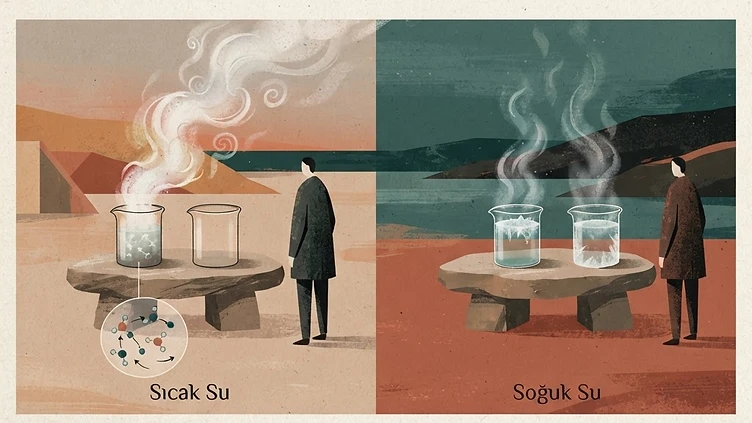
In a kitchen, standing before a freezer, one of the most mundane moments of daily life can occasionally raise a question that science has been unable to solve for centuries. The claim that hot water freezes before cold water sounds counterintuitive at first; because everything we are taught suggests that a liquid must cool down before it can freeze, implying that water which is already cold should win this race. Yet, the real world often refuses to follow the simple logic of textbooks, and sometimes the most ordinary observations are enough to shake the most established assumptions. The Mpemba Effect is the name of such an anomaly; a physical puzzle that is both astonishing and stubbornly resistant to explanation. ## A Student's Accidental Observation In 1963, Erasto Mpemba, a high school student in Tanzania, noticed something unusual while preparing an ice cream mixture in his school's kitchen. While placing the mixtures into the freezer with his friends, Mpemba, wanting to save time, placed his mixture in the freezer while it was still hot, without cooling it first. The exact opposite of what was expected happened: his hot mixture solidified before the pre-cooled mixtures of his friends. This was a coincidence too striking to escape a student's notice, and Mpemba did not hesitate to question it; the response he received when asking his teacher was the familiar dismissal that new ideas often face. He was told that what he observed was impossible, as if the laws of nature were not obligated to respect a student's kitchen experiment. However, Mpemba was persistent, and this persistence eventually gave him the opportunity to meet a physicist during a university visit years later. Rather than pushing the story aside, that physicist chose to listen with curiosity, and together they documented the observation through simple but rigorous experiments. What is interesting here is that this phenomenon was not entirely new in the history of science; similar observations had been voiced since the natural philosophers of antiquity, yet no one had made it a subject of systematic research. Mpemba's contribution was perhaps the question of why not, asked with the innocence of a child; that childlike curiosity which the scientific community often forgets, but which is the true engine of progress. ## A Non-Reproducible Phenomenon The true oddity of the Mpemba Effect lies in how it behaves like a ghost, seen once and then vanishing. In some experiments, hot water truly freezes faster than cold water, leaving no room for doubt; but when the same experiment is repeated in the same laboratory under seemingly identical conditions, sometimes no difference is observed, and at other times the result is completely opposite. This instability both excites and frustrates scientists because physics is a discipline built on reproducibility, and if an experiment cannot be reliably repeated, it becomes nearly impossible to derive a general law from it. The question to be asked here is this: perhaps the issue is not whether the effect exists, but rather our inability to fully define the conditions under which it emerges. Small variables such as the shape of the container, the amount of water, the temperature distribution within the freezer, and even which container the water was transferred from can fundamentally change the result. An experimenter can obtain completely different results with a difference of a few milliliters or a starting temperature change of a few degrees. This turns the effect into a real nightmare for researchers who wish to formulate it as a clear physical law, because each new experiment adds a new question mark to the list instead of confirming the previous result. This irreproducibility led some physicists to suggest that the effect is not real, but merely an illusion caused by measurement errors or uncontrolled variables. On the other hand, the fact that the effect still emerges in carefully controlled experiments invalidates this easy dismissal. It is as if nature refuses to give us a simple yes or no answer and instead displays a capricious behavior dependent on conditions. Perhaps the real lesson is here: some physical events may be a complex dance of many factors that cannot be explained by a single variable. ## Competing Explanations Over the years, physicists seeking to solve this puzzle have proposed several competing hypotheses, but none has been able to provide a complete explanation on its own. The evaporation hypothesis suggests that hot water evaporates faster, reducing the mass of water that needs to freeze; it seems reasonable with the logic that less water freezes faster. The convection hypothesis states that temperature differences within the hot water create strong currents, which help heat to be expelled from the container more quickly, whereas cold water remains more stagnant, making heat loss slower. The dissolved gases hypothesis looks at it from a different angle: when hot water is boiled, some of its dissolved gases escape, which might slightly change the water's freezing point and thermal conductivity. The supercooling hypothesis adds a more subtle detail; it suggests that some water does not solidify immediately even after dropping below the freezing point, experiencing a sort of delayed freezing that varies according to the initial temperature. Each hypothesis carries explanatory power under specific experimental conditions but remains entirely silent under others. The real problem is the possibility that these four explanations might act simultaneously at different rates rather than excluding each other. Perhaps in one experiment, evaporation is dominant, while in another, convection currents are more decisive, and this complex picture drives scientists who seek a single clear law into despair. Physics generally loves elegant, one-sentence laws, but the Mpemba Effect seems to be telling physics to question its own expectation of elegance. This debate, spanning over sixty years, perhaps teaches us something about science itself: not every question or curiosity needs to reach a clear and definitive answer. That small quirk noticed by a high school student in front of a freezer still occupies the most advanced laboratories and the sharpest minds, and this reminds us that no matter how much science progresses, some corners of nature may remain closed to it. Maybe the real question is not why water sometimes freezes faster, but rather how little we notice the deep complexity that can be hidden behind things that appear simple.

İlgili Denemeler
Can the Human Brain Detect Magnetic Fields?
Geophysicist Joseph Kirschvink's experiment at Caltech indicates that the human brain responds to magnetic fields, raising questions about a potential sixth sense.
Jan Hendrik Schön: The Physicist Who Fooled Science
The scandal of Jan Hendrik Schön's fabricated data at Bell Labs highlights the critical vulnerabilities in the scientific peer-review system.
Barry Marshall Drank Bacteria to Prove Stomach Ulcer Theory
Barry Marshall made medical history by consuming harmful bacteria to prove that stomach ulcers are caused by an infection rather than stress alone.
Tartışma (0)
Henüz yorum yok. İlk yorumu siz yapın.
Join the Newsletter
New essays, once a week, delivered to your inbox.