Movile Cave: Five Million Years Without Sunlight
Accidentally discovered beneath Romania, this cave reveals what science can learn from a life completely disconnected from the sun.
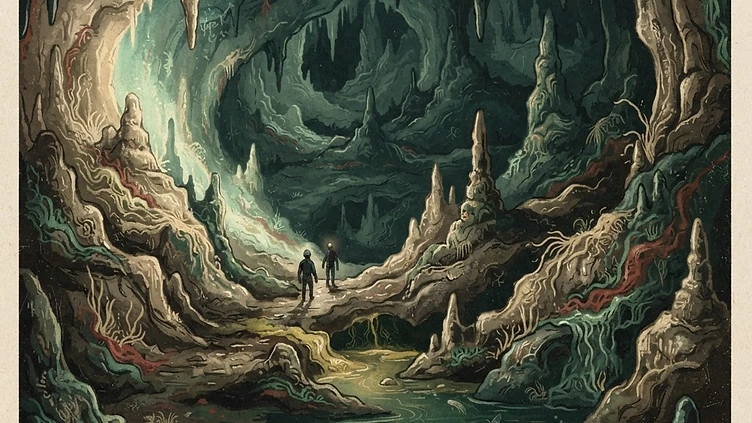
When we walk on the surface of the Earth, do we ever consider that just a few meters beneath our feet, there might exist a breathing world that the sun has never reached? For most of us, the underground is a void of stone and silence; we assume that life does not infiltrate those depths and that where there is no light, there can be no life. Yet, Movile Cave, hidden near Constanta in southern Romania, offers an example that shatters this comfortable assumption. This small subterranean universe, entirely isolated from the outside world for millions of years, demonstrates how life can be reinvented with completely different rules in the absence of the sun. And this discovery is, in fact, the work of an unplanned coincidence. ## An Unexpected Discovery from a Drilling Site In 1986, geologists searching for suitable land for a power plant in Romania were conducting routine drilling. Their goal was to measure geothermal resources, perhaps to find new energy potential; they had no intention of uncovering a world that had been closed off underground for five million years. When the drill reached a certain depth, they encountered an unexpected void. At first glance, this might have seemed like an ordinary cave, but the heavy, sulfurous odor rising from it immediately signaled to scientists that this place was not ordinary. This sense of departure from the mundane was actually the most striking aspect of the discovery: sometimes the greatest scientific breakthroughs knock on our door just when we are not looking for them. Those who entered the cave for the first time faced a scene they had not expected. The air was too toxic for humans to breathe; oxygen levels were far below those on the surface, while the density of sulfurous gases was uncomfortably high. Yet, despite these hostile conditions, there were living creatures moving on the walls and in the water. This moment was perhaps where the cave's true story began; because the creatures encountered here seemed to have diverged from their surface relatives, charting their own evolutionary paths in the dark. The question that needed to be asked became clear right here: how does an ecosystem feed and sustain itself without any input from the sun, the air, or the outside world? ## The Chemistry of a Sunless Ecosystem Most life on the surface owes its existence, directly or indirectly, to the sun. Plants photosynthesize, herbivores eat plants, carnivores eat herbivores; at the very beginning of the chain, there is always sunlight. In Movile Cave, this first link of the chain is completely missing. Here, the energy source is not light, but sulfur and methane compounds seeping through the rocks. Certain bacteria have the ability to generate energy by oxidizing these compounds; that is, they use chemosynthesis instead of photosynthesis. These bacteria multiply in a thin layer in the cave's waters and on its walls, forming their own small layer of primary production. This bacterial layer forms the foundation of the entire food web in the cave. Small invertebrates feed on these bacteria, and other creatures that eat them carry this energy one step higher. The result is a web of life that operates in its own closed loop, completely independent of the sun. Most of the creatures living here have developed features unlike their surface counterparts; their eyes have degenerated, and their color pigments have vanished, as there is no evolutionary advantage to seeing or being colored in the dark. This adaptation, which seems strange to the human mind, actually shows how flexible nature is; life finds a way to use whatever energy source is presented to it. But is this flexibility unique to Earth, or is it a rule that could be repeated in other corners of the universe? ## A Rehearsal for Extraterrestrial Life? This question transforms Movile Cave from a mere curiosity of biology into a true reference point for astrobiology. The moons of Jupiter, Europa, and Saturn, Enceladus, are places thought to host liquid oceans beneath thick layers of ice; it is almost impossible for sunlight to reach those depths. If traces of life are ever found on these moons, that life will likely need to rely on chemical energy sources rather than photosynthesis. Movile Cave stands as a tangible, Earth-bound example of exactly this scenario, allowing scientists to study a real, existing system instead of imagining a distant possibility. Some might find this comparison excessive; after all, Movile is a cave beneath the Earth's atmosphere and rocks, while Europa is a moon millions of kilometers away with vastly different physical conditions. But the power of the analogy lies not in perfect identity, but in the uniformity of the principle. The common point in both is the capacity to establish an energy economy disconnected from the sun. Understanding how the microorganisms in Movile convert sulfur and methane into energy provides scientists with a concrete framework for what kind of chemical processes could sustain life in a possible ocean beneath Europa's icy shell. Thus, Movile is not a simulation of a distant world, but the closest clue we have as to what one might look like. The story of Movile Cave actually makes us rethink the definition of life. We are accustomed to associating life always with light, warmth, and a fertile surface; but seeing that a balance can be established in the midst of darkness and toxic gases reminds us how narrow that definition is. For five million years, no one saw this cave, and no one knew of the existence of the creatures within; yet, life continued its own silent rhythm. This perseverance is perhaps a principle that holds true in every corner of the universe: when life finds a way, it knows how to continue even in places where no one is looking.
İlgili Denemeler
Can the Human Brain Detect Magnetic Fields?
Geophysicist Joseph Kirschvink's experiment at Caltech indicates that the human brain responds to magnetic fields, raising questions about a potential sixth sense.
Jan Hendrik Schön: The Physicist Who Fooled Science
The scandal of Jan Hendrik Schön's fabricated data at Bell Labs highlights the critical vulnerabilities in the scientific peer-review system.
Barry Marshall Drank Bacteria to Prove Stomach Ulcer Theory
Barry Marshall made medical history by consuming harmful bacteria to prove that stomach ulcers are caused by an infection rather than stress alone.
Tartışma (0)
Henüz yorum yok. İlk yorumu siz yapın.
Join the Newsletter
New essays, once a week, delivered to your inbox.